
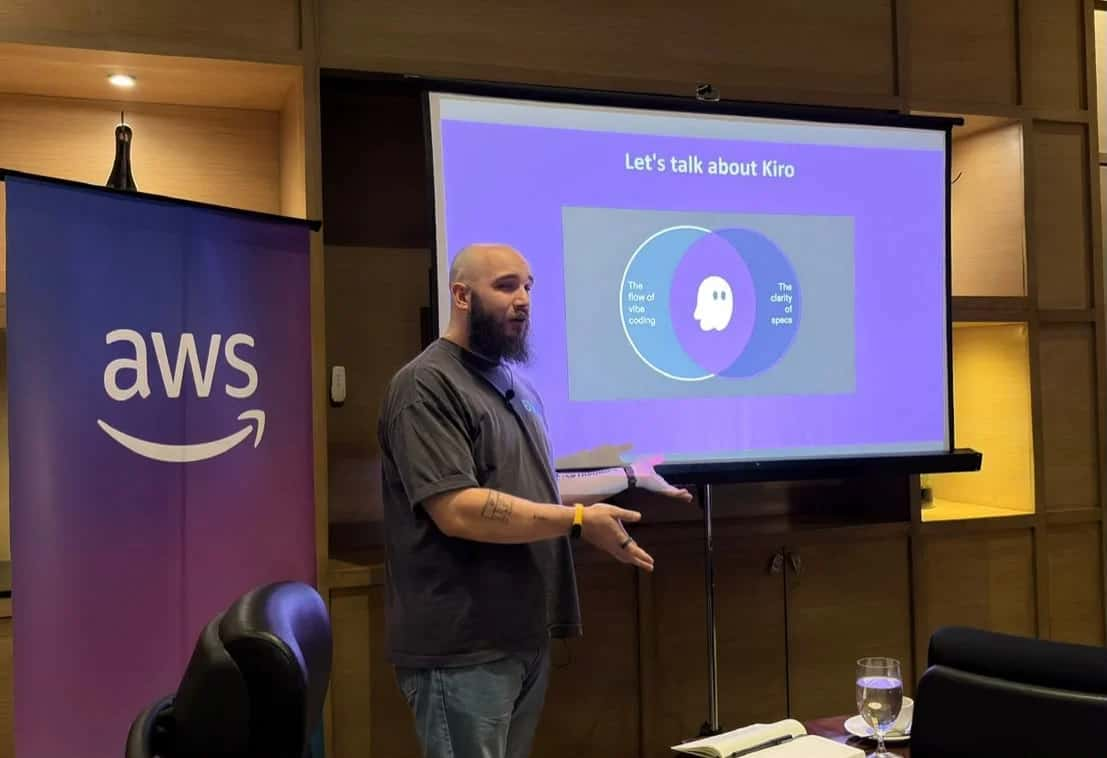

AI is accelerating software development, but AWS Developer Advocate Darko Mesaroš believes the fast pace could undermine the quality of code. Mesaroš calls this problem “AI slop in software”.
The jump from AI coding assistants to autonomous agents and multi-agent systems has changed how developers build software. Speaking to media at an AWS event in Bengaluru, Mesaroš warns that the exponential acceleration can create problems when the process lacks structure.
The concern is echoing in the developer community.
Alex Cohen, Co-founder and CEO of AI-powered healthcare communication platform Hello Patient, believes AI is far from replacing software engineers given the slop it produces in production apps. “It’s horrendous,” he wrote on X.
Similarly, Arpit Bhayani, Creator of Redis alternative DiceDB, said that agentic slop is making developers prioritise speed over software reliability, and that should not be seen as progress. “Systems are more fragile than ever, and engineers building them no longer trust their code to hold up in real-world edge cases,” he wrote on X.
According to a recent study by EntelligenceAI, for every $1 of AI tokens, $0.44 went to fixing bugs in generated code and $0.27 went to reworking badly generated code.
Mesaroš notes that the solution isn’t deferring AI coding tools but introducing established software engineering practices into AI-assisted development.
This is where AWS positions Kiro, its AI-powered development environment, which makes spec-driven development a core part of the workflow.
Kiro is available through an IDE, command line, and web interface, with a mobile version also in preview. Mesaroš says the command-line version is also being used in CI pipelines, while Kiro Web can connect to repositories and work on software remotely.
AWS has also released Kiro Crew, an open-source workspace for developers working with multiple autonomous agents. Crew allows AI agents to work on tasks across sessions, retain context, coordinate work, and continue development without requiring developers to remain actively involved throughout the process
Kiro Crew can also connect to knowledge bases and developer notes, and it stores its memory locally in a vector database.
Spec-Driven Development
Mesaroš distinguishes between prompting an AI agent to build an application and using a structured process to define what needs to be built before the agent starts generating code.
In a conventional software development process, developers create requirements documents, design documents, and task lists before implementation. Here, AI can take over the burdensome part of generating documentation.
Kiro can generate a requirements document describing what a feature should do, followed by a design document explaining how to implement it, and a task list covering the work required.
Mesaroš describes these specifications as more than documentation. “This is a contract between a developer and an agent,” he says.
The approach gives developers a way to check whether an AI agent is building what they actually asked for rather than simply accepting a prompt’s output.
Mesaroš also highlights Kiro’s property-based testing, which turns specifications into rules and tests AI-generated code against hundreds of random inputs to catch edge cases that traditional unit tests may miss. The objective, he says, is to ensure developers retain visibility into what an agent is doing rather than allowing it to generate thousands of lines of code without sufficient oversight.
Vibe Coding Still Has a Place
Mesaroš does not suggest abandoning vibe coding, where developers use natural-language prompts to rapidly generate applications. He sees it as useful for prototypes and quick experiments, with a transition to more structured development when the software becomes consequential. “Vibe coding is an excellent way to quickly get stuff out. Prototypes and quick turnarounds are fantastic.”
The distinction becomes more important when applications involve sensitive information or security requirements.
“The existence of spec-driven development doesn't mean you should stop vibe coding,” Mesaroš says. “I think it means you should apply spec-driven development for things that need it.”
Developers Should Understand Code
Mesaroš pushes back against the idea that AI agents will eliminate the need for developers to understand software engineering, as they will remain responsible for making decisions and directing the systems.
“The role of the developer is not a person who types in the actual code per se, but one who orchestrates a bunch of different agents or just a simple agent to produce the high-quality code,” he explains.
Mesaroš adds that traditional engineering practices such as testing, DevOps, and CI/CD do not disappear in an agentic development environment. “All of those things are incredibly important for AI development.”
He also recommends shifting testing as far to the left as possible—at the very beginning of the project timeline—so developers can identify problems during local development instead of waiting for code to reach a later stage of the pipeline.
Tokenomics
As developers increasingly use frontier models for coding, inference cost is also becoming a consideration. Mesaroš says developers are becoming more conscious of “tokenomics” and how much their agentic workflows cost.
Kiro provides access to multiple models under the same subscription, including Anthropic and OpenAI models as well as open-weight models. It also offers an auto model option that selects a model based on the complexity of the task.
“If a task is super simple, it's probably going to use a smaller model, something faster,” Mesaroš says. “But if it's something more complex, it's going to choose something more capable.”
He says spec-driven development can also reduce token consumption by reducing repeated coding iterations. Although creating a specification requires more upfront context, it allows the agent to complete the implementation with fewer cycles.
- The AI Slowdown Narrative Doesn’t Reflect Enterprise Reality
- India’s Enterprises are Scaling AI. Is the Infrastructure Ready?
- Industry Wants Faster Approvals and Cheaper Power in India’s Data Centre Policy
- Inside Jio Platforms: Its Tech Bets, Loss-Making Subsidiaries and Hidden Risks
- India’s GCCs to Add 1.4 Million Jobs, Drive 170 Million Sq. Ft. Office Demand by 2031
- AI Can Be Cyborg or Centaur. But Can Enterprises Monetise It?