

The artificial intelligence boom has created an unexpected casualty that most consumers did not see coming: the affordable smartphone. As hyperscale technology companies channel billions into data centres hungry for memory chips, the supply available for consumer devices is shrinking rapidly, and prices are rising as a result.
A Supply Chain Under Siege
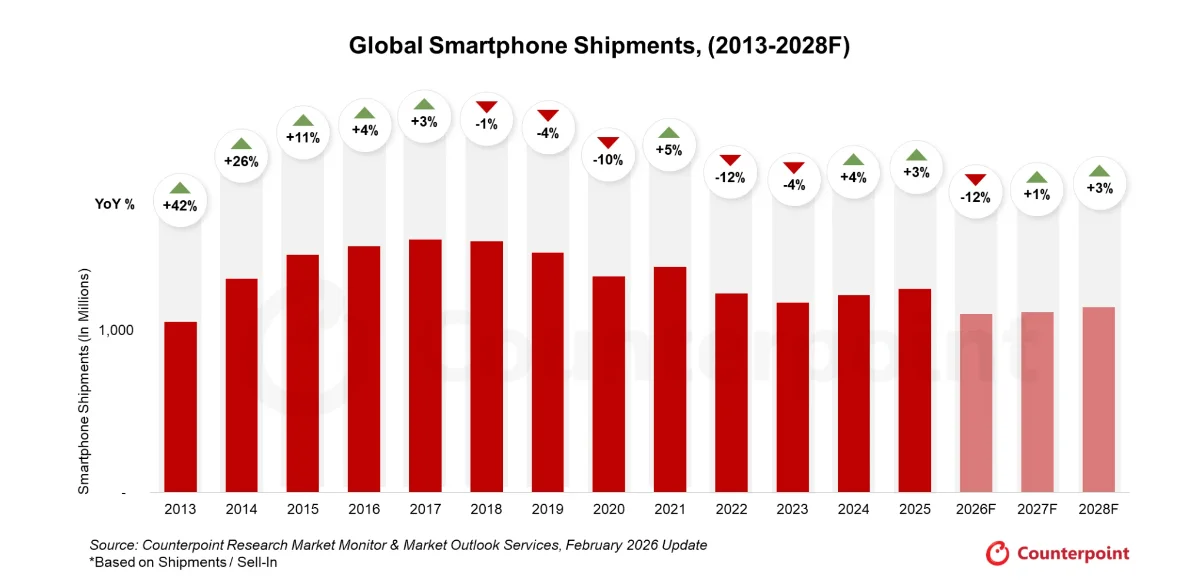
Counterpoint Research forecasts a 12.4% decline in global smartphone shipments in 2026, with total volumes expected to fall below 1.1 billion units—the lowest level since 2013. The root cause is a rapidly worsening memory supply crunch. Soaring demand for Dynamic Random Access Memory (DRAM) chips from AI infrastructure is crowding out supply for consumer electronics. Memory chip costs are expected to surge by 80% to 90% quarter-on-quarter during the first three months of this year alone.
Willy Shih, economist and professor at Harvard Business School, explains the dynamic clearly. “We’ve seen this huge growth in investments in AI data centres. There are just three major manufacturers of RAM. They have reallocated a lot of their capacity to the new and more profitable AI industry as they build high-bandwidth memory segments,” he tells CNBC.
Counterpoint expects memory shortages, rapid component price inflation, and structural vulnerabilities among lower-end original equipment manufacturers (OEMs) to not only weigh on 2026 numbers but to extend the downturn into 2027.
OEMs Face Difficult Trade-Offs
The low- and mid-range segments are under the greatest pressure, as legacy DRAM supply is unlikely to return in the short to medium term. As per Counterpoint’s Principal Analyst Yang Wang, OEMs are already responding. “OEMs are already responding with launch delays, streamlined portfolios, and specification trade-offs. We have also observed 10% to 20% price increases across some Android OEM portfolios in January 2026,” he says.
Nothing Co-Founder and CEO Carl Pei is equally direct. “Brands now face a simple choice: raise prices by 30% or more in some cases, or downgrade specs. The ‘more specs for less money’ model that many value brands were built on is no longer sustainable in 2026,” he says.
Senior Analyst Jeongku Choi warns that the pressure is two-sided. "For device manufacturers, this is a double whammy. Rising component costs and weakened consumer purchasing power will likely slow demand as the quarter progresses. OEMs will need to change procurement patterns or shift focus towards premium models to justify the higher price by delivering more value to consumers,” he says.
Premium Holds While the Mass Market Cracks
Not all segments are equally exposed. According to Counterpoint, the global average smartphone DRAM capacity reached 8.4 GB in December 2025, up from 7.4 GB from a year ago. Brands including Apple, Huawei, Samsung, and Vivo have increased their DRAM configurations over the past year. Senior Analyst at Counterpoint Research, Karn Chauhan, notes that the average DRAM in the premium segment rose to around 11 GB in December 2025, driven largely by the iPhone 17 Pro series. Apple, which accounts for over 70% of premium segment sales by volume, has significantly narrowed the historical memory gap with Android flagship devices.
Data from IDC aligns with the broader concern. The research firm predicts global shipments will drop to just 1.12 billion units this year.
Nabila Popal, Senior Research Director at IDC, expects market consolidation to accelerate as smaller players exit and low-end vendors face sharp shipment declines. “Although shipments will witness a record drop, smartphone average selling price is projected to rise 14% to a record $523 this year,” she says.
India in the Crossfire
For India, one of the world's largest and most price-sensitive smartphone markets, the implications are particularly severe. The country’s volume-driven ecosystem is built on aggressive sub-₹15,000 pricing, thin margins, and fierce competition from Chinese brands. That model is now under direct threat.

Your reaction
Discussion
What's your take on this story?
No comments yet — be the first to share your view.