Memory Chips are Having Their Main Character Moment. But Can It Last?
By Sanjana Gupta ·
Memory chipmakers have returned to the centre of the semiconductor rally as AI drives demand for faster, denser memory. AI workloads require vastly more memory than past computing waves, fundamentally changing demand patterns across the sector.
Data centres are now absorbing a growing share of advanced Dynamic Random Access Memory (DRAM), especially high-bandwidth memory used in accelerators. At the same time, supply remains constrained after years of cautious capital expenditure. This combination has pushed up earnings expectations and valuations across the memory sector.
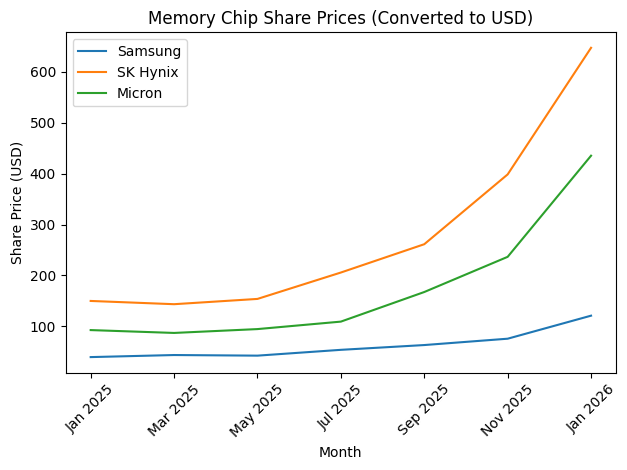
Shares of Micron, Samsung Electronics and SK Hynix have surged as prices for DRAM, NAND and high-bandwidth memory continue to rise. Over the past year, the industry has entered what many describe as a ‘hyper-bull’ supercycle: SK Hynix shares are up around 332.23%, Micron has soared by more than 389.02%, and Samsung has gained 206.68%.
This rally is being reinforced by an acute supply crunch. Spot prices for standard DRAM have increased by as much as 172% year on year. Meanwhile, the specialised High-Bandwidth Memory (HBM) market, projected to hit $54.6 billion by 2026, is effectively sold out through the end of the year.
The question that looms is whether this marks a lasting shift in the economics of memory chips or just another sharp cycle nearing its peak.
Memory has a long history of boom and bust. Capacity expansions are slow to come online, but when they do, they often arrive together. With new fabrication plants planned and technology continuing to advance, the next phase will test whether AI demand truly rewrites old rules or, ultimately, repeats them.
HBM is the Engine & Possibly Also the Bottleneck
HBM has become the defining product of the AI boom. Accelerators rely on stacked memory positioned close to processors, prompting manufacturers to divert capacity away from conventional DRAM towards more advanced designs.
Analysts broadly agree that this shift is driving the current rally. “I would say it is really AI-led growth. Now, if AI is a hype, then the vendors are in trouble,” says Holger Mueller, vice president and principal analyst at Constellation Research.
HBM is far more demanding to produce than standard memory, intensifying supply pressures across the industry. MS Hwang, research director at Counterpoint Research, says HBM is designed to break through the so-called ‘memory wall’ by delivering much higher bandwidth. Achieving this, however, requires far greater complexity and capacity than conventional DRAM.
The architecture echoes earlier efforts to overcome bandwidth limitations, albeit on a much more sophisticated scale. “This resembles the many attempts of the 1990s, such as Rambus DRAM, but today it demands far greater complexity and significantly more capacity,” Hwang says, drawing a comparison with past technologies.
The effects now reach beyond servers. “Elevated memory prices are squeezing consumer electronics makers, especially in smartphones and PCs,” he says. Data centre buyers, he adds, show low price sensitivity, allowing prices to rise well beyond historical limits.
Exposure to this shift varies sharply by company. “All companies are very different. Micron is totally dependent on HMB, SK Hynix less so, and Samsung is a mixed shop,” Mueller says. Any change in demand would hit them unevenly.
Supply Disciplines
Supporters of the rally argue that AI demand gives memory a stronger foundation than in past cycles. Michael Ashley Schulman, chief investment officer at Running Point Capital Advisors, says, “If you look historically at how demand for computers and memory chips has grown over several decades, the memory rally has more fundamental spine than people give it credit for.”
He says this cycle looks different because companies are exercising greater discipline about supply. Micron, he notes, plans to add capacity slowly and is keen to avoid the kind of oversupply that has repeatedly hurt the memory market in previous upswings.
Counterpoint also expects strength to persist through next year. “For 2026 alone, prices are unlikely to fall,” Hwang says. He adds that only modest easing may appear later in the year. “By 2027, demand and supply are expected to balance.”
Even so, the legacy of past cycles cannot be ignored. Hwang cautions that when profits rise, companies are reluctant to concede market share, raising the risk that excessive new capacity comes online at the same time.
Valuations already reflect lofty expectations. “The sustainability of corporate valuations depends on how long AI stays memory hungry and how disciplined supply remains,” Schulman says. He adds that Micron looks expensive because its earnings are still recovering, Samsung is valued as a broad electronics company, and SK Hynix trades at a lower valuation because investors still see memory as cyclical.
Exit Paths Look Familiar
“The main risk is that something, like a new technological breakthrough or massive supply from a new foundry source, eliminates the sustained scarcity,” Schulman affirms.
Equipment makers sit at the centre of any such transition. “ASML and TSMC are enablers of real capacity and advanced packaging scaling, and they also probably represent the mechanism by which the industry eventually de-bottlenecks memory and normalises pricing,” he explains.
ASML’s Q4 2025 results confirm this acceleration, with net bookings hitting a record €13.2 billion—more than doubling the previous quarter—driven by “notably more positive” medium-term capacity plans from customers.
Critically for the memory sector, ASML is forecasting 2026 sales to reach up as chipmakers scale up the advanced lithography required for HBM4 and next-gen DRAM to sustain the AI supercycle. The call mentioned, “AI demand for compute density and high-bandwidth memory is growing 2–3× faster than overall semiconductor sales.”
In 2025, ASML recorded that €8,420 of the €32,667 in total net sales by end-use were for the memory sector.
Schulman believes that even custom AI chips developed by companies such as Microsoft, Amazon, and Google are, for now, largely supportive of memory demand. He thinks they could also shift the balance. Over time, however, stronger buyer power could compress margins.
Mueller remains more direct about what could end the rally. “The AI bubble confirms itself as a bubble and bursts.”
For now, memory sits firmly at the core of AI infrastructure. Prices are rising, supply remains tight, and confidence is high. The rally may prove more durable than past ones, but memory cycles have a habit of ending the way they begin: abruptly.