
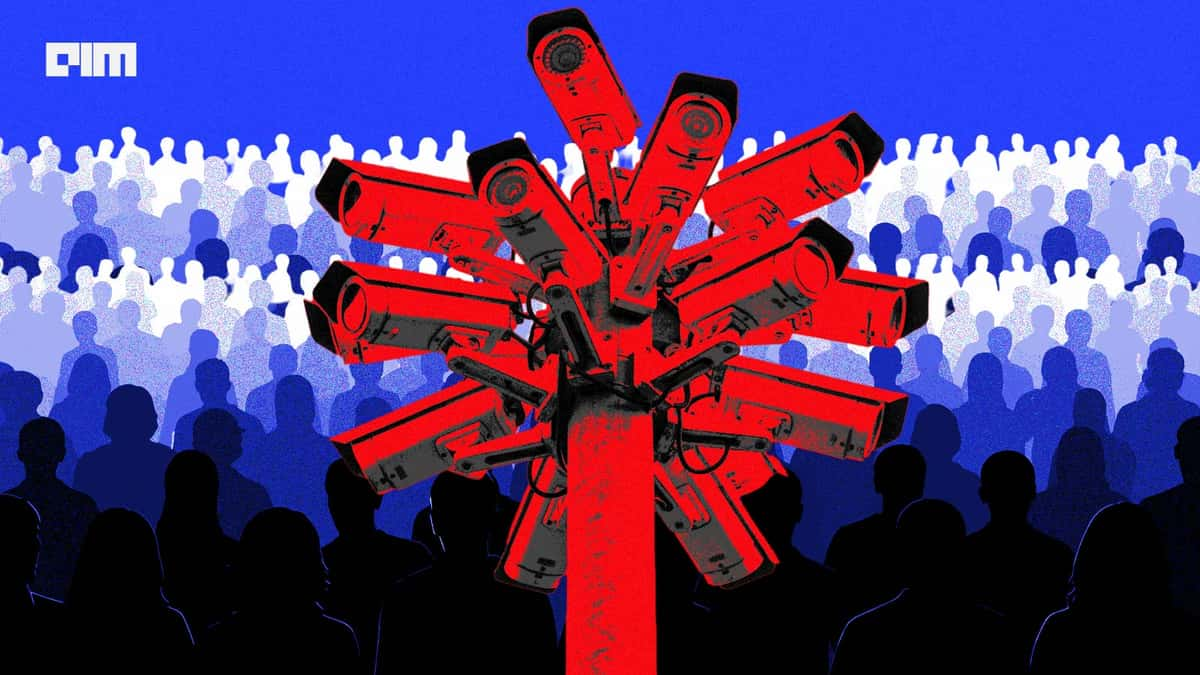


At the recently concluded Cockroach Janata Party (CJP) protests at Jantar Mantar in Delhi, Delhi Police were seen using facial recognition cameras and software to trace protestors and purported criminals. According to a report by The Hindu, Delhi Police identified 2,873 people with previous criminal records. Meanwhile, a Newslaundry investigation found cops wearing Meta AI glasses at the protest site, capturing images.
Delhi Police first acquired the Automated Facial Recognition System (AFRS) in March 2018 following a Delhi High Court order to identify missing children using the software. It was then reportedly deployed at a 2019 rally of Prime Minister Narendra Modi to identify “law and order suspects”. However, in the space of about eight years, it has grown from a handful of pilot projects to what may be one of the largest state-run surveillance networks in the world.
India is part of a growing list of countries using facial recognition technology (FRT) during public events to screen crowds. According to the AI Global Surveillance Index by Carnegie Endowment for International Peace, at least 64 countries use public facial recognition systems. These include China, which has an extensive network of smart CCTV cameras, and the UK, where police typically mount specialised cameras on vans during large public gatherings.
But that raises several questions, not just on the purpose of surveillance, but also its legality, the tech behind it, and where the data for FRT comes from.
Where the Data Comes From
Facial recognition systems are only as powerful as the databases they are matched against, and in India, those databases have been stitched together from a patchwork of sources that were never originally meant to fuel real-time surveillance.
The centrepiece is the AFRS developed by the National Crime Records Bureau (NCRB). The system, tendered in 2019 with a budget of roughly ₹308 crore, is hosted at the NCRB Data Centre in Delhi.
“The system draws images from criminal records, passport applications, prison databases, and databases maintained by the Ministry of Women and Child Development, meaning a person's face could enter a police-matching system without them ever having been convicted, or even accused, of a crime,” V Rajendran, Chairman of non-profit Digital Security Association of India, tells AIM.
State governments have layered on their own systems. Uttar Pradesh's Trinetra platform gives roughly 1,470 police stations across 70 districts access to a centralised criminal-record repository, complete with sketch-based search tools built on machine learning. During Ganesh Chaturthi processions in 2025, Mumbai and Pune police used AI-linked CCTV combining facial recognition with behavioural analytics to monitor the crowds.
“At the national level, the aviation sector's DigiYatra programme links a traveller's Aadhaar identity, boarding pass and live facial scan to allow paperless entry at airports, folding India's biometric identity infrastructure directly into a travel-surveillance tool,” Rajendran adds.
The railway network, Delhi's Safe City Project cameras, and metro-rail CCTV feeds have all been wired into policing efforts as well, most recently expanded under a phase of Delhi Police's surveillance grid inaugurated in February 2026. According to the digital rights group Internet Freedom Foundation (IFF), around 25,000 CCTV cameras are integrated into the network, including at least 2,100 AI-enabled cameras.
A joint investigation by The Reporters' Collective and Investigate Europe this year found that live facial-matching software supplied by Spanish vendor Herta Security is being deployed by several Indian law-enforcement agencies. IFF's tracking initiative, Project Panoptic, has logged more than 120 government contracts related to facial recognition since 2020, spanning policing, schools, and welfare delivery—evidence, its researchers argue, of a system built first and questioned later.
Regulation remains a step behind surveillance. While the Digital Personal Data Protection Act, 2023, governs personal data broadly, including biometric information, the Facial Recognition Technology (Regulation of Police Powers) Bill to regulate police use of FRT with judicial oversight and magistrate-approval safeguards has remained pending in Parliament since 2023.
Apar Gupta, Executive Director of IFF, also points to the Criminal Procedure Identification Act as expanding what police can collect and how long they can keep it. "[The Act permits] the police now under an FIR to take biometric prints of a person—including their thumbprints, their iris scans, their photographs—not only of people who are accused in that FIR… and retain that for 75 years and link it to databases," he notes.
The Neural Networks Behind FRT
The reason today's systems can scan a crowd and flag a face within seconds lies in deep learning, specifically convolutional neural networks (CNNs)—the same AI architecture used in image classification more broadly.
The pipeline generally runs in four stages.
First, a detection algorithm locates faces within a video frame, even in poor lighting or dense crowds, using models such as MTCNN or RetinaFace. Second, the detected face is aligned, rotated, and cropped so key landmarks like the eyes, nose, and chin sit in a standard position.
Third, a CNN—architectures such as FaceNet, ArcFace, or DeepFace—converts the aligned face into a compact numerical code called an embedding, typically a vector of around 128 measurements capturing the underlying geometry of the face rather than the raw pixels themselves.
Finally, that embedding is compared mathematically against embeddings already stored in a database; the closest match, measured by distance in this numerical space, becomes the system's best guess at identity.
Gupta notes that 80% of a person's match on camera is sufficient for identification. “Our face has a certain set of distinctive features. The space between my eyebrows, the length of my nose—and the software converts this to a string of numbers, based on which it then matches any other image that may be a 1:1 match or a 1:N match,” he explains.
This embedding-based approach allows a single server to compare live face capture against millions of stored images in a matter of seconds.
It is also why the quality and diversity of the original training data matters so much: models trained mostly on one demographic tend to perform worse on others, and researchers globally, including the US National Institute of Standards and Technology, have repeatedly documented higher error rates for certain skin tones, genders and age groups.
Documentation vs Surveillance
In Bengaluru, when protesters gathered in solidarity with the Jantar Mantar demonstrations, police were similarly seen photographing the crowd.
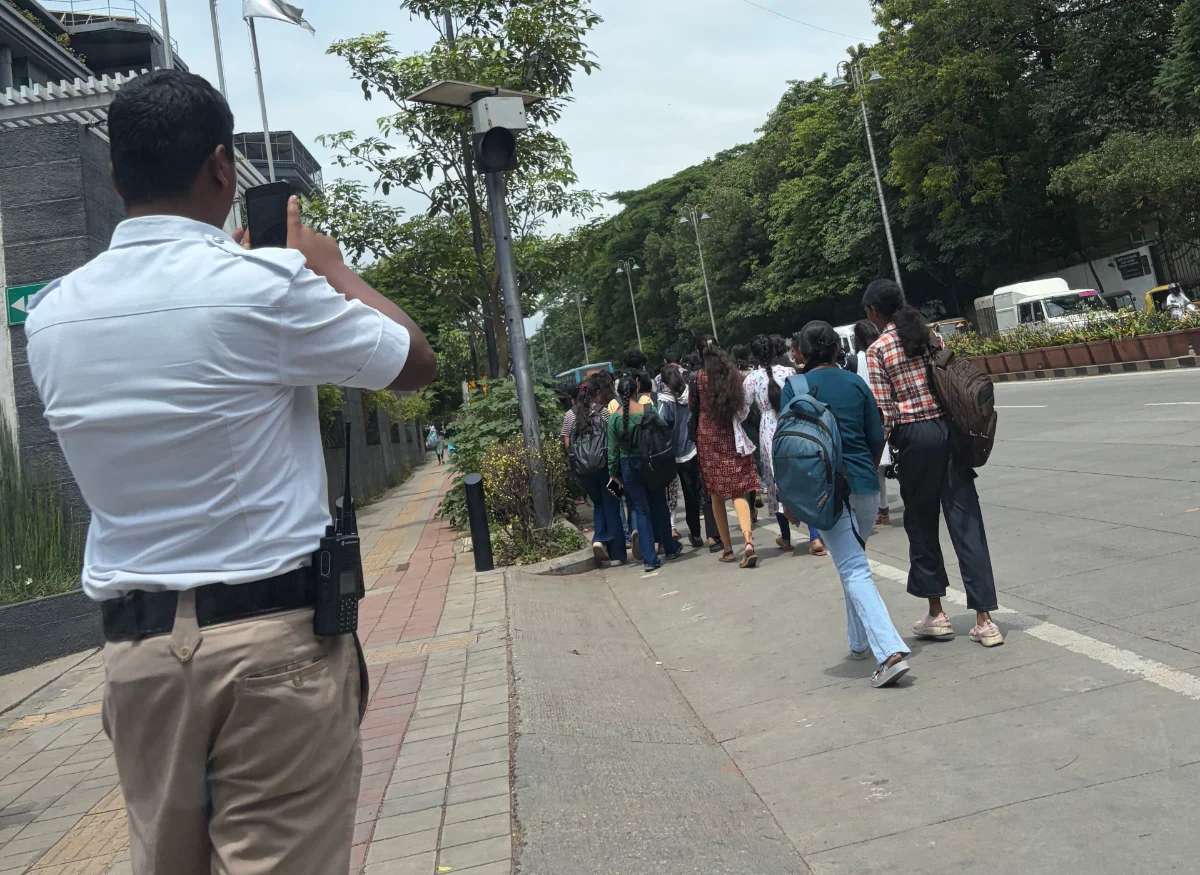
Asked about this, Karnataka's Home Minister, Priyank Kharge, told AIM that the photographs were taken purely for documentation purposes and would not be used to take any action against the protesters.
He explained that if questions were ever raised later about who was present at a given location and time, the police would be able to answer them, and maintained that protesters remain safeguarded in cities like Bengaluru and across Karnataka. He also pointed to recognition the Bengaluru City Police has received for facilitating peaceful protests in the state.
However, experts remain wary of the lines that blur documentation from surveillance. But beyond surveillance, documenting the police during such events may be crucial to reporting on excesses, if it that comes with risks.
Gupta warns that masks or caps offer limited protection and may themselves draw police attention. He advises protesters that if they film and post online, blur the faces of bystanders who may be unwittingly identified, particularly migrants or others who could be vulnerable to targeting, especially since Delhi Police is also reviewing protest footage circulated on social media.
"Documenting the protests is a double-edged sword," he says, "please do it responsibly, but also does not put other people at risk."
- AI Can Be Cyborg or Centaur. But Can Enterprises Monetise It?
- AMD’s Server CPU Business Faces a New AI Boom
- How an Engineer Is Using AI to Bridge the Accessible Education Gap
- AI Agents are Making Human Customer Service a Specialist Job
- Why Nandan Nilekani-Backed F2A Believes India's Investment Opportunity Lies in Edge AI
- India Needs to Build the AI 'Brain' for Robotics, Not Just Import Hardware