
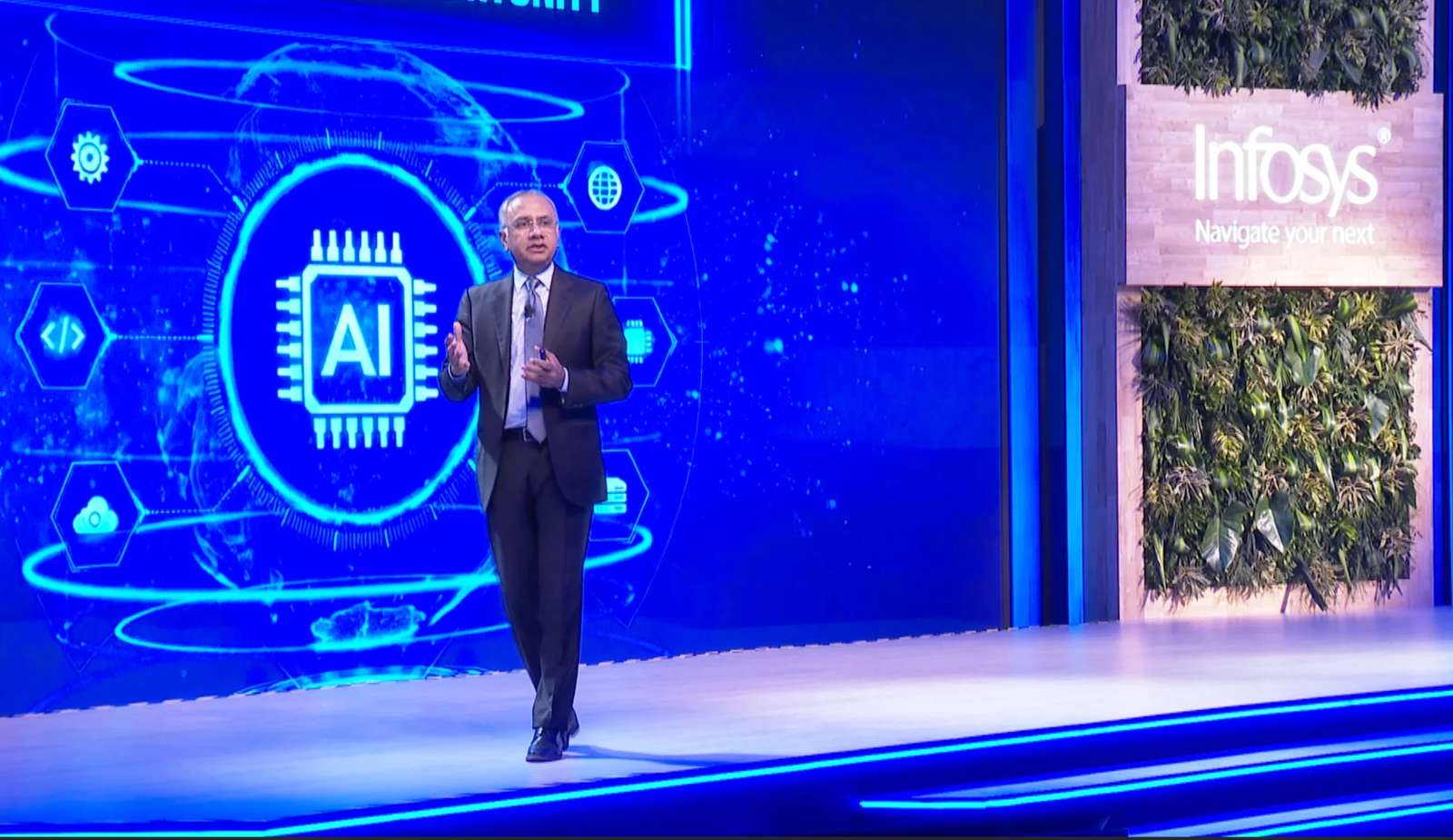
Infosys Chief Executive Officer Salil Parekh said AI-led services now account for 5.5% of the company’s Q3 revenue, as AI work becomes embedded across 90% of its top 200 large client engagements.
“And this, for us today, represents 5.5% of our revenue in Q3 and it’s growing at a robust pace,” Parekh said during Infosys Investor AI Day 2026. “This is something which is extremely dynamic. It is something that is working extremely well with our clients.”
Responding to one of the analyst’s questions at the event, Parekh said that revealing AI revenue is now similar to revealing digital numbers a few years back when they were close to 25%. “We don't know if this is going to go in that sort of a range in 18 months, or will it take years, but we are well on our way… if it goes faster, we are ready. Even if it goes at that pace, we are ready,” he said.
This is after the company repeatedly refused to mention AI-led revenue over the last quarter while peers like HCLTech and TCS continued to do so as it said AI is part of all deal conversations. Though, the company had revealed during its Q3 press conference that its teams are running 4,600 active AI projects and have built over 500 AI agents.
Parekh emphasised that AI is no longer limited to experimental pilots.
“Today, we are doing AI work for 90% of our large, 200 clients. So this is not something which is just here and there in pilots, in terms of the scale, it's across many things. It's small and large. Parts of large programs with large clients.”
Parekh introduced what he described as an AI-first value framework, visually represented as a hexagon, to structure Infosys’ AI strategy. The framework spans six new growth areas: data protection; business process transformation; customer service; legacy modernisation; physical AI; and AI trust.
“This is a large opportunity set, and this is where we see a lot of the growth coming,” Parekh said. He described legacy modernisation as “a massive, large opportunity,” alongside customer service transformation.
Physical AI, where AI software is embedded into devices, was identified as an emerging growth area. AI trust, he said, spans both cybersecurity and responsible AI.
Parekh said the hexagon framework is operationalised internally through 30 offerings and 100 sub-offerings, supported by engineering teams, agents built on Infosys’ Topaz platform, and strategic partnerships.
He added that Infosys is working closely “with each of the large AI players in very close coordination” to support client outcomes.
Parekh acknowledged that AI-driven productivity may compress certain traditional IT services revenue streams but said expansion outweighs compression. “We understand that the opportunities between $300 and $400 billion… getting to 2030,” he said, referring to external estimates of the broader AI services market.
“At the same time… AI productivity leads to compression in IT services. However, today, we have a clear view that the opportunity is massive and large, and that that will become the driving force of what we will grow and drive through in the next coming years.”
The company recruited 20,000 college graduates this year and plans to recruit another 20,000 next financial year, while also focusing on AI upskilling.
In addition to AI-first offerings, Parekh said Infosys is infusing AI into its traditional service lines “making sure that AI is infused into it to become even more relevant for clients.”
- AI Productivity to Add $28 Billion to $84 Billion to India's GDP: Cognizant Study
- OpenAI's Codex Helps in Aerodynamic Engineering for Mazda
- Bengaluru Accounts for 34% of India's FDE Talent: Report
- 84% See AI Productivity Gains, but Only 10% Allow Agent Autonomy: TCS Study
- Snowflake Introduces Business Ontology, Cortex AI Gateway to Bring AI Agents Into Enterprise Workflows
- Three Members Behind Claude Code Leave Anthropic Within 10 Days