
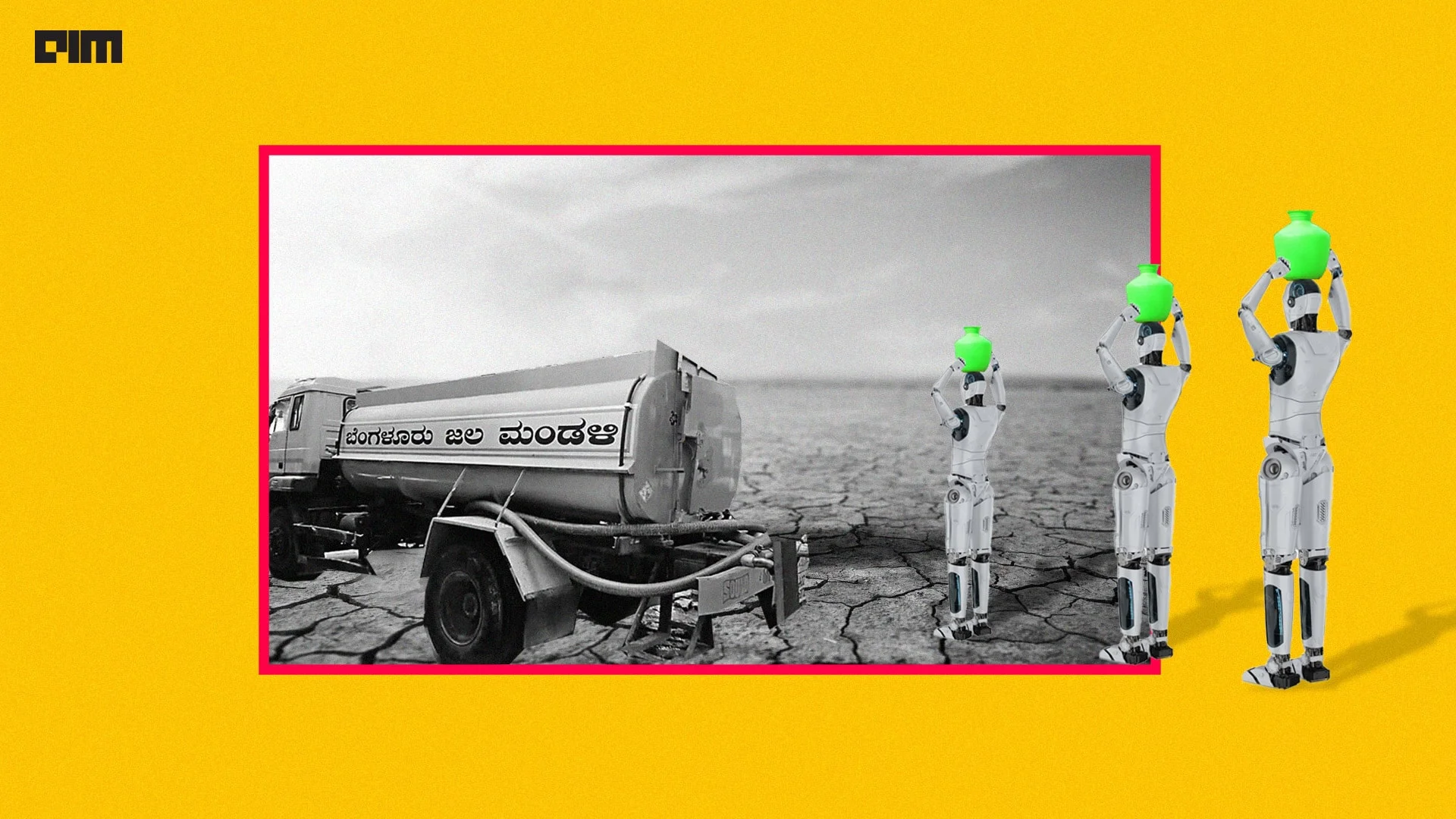
Over concretisation, coupled with depleting groundwater levels, lack of rainfall, and scorching heat, has resulted in a severe water shortage in Bengaluru. The situation is so dire that residents of Parkwest Housing Society in central Bengaluru's Hosakere Road were heard chanting ‘We want water’ at a protest.
The scarcity of water predominantly stems from the declining groundwater levels, resulting in numerous borewells across the city running dry. Out of approximately 16,000 public borewells in Bengaluru, nearly 7000 of them have already dried up.
To tackle the city's current water problem, the Bangalore Water Supply and Sewerage Board (BWSSB) has started leveraging AI. The board has deployed Internet of Things (IoT) sensors to analyse flow patterns and transmit data to the cloud for evaluation.
By running an AI model on top of it, the system will control motor operations to ensure efficient usage. In the event of decreasing water levels, automatic signals will trigger shutdowns, reducing the need for manual intervention, officials said.
While it's commendable that BWSSB is turning its focus to AI to address Bengaluru’s water challenges, it's important to note that AI alone cannot completely resolve the city’s water crisis. However, it can certainly aid in enhancing planning and increasing the efficiency of existing water systems.
It’s all about data
For AI to be helpful, it relies on a significant amount of data and BWSSB is already data-rich, according to Navaneethan Santhanam, chief scientist at SmarTerra.
He believes AI can help fix some of Bengaluru's water-related problems. “It is not the only solution, but certainly a very important one. At its heart, AI relies on data—data about water consumption, supply volumes, pressures, and timings, surface and groundwater levels, etc. This data is usually available with utilities, particularly one as advanced as BWSSB,” Santhanam told AIM.
Utilities often collect billing data, metre data, customer information systems data, etc. Moreover, utilities track pressure and flow data across their networks, ensuring adequate supply and detecting leaks. They also possess comprehensive GIS maps of their networks, detailing pipe locations, materials, and maintenance records, including historical leakages.
AI models can also examine historical water consumption data, population growth rates, weather patterns, and other pertinent factors to predict future water demand across various zones within the city. Such analysis with aid BWSSB in strategically planning and distributing water resources for enhanced efficiency and allocation.
Moreover, in Bengaluru’s case, AI can be leveraged to predict groundwater depth and better prepare for a scenario that the city is facing today.
However, there is a need for better data collection as well as data cleansing and visualisation. “We need tools to help make sense of the data. In reality, there is too much ‘raw’ data for the utility to understand in its entirety. The data needs to be cleaned, formatted, and visualised in a way that does not overwhelm,” Santhanam said.
Addressing leakages
The situation could have been even more dire in the city; however, the Bangalore Water Supply and Sewerage Board (BWSSB) provides Cauvery water to approximately 70-80% of the city's 13 million population.
However, according to officials, the situation appears dire as the Krishnaraja Sagar Dam in Mandya district, the primary source of Cauvery water supply to Bengaluru, is experiencing inadequate water levels exacerbated by the summer.
Santhanam believes his startup’s AI-powered data analytics platform could come to Bengaluru’s aid. SmartTerra uses a mix of generative AI along with modern geospatial analysis, forecasting, and hydraulic modelling to help utilities pinpoint network failures such as leaks, failing pipes, and faulty metres.
“Our focus lies in aiding cities to mitigate water losses. Presently, in India, approximately 40% to 50% of water dissipates before reaching end-users.
“Take Bangalore, for instance, where water is pumped from over 100 kilometres away, treated, and distributed through networks to households and enterprises. However, for every litre dispatched, roughly one litre is lost due to pipe leakages, bursts, or customer-related issues,” he said.
He indicates that nearly half of the generated water intended for city residents' use fails to reach its final destination. AI can pinpoint areas where water consumption exceeds normal levels, potentially indicating the presence of leaks that require fixing. Addressing these leaks can conserve more water, resulting in increased availability and reduced wastage.
Addressing Data Silos
Even though municipalities and water bodies are data-rich, they often remain segregated, hindering their effective utilisation. “This is where our solution comes in. We directly ingest utility data into our systems, performing data cleaning and validation automatically using AI.
“We then apply various AI algorithms to detect leaks, failing metres, and pipes. Results are presented through intuitive visualisations, both spatially and temporally, aiding utilities in identifying and addressing issues efficiently.
“Additionally, AI-generated tasks prioritise areas requiring attention, optimising risk management efforts. AI streamlines data management, unifying disparate datasets and highlighting anomalous patterns for enhanced utility operations,” Santhanam pointed out.
While SmarTerra deploys a predictive AI model, the startup has recently started experimenting with Large Language Models (LLMs).
They are currently developing a natural language query engine utilising LLMs. “With this technology, individuals can easily inquire, for example, "What are the 10 most leaky areas in Bangalore?" and the model will provide comprehensive results in the form of charts, maps, and tables.
“Our objective is to leverage LLMs to streamline access to analytics, making it accessible to anyone with an interest.”
The Bengaluru-based startup already operates in many Indian cities and works closely with utility companies such as L&T, Suez, and many state-owned water bodies in India as well as in foreign markets such as Singapore and the Philippines.
The company has previously worked with BWSSB as well as is looking to enhance its collaboration with them.

Your reaction
Discussion
What's your take on this story?
No comments yet — be the first to share your view.