
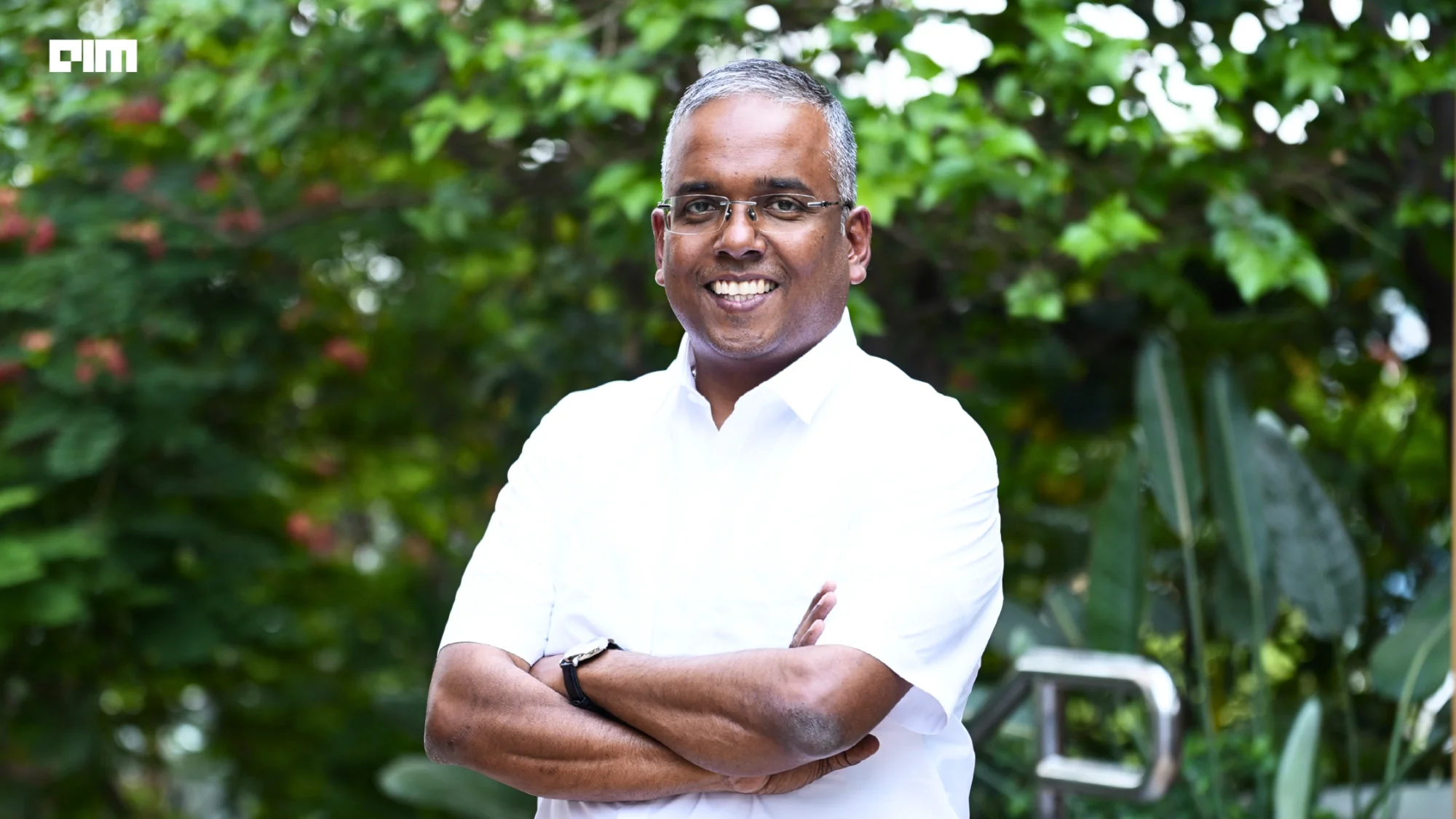
When Databricks closed at $5.4 billion in revenue, it marked one of the fastest enterprise software scale-ups in recent memory. But for Kamalkanth Tummala, who leads the company in India, that number is not the headline.
The bigger story, he argues, is what comes next, and where India fits into it.
“In literally 10 years, we’ve gone from 0 to 5.4 billion,” he tells AIM on the What’s the Point podcast. “Now the expectation is that every region, including India, should beat global growth.”
That distinction matters. India is no longer a support market or a cost centre in the global tech playbook. For companies like Databricks, it is becoming the next frontier of scale, experimentation, and eventually, product definition.
Tummala reduces India’s opportunity into a simple equation: population multiplied by digital interaction.
“[India has the] second largest smartphone base, UPI, and the next generation doing everything digitally. That combination [creates massive opportunities],” he says.
This is not just about enterprises adopting AI. It is about a country where hundreds of millions of people are generating sizable amounts of data daily through payments, logistics, entertainment, and services. That creates a different kind of demand, not just for AI models, but for the infrastructure needed to organise, process and use those models effectively.
Databricks wants to position itself in that layer.
Not as a model company. Not as a cloud provider. But as the connective tissue.
The AI Battle Will Be Won Through Data
At a time when the AI conversation is dominated by model releases from companies like OpenAI, Anthropic, and Google, Tummala’s framing is deliberately different. “Models will keep evolving. Six months back one was the flavour, today another is,” he says. “But we own the data layer.”
If ChatGPT is the interface, Databricks is what ensures the answers are right.
“What if the data layer itself is not there, or the LLM is hallucinating? Then adoption goes away,” he says. The company’s role, as he describes it, is threefold: preparing data, governing it, and then enabling AI on top of it.
“We are all three. Data, infrastructure, and AI,” Tummala adds.
That positioning brings a strategic advantage. It allows Databricks to stay relevant regardless of which model wins. Whether it is OpenAI, Gemini, or Claude, the underlying problem of clean, contextual, governed data remains unsolved for most enterprises.
And that is where the money is.
Open Wins Over Lock-In
One of the more subtle but important points Tummala makes is around openness.
“You can’t lock data in. The beauty is we keep it open so you are taking inputs from everywhere,” he says.
This is also how Databricks competes with hyperscalers like AWS, Azure, and Google Cloud—all of whom are both partners and competitors.
“They have their own stacks. [In some areas], we are friends. [In some others], enemies,” he says.
It is a familiar balancing act in enterprise tech. But Databricks’ bet is that customers will not want to be locked into a single ecosystem, especially as AI workloads become more expensive and more critical.
“The market is so big that everyone can play. But the question is what serves the customer best,” he points out.
Enterprise software used to move slowly, with months spent on planning, proofs-of-concept, and integrations. Tummala believes that model is collapsing. “Customers don’t have time for six months or eight months,” Tummala says. “With Databricks, you can see something in two to four weeks.”
The “new normal”, as he calls it, is not faster queries or better dashboards. It is about delivering immediate value. “You’ve got used to generative AI. That’s the new normal. Now what next?” he asks.
The answer, increasingly, is outcomes. Better supply chains. More precise customer targeting. Faster decision-making at the edge.
Databricks wants to sit at the centre of that transition.
AI is Not Killing Jobs. It is Compressing Time
Few topics come up as frequently in AI conversations as job loss. Tummala’s view is more nuanced. He breaks down a typical software project lifecycle and makes a simple point.
“Coding is probably 20% of the effort,” he says. The rest is discovery, design, testing, integration, and feedback. AI may dramatically accelerate coding, but that does not eliminate the need for everything else.
“What took 10 months before, you’re doing in much less time,” he says.
The implication is clear. AI is not removing work. It is compressing timelines, and that changes expectations for everyone.
“If someone can do in 30 minutes what took three weeks, how do we look?” he asks. That, he argues, is the real disruption. Not unemployment, but irrelevance.
The Most Valuable Skill in AI
Tummala keeps returning to one idea: continuous learning.
“Your competition is with the AI kids who are coming in,” he says.
He draws a generational arc, from floppy disks to the internet, to smartphones, and now to AI-native users. Each wave has lowered the barrier to entry while raising the baseline expectation.
“It’s important to constantly keep learning and work,” he says. But he is also pragmatic about how that learning happens.
“Don’t try to become 100%. Can I put 10%, 20% of this new tech into what I do?” he says. That incremental adoption, he argues, is what separates those who stay relevant from those who don’t.
India Can Produce Global Enterprise Giants
On the question of whether India can produce a Databricks-scale company, Tummala is unequivocal. He thinks it’s “definitely possible”.
But he is equally clear about what it takes.
“Find product market fit. Fail fast. Get your first customers,” he says. He points out that India’s startup ecosystem has already evolved significantly.
“Did we have these stories 10 years back? We did not. Now we have quite a dozen,” he says. The next phase, he believes, will come from a shift in mindset.
That cultural change, combined with access to tools like AI and no-code platforms, could compress the timeline for building global companies.
But there is a caveat. “Building an app is one thing. Building at enterprise scale, with security and context, that is the challenge,” he says.
AI is Not a Bubble
Unlike previous hype cycles, Tummala is convinced AI is not going away. “I don’t think it’s a bubble anymore,” he says. He contrasts it with earlier trends like the metaverse or NFTs, where adoption never reached meaningful production scale.
With AI, that threshold has already been crossed.
“We are seeing 57% of enterprises embracing AI in production,” he says.
That is what makes this cycle different. Once something becomes part of production workflows, it stops being optional. It becomes infrastructure.
The Personal Edge Still Matters
For all the talk of AI, Tummala repeatedly returns to something more human: context, empathy, and judgement.
“AI doesn’t have emotion,” he says. That matters, especially in domains like storytelling, leadership, and decision-making.
“Am I keeping myself abreast?” he asks. He admits he was late to tools like vibe coding and is now catching up. That discipline extends to his team as well.
“If you have not done it, you can’t speak about it,” he says.
In an industry built around selling the future, credibility comes from practising it.
Databricks’ India push is not just about hiring or revenue targets. It is about positioning itself at the centre of a structural shift.
India’s scale and digital intensity are turning it into a proving ground for the next wave of enterprise AI. The companies that understand that early will do more than just grow faster. They will define how the next decade of enterprise tech is built and deployed.

Your reaction
Discussion
What's your take on this story?
No comments yet — be the first to share your view.