‘We Have Swarms of Agents’: Yasmeen Ahmad on Google’s Future of Enterprise AI
By Smruthi Nadig ·
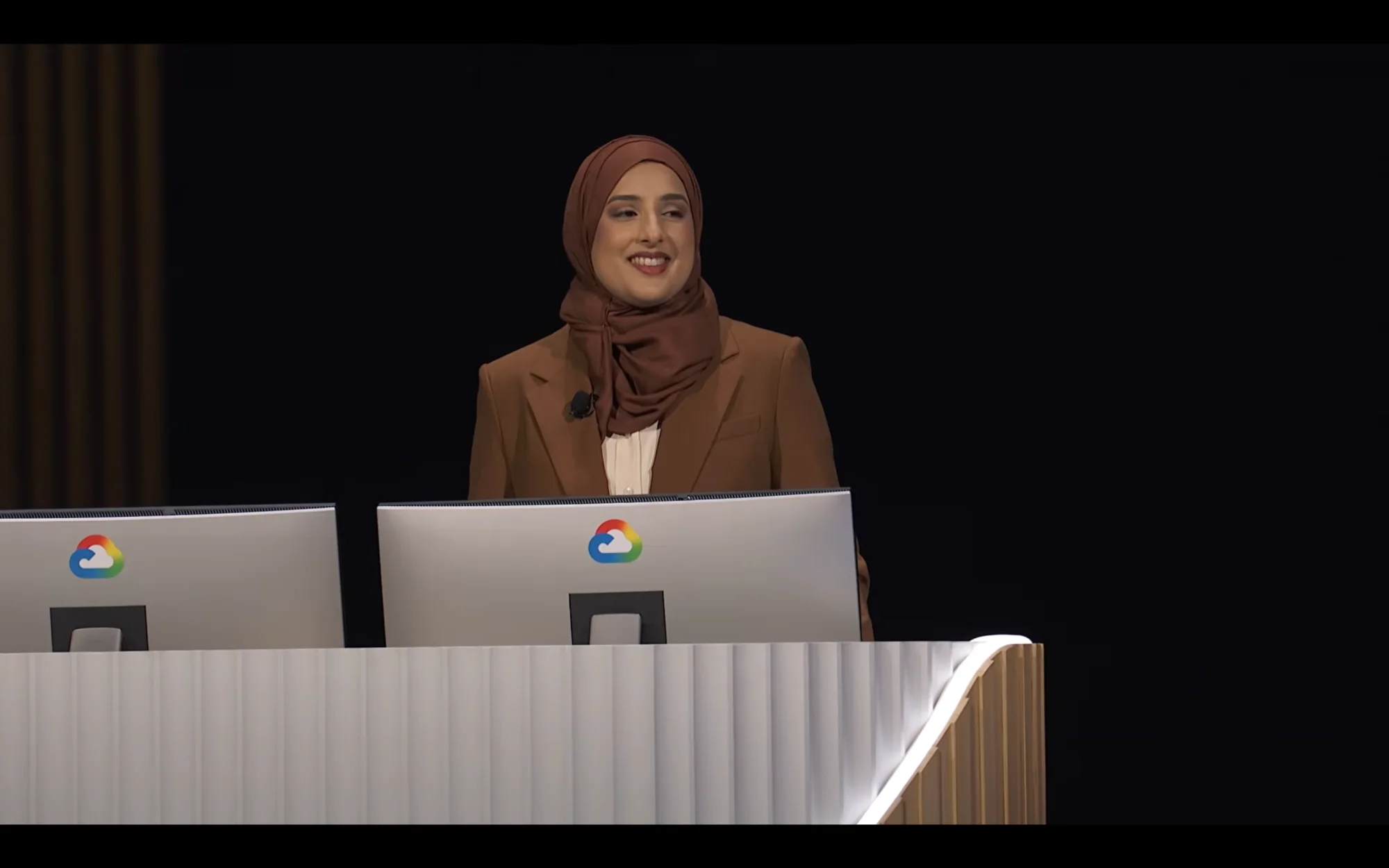
Yasmeen Ahmad, Managing Director of Product Management, Data and AI Cloud at Google, believes the future of enterprise AI will not be determined by models alone. It will depend on whether companies can rebuild their data infrastructure for a world where AI agents, not humans, become the primary users of enterprise systems.
As enterprises race towards agentic AI, the challenge is reliability: can autonomous agents operate across fragmented enterprise systems in real-time without breaking trust, governance, or costs?
Ahmad, who leads Google Cloud’s Data Cloud engineering arm, argues that this is where the industry’s biggest bottleneck lies. “The biggest barrier for adoption today is trust, especially as we get to autonomous agents,” she tells AIM.
Google said the Gemini Enterprise has crossed 8 million subscribers and over 2,500 companies in six months, as enterprises increasingly move from pilots to production deployments. Across its ecosystem, more than 6 trillion tokens are processed monthly through its Agent Development Kit infrastructure.
AI-Ready Data is No Longer Enough
Over the last few years, much of the enterprise AI conversation has centred around “AI-ready data,” clean, structured datasets prepared for machine learning systems. But Google found that even highly curated enterprise data wasn't enough to make agents reliable at scale.
“No matter how hard you tried and how much you cleaned the data, you still only got to 50–60% accuracy when using agents over that data,” she says. “There was something missing.”
That missing layer is context.
“It was the data scientists who would speak to the supply chain team or the logistics team because they understood the context around how the business operates,” Ahmad says. “Then they could apply that context with the data and build really good models.”
That realisation pushed Google towards building what it now calls a “universal context engine.” Knowledge Catalog is a semantic layer designed to sit on top of enterprise data systems and provide organisational meaning to AI agents.
Rather than simply querying raw information, agents first interact with this context layer, which interprets relationships, permissions, and business meaning before routing agents towards the right data sources.
Rebuilding Data Stack for Agents
For Ahmad, the shift towards agentic systems represents more than a product evolution. It marks a structural transition in how enterprise infrastructure itself must operate.
“The modern data stacks that moved into the cloud were still built for humans,” she says. “They were designed for a human who’s clicking a button or doing one request. That era is breaking down.”
Now, agents interact with systems continuously and autonomously. Ahmad says some BigQuery customers have not written SQL queries in months because AI agents are handling those interactions automatically.
Traditional SQL engines, rigid APIs, and manually orchestrated workflows were not designed for systems where swarms of agents simultaneously perform reasoning and execution tasks across structured and unstructured data environments.
“When we look at web traffic today, in the time that a human would normally click once, an agent might do 10–20 calls,” Ahmad says. “We have swarms of agents.”
As a result, Google is redesigning infrastructure around vector embeddings, graph relationships, multimodal search, and low-latency orchestration.
The infrastructure push behind that strategy is massive. Google plans capital expenditure of $175–185 billion this year, with roughly half directed towards cloud infrastructure as demand for AI inference and enterprise agents accelerates.
Governance, Trust, and the Multi-Cloud Challenge
Ahmad highlights that organisations often operate within a single cloud environment, which doesn’t necessarily reflect reality. Enterprise data now exists across AWS, Salesforce, Snowflake, ServiceNow, and internal systems simultaneously.
“I don’t think I’ve met a customer in the last six months who said all of my data is in one place,” she says.
That fragmentation creates operational challenges for agentic systems, particularly around latency and consistency. To address this, Google announced its cross-cloud lakehouse architecture at Google Cloud Next 2026 to enable AI systems to operate directly across distributed data environments without forcing enterprises to migrate everything to a single platform.
Historically, moving data across clouds introduced high latency and expensive egress costs. Ahmad says Google’s latest cross-cloud interconnect infrastructure significantly reduces both. “The egress is negligible,” she says. “You can move data fast.”
As enterprises move towards autonomous systems, governance becomes inseparable from infrastructure design itself. Ahmad repeatedly returns to trust as the defining issue for enterprise AI adoption, particularly in sectors such as healthcare and banking.
“The stakes are high,” she says, referencing deployments where Gemini assists radiologists in analysing mammograms and medical imaging.
“The permissioning actually lives at the data layer,” Ahmad says. “The first thing that the universal context engine is doing is making sure you’ve got access permissions to even access that context.”
That principle becomes increasingly important as enterprises scale to thousands, or even millions, of autonomous agents operating simultaneously.
Google claims it has reduced BigQuery query costs by 40% and improved speeds by 35% over the last year in preparation for this transition.
Beyond Conversational AI
For Ahmad, the future of enterprise AI extends beyond conversational interfaces into autonomous orchestration systems that monitor environments, reason over real-time data, execute workflows independently, and escalate only when human intervention becomes necessary.
She points to telecom operator Optus as an example. Instead of waiting for failures to occur, autonomous agents proactively monitor network sensor data, detect anomalies, generate summaries, create ServiceNow tickets, and alert engineers before outages happen.
“That’s super interesting because now you have a real-time autonomous agentic system that is monitoring, executing, and then alerting the human,” Ahmad says.
That transition fundamentally changes the role of enterprise workers. Employees increasingly move from executing repetitive operational tasks to supervising and orchestrating autonomous systems. “Whether you are a two-person startup or a multinational enterprise, you all have access to the world’s most powerful multimodal thinking models,” she says.