Key takeaways
- Wadhwani AI's Shishu Maapan app empowers ASHA workers with AI for newborn health monitoring.
- The app uses smartphone video and AI to accurately estimate critical anthropometric measurements.
- Shishu Maapan reduces equipment burden, simplifies monitoring, and improves frontline care efficiency.
- Currently deployed with over 700 ASHA workers, the technology is enhancing rural neonatal care.
In rural India, Accredited Social Health Activists, or ASHA workers, work on the frontlines of maternity care. Numbering over a million, they are often the first port of call during a health crisis in a family, and have been instrumental in lowering both the maternal mortality rate and the infant mortality rate.
A part of their routine is screening newborns through the Home-Based Newborn Care (HBNC) programme every few days for the first 42 days. They take anthropometric measurements, including measuring the baby’s weight, length, head circumference, and chest circumference, to monitor their health and development. However, the women often have to carry heavy equipment—from weighing scales to immunisation ice boxes—and walk for hours to deliver care.
Now, a technological shift is helping ASHA workers swap weighing scales with smartphones.
Wadhwani AI, a non-profit institute developing AI solutions for underserved communities, has developed Shishu Maapan, an AI-powered application that allows ASHA workers to estimate a newborn’s weight and other key measurements using just a smartphone.
“Earlier, mothers were afraid because they thought their baby might fall because of the weighing machines. Now, I just take a video with my phone. The mothers relax, and I get the measurement right away. It’s easy, and it helps me remember follow-ups,” Tai Api, an ASHA worker in the Papum Pare district of Arunachal Pradesh, tells AIM.
The app was first deployed in the Union Territory of Dadra and Nagar Haveli and Daman and Diu in 2023. It is currently being used by more than 700 ASHA workers.
The Digital Shift
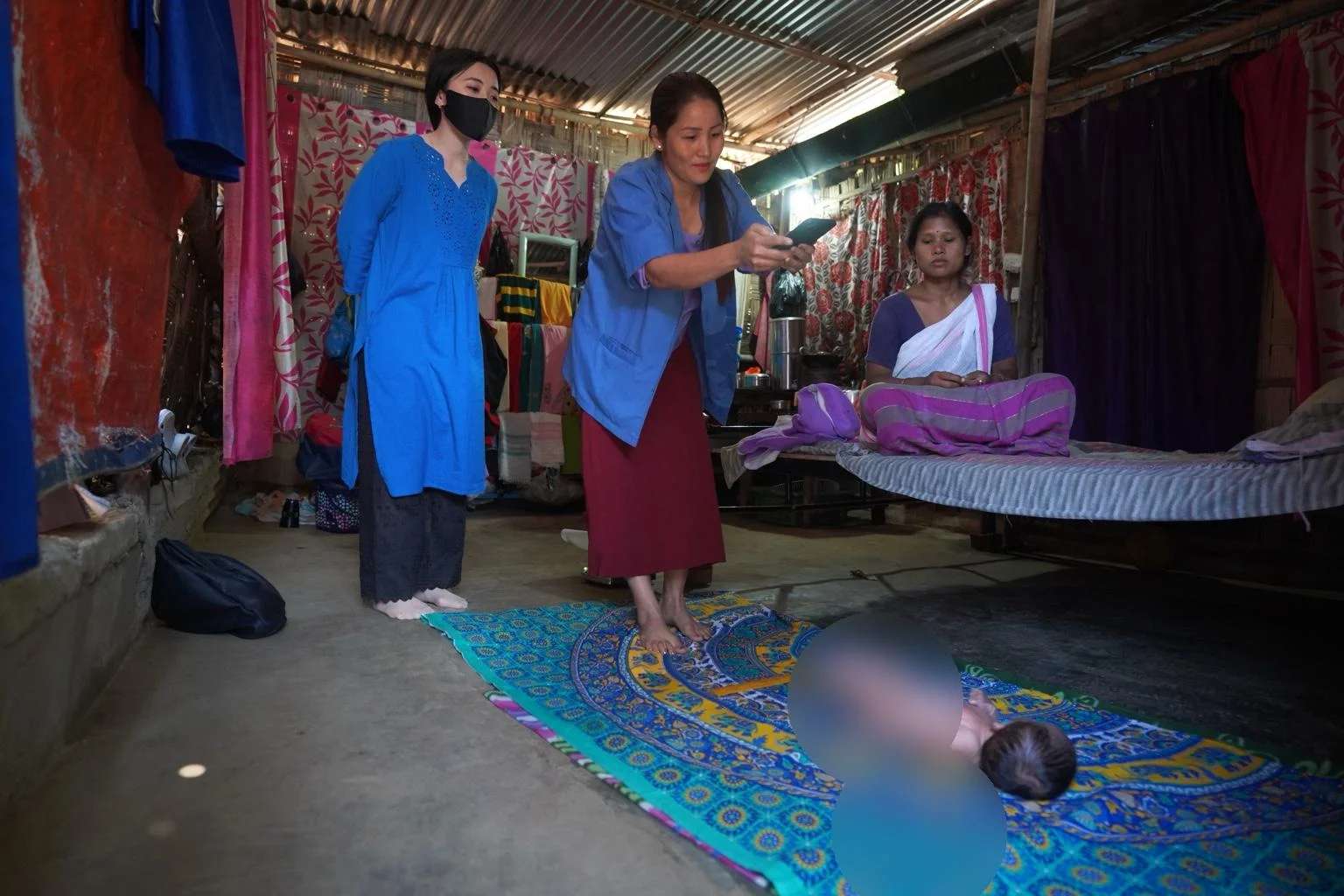
The process is simple. During a home visit, an ASHA worker has to place the baby on a flat surface, position a small ruler near the infant’s feet and record a short 10–15 second video.
Behind this ordinary process lies a complex AI system.
Once the video is recorded, the app breaks it into frames and analyses them using computer vision and machine learning. A Convolutional Neural Network (CNN)-based model then analyses these frames to extract visual features related to the baby’s body proportions. Through a multi-task learning framework, the model simultaneously estimates key anthropometric measurements.
The results are generated within seconds and displayed on the mobile application, enabling the ASHA worker to quickly assess whether the newborn’s growth is within a healthy range or if the baby may require additional monitoring or referral.
“ASHAs earlier struggled with weighing scales that were often uncalibrated or damaged. Now, a mobile phone allows faster, safer measurement, and gives us data we can trust,” Dr Tania Raju, District ASHA Nodal Officer, Papum Pare, Arunachal Pradesh, notes.
This shift from hardware to software has made monitoring significantly easier, especially in regions like the Papum Pare district, where carrying equipment across long distances is part of the job.
Bridging Gap Between Technology and Trust
Like most technologies introduced at the grassroots level, Shishu Mapan too faced some initial resistance.
“One of the biggest challenges was ensuring that the technology fits seamlessly into the daily workflow of frontline workers. Initial adoption took a couple of months before it became fully integrated,” says Dr Ashok Jaybhaye, Program Manager, MNCH, Wadhwani AI.
There was hesitation from families in the early stages of adaptation. “Over time, with the trust ASHA workers have built within communities, this resistance has reduced significantly,” he adds.
One of the app’s key strengths is its ability to function without internet access, especially in low-network regions.
Dr Jaybhaye explains that the app operates on edge AI, where the AI model runs directly on the worker’s smartphone, enabling the video to be analysed locally without an internet connection. Once connectivity is available, the data is synced to central dashboards for monitoring and follow-ups. The app also ensures privacy, automatically deleting videos after processing.
The system has already moved beyond pilot testing.
According to Wadhwani AI, Shishu Maapan has supported more than 21,000 HBNC visits and facilitated the registration of over 8,000 newborns. Contextualisation activities are underway in states, including Assam, Arunachal Pradesh, Meghalaya, and Odisha.
In a system where early detection can significantly impact infant health outcomes, this shift from weighing scales to smartphone videos marks a subtle but important transformation in public healthcare delivery.