Key takeaways
- AI tools are transforming software engineering roles, shifting focus from manual coding to collaboration.
- Emerging platforms enable beginners to code, democratizing access to software development.
- Andrej Karpathy's 'vibe coding' highlights the potential of generating code from ideas alone.
- Replit CEO emphasizes AI as an empowering tool, not a replacement for human creativity.
- Job roles will evolve, but employment opportunities in tech will persist despite AI advancements.
For quite some time now, the discussion around AI potentially replacing software engineering jobs has gained significant attention. Tools like Cursor, Windsurf, and Claude have become dominant forces in the coding world since last year, providing auto-completion features and generating code for a wide range of use cases.
Recently, the internet has seen a surge of experiments where people demonstrate what has come to be known as ‘vibe coding’, a term introduced by OpenAI co-founder Andrej Karpathy. In this approach, simply having an idea is enough to generate functional code.
While AI tools like GitHub Copilot have long assisted professionals by autocompleting code, newer platforms such as Cursor, Replit, Bolt, and Lovable are now making it easier for beginners to get involved in coding, offering enhanced features that simplify the process.
Against the backdrop of these innovations, one thing is clear: AI is not only enhancing productivity but also fundamentally redefining job roles across the enterprise. The role of a software engineer is no longer confined to manual coding; it now encompasses collaboration with AI tools that are transforming the industry in profound ways.
Amjad Masad, CEO of Replit, has voiced his unease with the term ‘vibe coding’, suggesting that it trivialises the profound capabilities of generative AI and downplays the creative effort involved in software development. He maintains that AI should be viewed as a tool to empower more individuals to create, rather than a means of replacing them.
On the topic of employment, Masad remarked, “We’re all going to have jobs—they’re just going to be very powerful.”
Masad recently suggested that learning to code may no longer be essential. He shared a video clip on X in which he agrees with Dario Amodei of Anthropic, who predicted that the majority of code in the near future would be generated by AI. Amodei anticipates that AI could be responsible for writing up to 90% of all code within the next six months.
Explaining the indispensable nature of such tools, Abhishek Upperwal, CEO of Soket AI Labs, told AIM, “These tools are only as good as the person using them. If you know your stuff, they’ll blow your mind with the quality. But hand them to someone without decent programming skills, and it’s chaos. They’re powerful, but they’re not magic. Yet.”
Augmenting Job Roles, Not Replacing Them
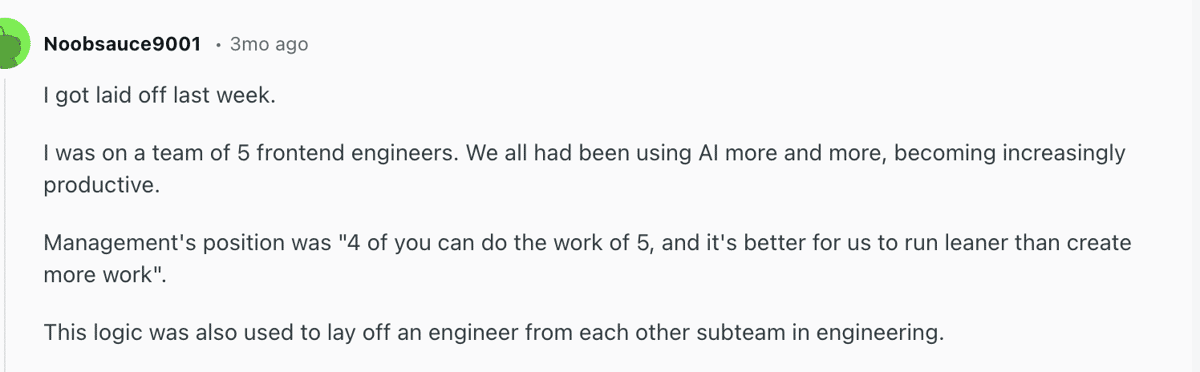
A Reddit user revealed that he was recently laid off from a team of five frontend engineers.
Reflecting on the trend, Alan Flower, executive vice president and head of AI Labs at HCLTech, clearly stated, “It’s not so much about replacing job roles. It’s about augmenting the role with AI.”
Flower highlighted how business leaders worldwide perceive AI and said, “They see AI as a net gain in terms of productivity.”
However, this gain is not restricted to merely accomplishing more tasks. Instead, it encompasses both the speed and quality of execution.
This change is especially relevant in areas such as IT and engineering, where work backlogs are a persistent challenge. “Every business leader that I engage with has got what I would call a never-ending backlog of things they can never get done,” Flower noted.
AI enables businesses to “start more projects, complete more projects, and drive transformation further and deeper”.
Considering this, one key area of transformation is software engineering. Flower highlighted that HCLTech’s AI Force platform has been pivotal in this shift. The patented GenAI platform drives service transformation throughout the software engineering and IT operations lifecycle.
“With AI Force, every role within a software engineering team—product owners, testers, engineers, scrum masters—has received AI enhancement,” he explained.
For instance, while developers usually spend only around 30% of their time writing code, the remainder is devoted to testing, documentation, and analysis. AI is now assisting in streamlining the entire lifecycle. “We have observed perhaps over a 60% productivity increase in certain areas,” Flower disclosed.
Creating New Roles
AI isn’t just changing old roles; it is creating new ones.
Back in 2017, a report by the Institute for the Future stated that 85% of the jobs that would exist in 2030 haven’t even been invented yet. The same is true for prompt engineering, which has now emerged as a critical new skill in the era of generative AI.
“There is a massive demand for people who can drive modern, generative AI platforms well,” Flower shared.
Another emerging field is AI operations, where professionals manage and run complex AI stacks. “That’s not just technical, it encapsulates an awful lot of governance as well,” he added, highlighting the need for a new generation of professionals with a hybrid skillset that combines engineering prowess and ethical oversight.
Reskilling the Workforce
By 2027, 44% of workers are expected to shift their core skills. The World Economic Forum’s Future of Jobs Report shows that nearly half of all employees will need to adapt to technological advancements in the near future.
Reskilling and upskilling are essential to keep pace with this change, and HCLTech is deeply invested in this journey. “Our global engineering workforce is already using AI Force,” Flower said.
Even beyond the engineering teams, the company encourages its workforce to adopt AI tools like Microsoft Copilot. Flower noted that there is strong evidence suggesting that once individuals begin using these tools and experience some initial benefits, the process becomes habitual.
“We’ve already deployed solutions with smaller, customised models that might, for example, understand the healthcare domain,” he explained, referencing their GenAI-powered clinical advisor platform.
HCL Tech’s Next Big Leap
HCL’s smaller models work in tandem with large foundational models, forming multi-model architectures that are more efficient.
Flower explained that a large language model (LLM) isn’t necessary for every task. The most common approach is to use an LLM to interact with the end user while using a selection of more optimised, smaller models to handle specific tasks in the background.
Agentic AI is another frontier where HCLTech is making strides. “We publicly showed how we were using agentic AI in production,” Flower shared. These agents are trained to handle traditional IT operations roles such as network and cloud engineering or service desk functions.
“This is the perfect example of how someone working at a service desk can take one of these tickets and think, ‘I’m going to delegate it,’” Flower said.
The result? Employees have more time to provide better customer service, while overall productivity and efficiency significantly improve.
Looking to the future, Flower reaffirmed that the demand for AI-driven transformation is stronger than ever. “My labs have completed over 500 GenAI engagements…Clients come to us with transformational projects,” he shared.
During their Q4 earnings calls, Indian IT companies such as Accenture, TCS, and Wipro highlighted their strong focus on AI-led innovation and automation, with an emphasis on upskilling talent.
Milind Lakkad, CHRO at TCS, addressed concerns about AI’s impact on hiring. When asked about the effect of AI upskilling on TCS employees, he said, “We don’t see any impact on hiring because of AI.”