
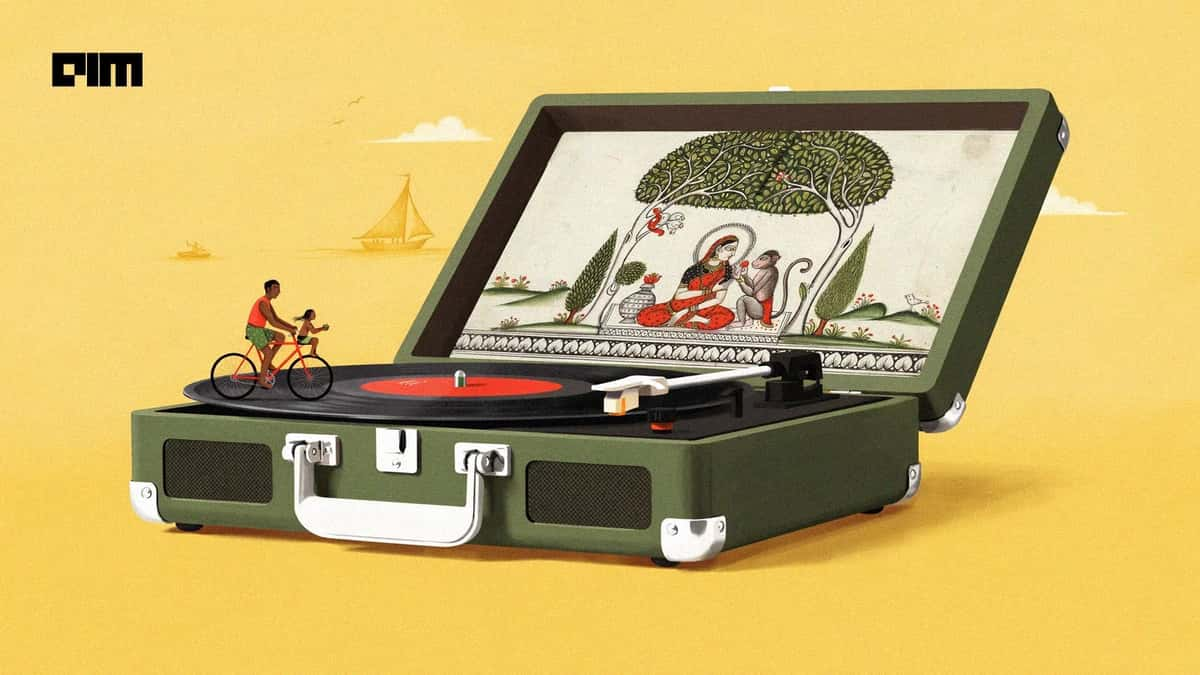

When Raksha Rao and Krishnaprasad Jagadish observed the content their children were consuming, they noticed a growing gap. The Indian stories that once travelled from grandparents to children by the bedside were slowly being replaced by videos on tablets and smartphones.
According to a study published in the National Library of Medicine, children in India under the age of five spend an average 2.22 hours a day in front of a screen—more than double the threshold recommended by the Indian Academy of Pediatrics.
While global children’s content was entertaining and accessible, they felt something was missing—stories rooted in Indian culture, languages, and traditions.
That led them to create Katha Room, an audio-first storytelling platform that brings Indian folklore, mythology, and regional stories to children through carefully curated narration rather than animated visuals.
“We felt children were getting access to a lot of content, but not necessarily the stories we grew up with. We wanted to recreate that experience of hearing stories from grandparents and pass those traditions forward,” Raksha Rao, CEO and Co-founder as well as Product and Strategy Lead at, Parjanya Creative Solutions, the company behind Katha Room, tells AIM.
Today, the platform hosts more than 250 stories across five languages and has notched over 10,000 downloads on iOS and Android combined, while remaining entirely bootstrapped.
The Inception
The idea for Katharoom emerged organically.
Rao, along with her husband Krishnaprasad Jagadish, Engineering Lead, CTO and Co-founder pf Parjanya Creative Solutions and their longtime friend Harish Kumar, were discussing how childhood experiences had changed over the years. All three have engineering backgrounds and spent years building technology products but they shared a common concern about preserving Indian storytelling traditions.
“We were all talking about how our children were growing up very differently from us. We had grandparents telling us stories every day. Our children were mostly consuming digital content,” recalls Harish Kumar, Content and Product Lead, CEO and Co-founder, ScalePeak Technologies, which developed Katha Room in partnership with Parjanya.
The team launched an early version of Katha Room in late 2025 with just 30 Kannada stories. Rather than rushing content out, they focused on professional recordings, research, and storytelling quality.
The response surprised them. “Kids who were primarily watching videos suddenly started listening to audio stories one after another. That validated our belief that children would engage even without visual stimulation,” Kumar says.
Building Stories, Not Algorithms
Unlike many children’s content platforms that rely heavily on animation, Katha Room deliberately chose an audio-first approach. The founders believe storytelling works best when children actively imagine characters, settings, and situations rather than passively consume visuals.
Most stories on the platform run for three to five minutes and are designed around routines such as bedtime or dinner time. Features such as playlists, autoplay, and sleep timers were later introduced after feedback from parents.
“We don’t want children spending endless hours on the platform. We want storytelling to become a meaningful routine, not an addictive habit,” Rao explains.
A 2025 study published in the International Journal of Elementary Education found that storytelling-based digital experiences can improve children’s engagement, narrative comprehension, communication skills, and understanding of moral values. The researchers observed that children showed high levels of enthusiasm and participation when learning through storytelling, suggesting that thoughtfully designed digital storytelling tools can support creativity and social-emotional development alongside entertainment.
Preserving Languages Through Tech
Katharoom currently offers stories in Kannada, Hindi, Tamil, English, and Sanskrit with plans to expand into several more Indian languages. “We see language as an important part of cultural identity. If we don’t build in these languages, entire communities may remain underserved,” notes Rao.
The team also places significant emphasis on content curation. Stories are adapted specifically for children rather than simply reproduced from traditional texts. Even when drawing on well-known sources such as the Panchatantra, the founders ensure that the stories remain engaging and relevant to young audiences.
“We don’t use AI to generate stories. The value of our product comes from human curation, human storytelling, and human narration,” Kumar explains.
The founders, however, add that they use artificial intelligence to support workflows such as translation, metadata generation, and search optimisation.
Finding Validation Beyond Downloads
Several milestones helped convince the founders that Katha Room could grow beyond a passion project.
One came when parents began paying for subscriptions after the company introduced a paywall. Another came from preschools that expressed interest in bulk subscriptions.
The company currently works with three preschools and is exploring partnerships with libraries and bookstores.
This year, Katha Room was named a finalist for the 2026 Apple Design Awards in the Social Impact category.
“For a small Indian team, having Apple recognise our work around regional languages and storytelling traditions was an incredible validation,” adds Rao.
“Katha Room keeps its focus on stories drawn from Indian folklore, and decorates them with a UI drawn from the Gond art form—its intricate patterns and vibrant colors bringing warmth to every screen. Katha Room is also a lovely showcase for sound design, encouraging listeners to conjure characters, settings, and emotions for themselves,” Apple noted in its citation.
The app also holds a 4.8-star rating on the App Store and has been featured by Apple Editorial.
Taking Indian Stories Global
Looking ahead, the founders see a much larger opportunity.
Alongside expanding into additional Indian languages, Katha Room is targeting diaspora communities that want their kids to stay connected to their roots. But the vision extends beyond Indian families abroad.
“If anime could travel from Japan and become popular globally, there’s no reason Indian stories cannot do the same,” Rao affirms.
The team also hopes to build technology that enables families and communities to preserve stories that have never been formally recorded.
“India has billions of stories that are still untold. Somewhere, a grandmother knows a story that has never been documented. We want to build the tools that help preserve those stories for future generations,” she adds.
As debates around children’s screen time continue to grow, Katha Room is taking a different approach, using technology not to replace traditional storytelling, but to ensure it survives in a digital age.
- Enmovil Plans to Quadruple FDE Team as Enterprise AI Hiring Moves Beyond Coding
- Does the World Need a New GitHub?
- Can India’s AI Boom Reach Bharat?
- AI's Next Agritech Frontier Is India's Fragmented Supply Chain
- India’s Frontier AI Race Gets a 240M Model That Beats Liquid AI
- The AI Slowdown Narrative Doesn’t Reflect Enterprise Reality