
Google’s Gemini is gaining an edge over Claude with its coding prowess, and GitHub Copilot is adding vibe coding abilities. Given these developments, the trend for the companies' focus is clear—building AI solutions tailored for developers and vibe coders.
OpenAI (considering it already has a two-million-plus business user base) is not holding back either. Numerous new developments by the Sam Altman-led company signify its priority of getting developers on board their platform.
New AI Models and Tools Built for Coding
On Wednesday, OpenAI launched o3 and o4-mini. The models are trained to think for longer before providing an output. O3 is a reasoning model, and o4-mini is a smaller model optimised for fast, cost-efficient reasoning.
These reasoning models can harness various abilities, such as searching the web, analysing uploaded files and other data with Python, and generating images, all from within ChatGPT.
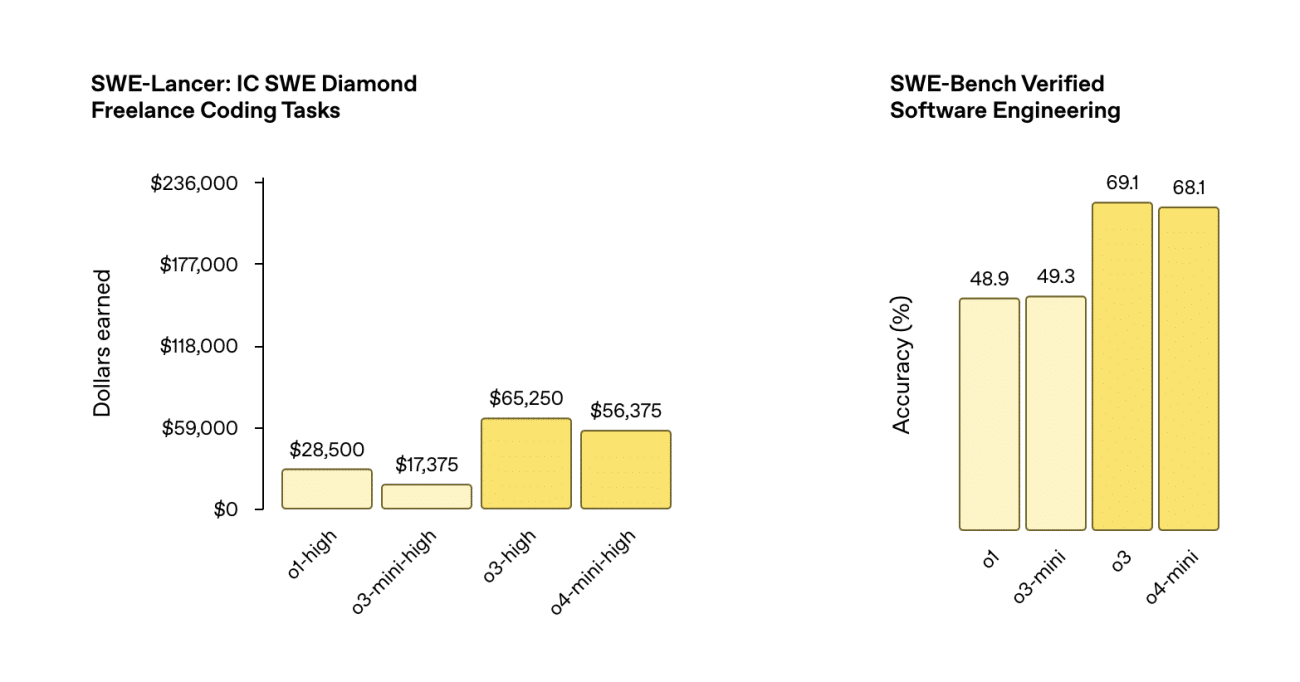
OpenAI mentioned that its models achieve higher benchmark numbers in tests like Codeforces competition code than their predecessors, citing a 20% fewer major errors over OpenAI o1, as tested by external experts.
The benchmark tests for coding involved SWE-Lancer, SWE-Bench Verified Software Engineering and Aider Polygot Code Editing.
Not limited to its internal tests, Aider’s polyglot coding leaderboard puts o3 at the top in terms of accuracy. While the leaderboard chart mentions the price being higher than Gemini, the o4-mini is still cheaper than the Claude 3.7 Sonnet, and o1.
Prior to the reasoning models, on April 14, OpenAI introduced the GPT-4.1 series, built for API usage. This series focuses on coding and instruction following while expanding the context window. GPT-4.1 scored 54.6% on SWE-bench Verified, closing in on the gap with Gemini 2.5 Pro, which scored 63.8%. The GPT-4.1 nano also performed better than GPT-4o.
In addition to improving the models, OpenAI released Codex CLI, an open-source, lightweight coding agent that can run from your terminal and is available under an Apache-2.0 license.
Although this is an experimental project, notable companies have tested it, illustrating its usability for developers. Cloudflare demonstrated how to use OpenAI Codex to deploy a full-stack Cloudflare Workers application in just a few minutes.
Some developers have appreciated the tool's open-source nature, which they consider an advantage over options like Claude Code.
OpenAI Eyes Vibe Coding Platforms
OpenAI is reportedly planning to buy Windsurf for about $3 billion, according to a Bloomberg report.
If that turns out to be true, OpenAI will compete with AI coding platforms, including Microsoft’s VS Code, Claude Code, and others. This would also open up competition with Anthropic.
Not to forget, in 2023, OpenAI invested $8 million to help improve Cursor. It is unclear if OpenAI aims to compete with Cursor or later partner with it, but the company is potentially positioning itself to participate in the vibe-coding war.
Developers, however, have a mixed opinion on OpenAI’s potential Windsurf acquisition.
Eduard Ruzga, staff engineer at Prezi, told AIM, “I tried Codex this morning, but I do not really like it. It is somewhat restricted in nature, and terminal UX feels worse than Claude.”
He added, “I am not sure about Codex yet. It feels like a competitor to Claude Code that has issues. It uses an API key so that you may run up quite a bill with it, and they do not show how much you spent.” He highlighted that he spent 30 cents on just one call.
When asked about the Windsurf acquisition, he said, “If OpenAI buys it and subsidises LLM costs, it could be quite a big move, raising stakes in this market.” He remarked that it would be a bold move considering Microsoft’s recent push with GitHub Copilot’s agent mode.
Prasun Anand, creator of Zasper, shared his thoughts on the same, and told AIM, “The world needs good ‘coding assistants’. Developers spend at least four hours daily with their IDEs. Windsurf has built a strong distribution, and OpenAI acknowledges this with its plan to acquire Windsurf.”
Likewise, Sulaiman Mudimala, founder of Bezu AI, told AIM that OpenAI needs to earn developers’ trust, like Anthropic has with its Claude model. He believes that the potential acquisition alone will not win over developers.

Your reaction
Discussion
What's your take on this story?
No comments yet — be the first to share your view.