
Key takeaways
- The reliability of machine learning models is measured by their error rates during predictions.
- Adversarial examples are intentionally crafted inputs that can deceive machine learning models.
- Real-world applications of models may encounter unforeseen data, challenging their effectiveness.
- Monitoring adversarial attacks is crucial, particularly for safety-critical systems like autonomous vehicles.
- Adversarial techniques are developed to enhance the resilience of models against unexpected inputs.
 The reliability of a machine learning model is assessed based on how erroneous it is. Lesser the number of errors, better the prediction. In theory, ML models should be able to predict, classify and recommend right every single time. However, when deployed in the real world, the model has a very good chance of running into information that has never appeared during training. To prepare the model for such untimely adversities, adversarial techniques have been developed.
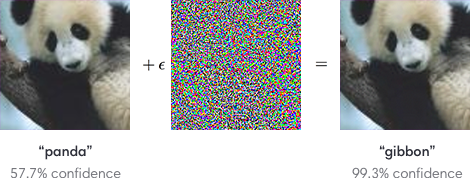
Adversarial examples are inputs to machine learning models that an attacker has intentionally designed to cause the model to make a mistake.
What Do Adversarial Examples Look Like
Preparing For Unforeseen Attacks
Notably, common classification benchmarks often do not naturally provide such protections on their own. Further, besides explicitly incorporating this information, they give away if the learning algorithms are inferring good similarity structure. In an attempt to fortify a model’s defense strategy to avoid misclassification, researchers at Open AI introduce a new metric, UAR (Unforeseen Attack Robustness), which evaluates the robustness of a single model against an unanticipated attack, and highlights the need to measure performance across a more diverse range of unforeseen attacks.
- Evaluate models against adversarial distortions that are not similar to those used in training. Consider L_1, L_2 JPEG, Elastic, and Fog attacks as a starting point. They provide implementations, pre-trained models, and calibrations for a variety of attacks in our code package
- Choose a calibrated range of distortion sizes by evaluating against adversarially trained models
- Compute the UAR scores of adversarially trained models for several different distortion types. A UAR score near 100 against an unforeseen adversarial attack implies performance comparable to a defense with prior knowledge of the attack
 An UAR score greater than 100 means that a defense is outperforming an adversarially trained model on that distortion.