
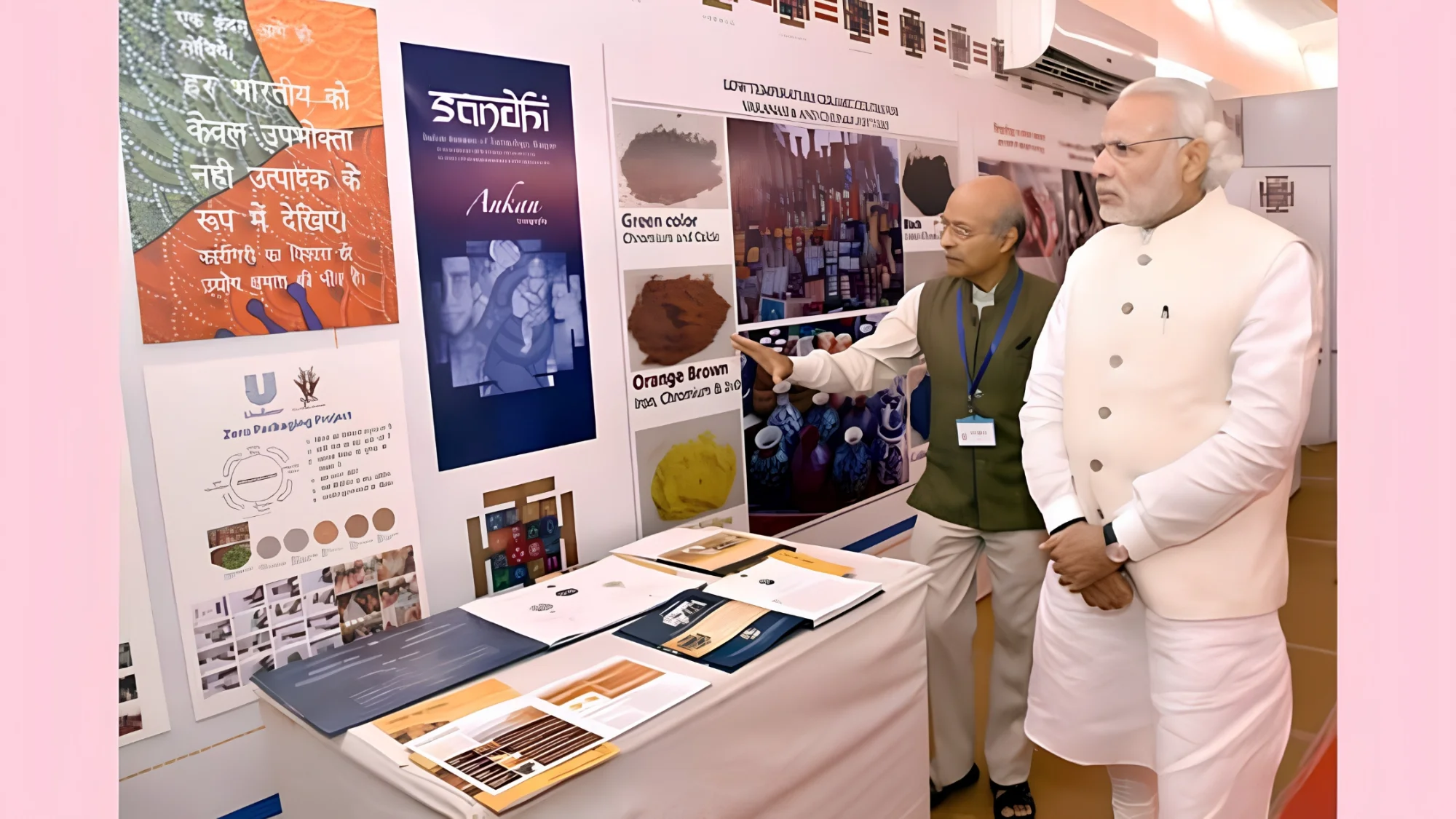
In 2016, Prime Minister Narendra Modi watched a live demonstration of machine translation across Indian languages. It was early, imperfect, and far from production-ready, but it worked. For Prof Rajeev Sangal, that moment was less about the technology on display and more about what it represented.
India could build AI systems for itself, rooted in its own complexity, languages, and problems.
That demonstration would eventually evolve into Mission Bhashini, India’s first AI mission, a platform that today processes 15 million inferences daily and has crossed 600 crore requests. By any measure, it is one of the most ambitious AI collaborations India has executed, bringing together 70 research groups across 30 institutions.
And yet, nearly a decade after that first demonstration, Sangal’s assessment is stark.
“Despite all the hype around AI today, India still lacks a clear AI vision,” he tells AIM.
The contradiction defines the moment India finds itself in. The country has demonstrated that it can build at scale. But it is still struggling to decide what exactly it wants to build.
The Intent
Sangal does not begin with technology when explaining this gap. He begins with intent.
“I believe we are not thinking big enough,” he says, before sharpening the point further. “India is thinking, where are the world’s companies going? What are MNCs doing? Let us repeat it. Let us just follow them.”
For him, this instinct to follow is the core problem. The global AI race today is defined by large models, massive compute infrastructure, and the dominance of a few companies. India, in trying to replicate that playbook, risks overlooking its own opportunity.
“One has to see what India needs and look at Indian problems that will be amenable to AI,” he says.
That thinking shaped Bhashini from the outset. When Sangal received a call in 2018 from the Prime Minister’s Science, Technology and Innovation Advisory Council, the original ask was relatively narrow: design a language translation mission for scientific material. He pushed back immediately.
“At that time, let us be more ambitious. Let us do it not just for science but all subjects,” he recalls. Then he went a step further. “Let us build a speech-to-speech translation system.”
At the time, even experts were sceptical. Speech and language research largely operated in silos, and combining them across Indian languages, with all their variations, sounded unrealistic.
“People didn’t believe us,” he says.
What followed was not a single breakthrough, but a coordination exercise on a national scale. Sangal rejected the conventional model of isolated government projects. “This is such a large mission that approach is not going to work,” he says. Instead, he pushed for a consortium approach, forcing collaboration across institutions that were used to working independently.
His role, as he describes it, was not to build the technology himself, but to hold the system together. “My job was to coordinate the team,” he says. Meetings would often stretch from morning to night, resolving disagreements, aligning outputs, and solving both scientific and coordination problems.
The scale of the problem was uniquely Indian. Twenty-two scheduled languages, dozens of dialects within each, and speech patterns that changed every few districts. “The data had to be collected virtually in every district,” he says. That meant people physically recording voices, translators working sentence by sentence, and systems being trained on real-world usage rather than abstract datasets.
The effort also exposed a structural weakness. India tried to outsource data creation. It failed.
“The data you get is lacking quality,” Sangal says. Vendors had to be removed, and IIT Madras stepped in, hiring over 100 translators to take control of the process. “Data collection, data quality is a hard task,” he adds, underlining a lesson that extends far beyond Bhashini.
Countries cannot outsource the core of their AI systems, especially when that core is their own language and context.
1,000 Problems
These lessons feed directly into Sangal’s critique of India’s current AI trajectory. The country, he argues, is focusing too heavily on compute and infrastructure, without asking a more fundamental question: what problems is AI supposed to solve?
His answer is simple, almost deceptively so. Pick 1,000 problems. Solve them locally. Then scale.
He uses groundwater as an example. Instead of building a national model, create systems that can predict groundwater levels at the level of a village or a cluster of villages, taking into account rainfall, water usage, crops, and local water bodies.
“One part of the country may have drought, the other part may have floods,” he says. “We are a subcontinent.”
The implication is clear. Centralised models will miss local realities. Distributed systems, built on local data, will outperform them.
“If this local data can be sourced, then no one can compete with us,” he says.
This is where Sangal’s argument moves beyond technology into something more philosophical. “We produce not just users and consumers, we produce producers of AI,” he says. The distinction is critical. India is currently training people to use AI tools. Sangal wants India to train people to build AI systems.
The Swarajya
That vision leads him to a concept rarely heard in AI policy discussions: Swarajya. Drawing on Mohandas Karamchand Gandhi’s idea of self-reliance at the village level, Sangal imagines a distributed AI ecosystem where local communities build solutions for local problems. “What an interesting story it would have been if it is AI that brought Swarajya to India,” he says.
To make that happen, he introduces what he believes is the missing piece in AI strategy: social force.
“The sixth thing nobody is talking about is social forces,” he says. Data, algorithms, compute, research, and startups are the standard pillars. But in India, he argues, communities themselves must become part of the system.
He is dismissive of the term ‘crowdsourcing’. “India is a country of communities, not crowds,” he says. The difference is important. Schools, colleges, and local groups can collect data, define problems, and contribute to solutions. Education, in this model, shifts from rote learning to real-world engagement. “The whole education now moves outside this classroom,” he says.
Sangal also takes aim at the policymaking process itself. “Our bureaucracy sits in rooms, air-conditioned rooms, and thinks about India’s problems, and they don’t understand India,” he says. “I sometimes use the word all-knowing bureaucrats, but I add a word to it: all-knowing, ignorant bureaucrat.”
It is not a casual remark. It reflects his view that policy is being designed without sufficient consultation, without openness to alternative ideas, and with a narrow focus on infrastructure. He points out that he himself was not consulted in broader AI mission discussions, despite having led Bhashini.
“The only narrow path that seems to have appeared to them is how to build compute infrastructure,” he says.
That focus, he argues, is incomplete and potentially dangerous. The debate around data centres illustrates this. As global companies set up infrastructure in India, Sangal raises a basic question: “If foreign companies build data centres in India, where will the data reside? Who will control it?”
The cost is not just strategic, but physical. “It will be at the cost of our water, our electricity,” he says.
The UPI to AI
For Sangal, AI sovereignty is more about controlling data, building applications, and defining direction than hosting infrastructure. Without that, India risks becoming a passive participant in someone else’s ecosystem.
This perspective also shapes his disagreement with attempts to replicate models like UPI in AI. “UPI was a great effort, but it required centralisation,” he says. AI, by contrast, “requires a distributed effort.” Trying to centralise AI, he argues, is a category error.
There is also a geopolitical edge to his warning. “China is also doing things about what their country needs… then we will be left behind,” he says. The risk is not just falling behind the West, but also ending up following whichever country first defines the next model.
Despite the sharp critique, Sangal is not pessimistic. He sees immense potential, especially in younger generations. “There is an intense desire to do something… many of them are very well informed,” he says. But they are being shown a narrow set of role models. “They are being shown only one kind of models… become Google or become OpenAI.”
His answer is to expand that imagination. If even a small percentage move towards building local, distributed solutions, it could create a cascading effect. “Even if 5% move forward, that becomes success,” he says.
Through the conversation, he returns repeatedly to one point. “It is not too late.”
India has the infrastructure, the talent, and working examples like Bhashini. What it lacks, he argues, is alignment between vision and execution. “The question is, what strategy would you employ to reach the vision?”
“Policy makers should become much more open to different views,” he says. And then, without softening the blow, he offers his final prescription: “If they feel they are not up to the job, get scientists to head the AI mission.”

Your reaction
Discussion
What's your take on this story?
No comments yet — be the first to share your view.