India Finds it Easier to Blame Fable Than Develop Sovereign AI
By Siddharth Jindal ·
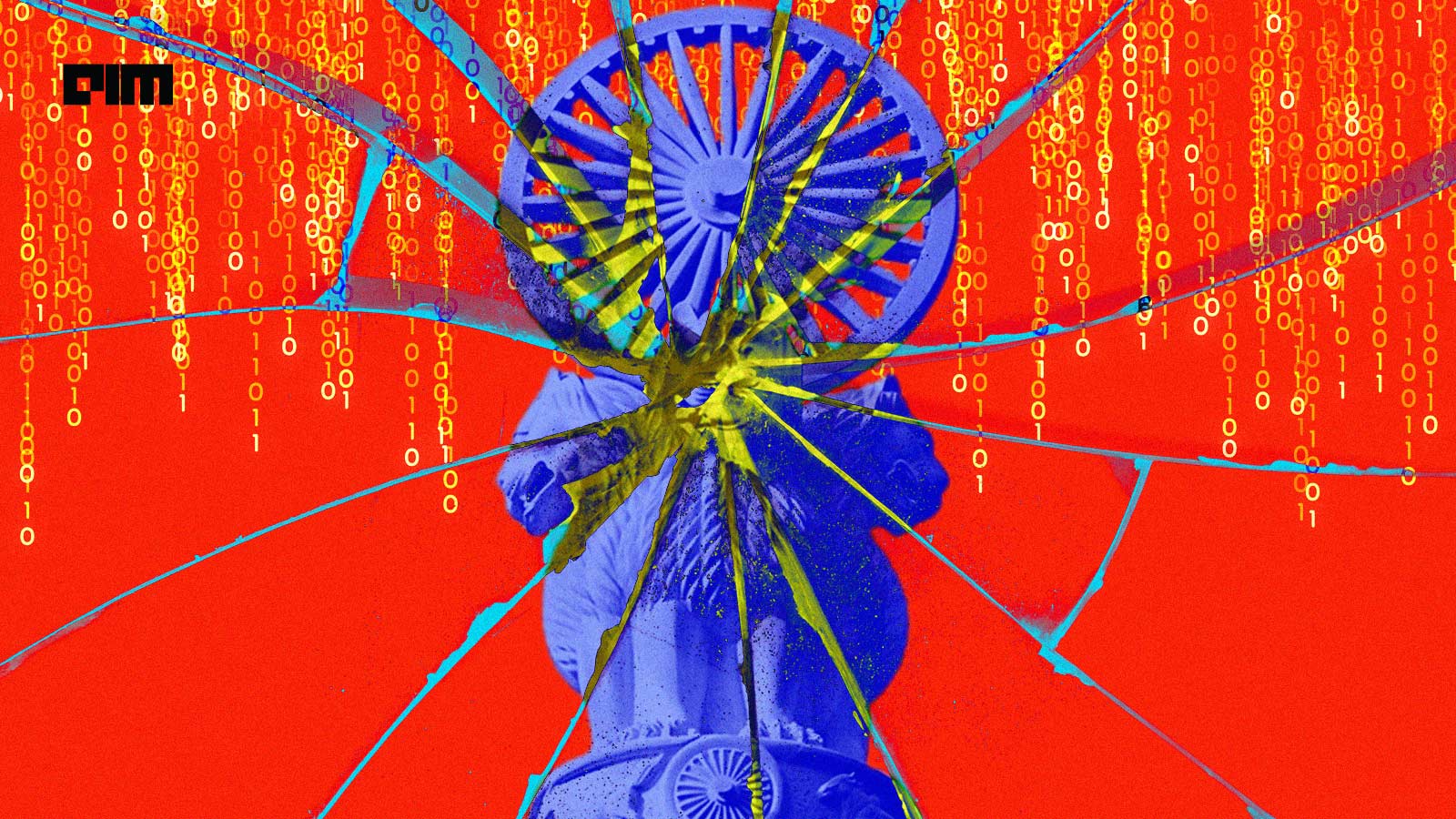
The US government’s recent decision to suspend access to Anthropic Fable and Mythos for foreign nationals has reignited the debate in India on whether the country should seriously consider building comparable frontier models.
That’s easier said than done. Training frontier AI models takes massive compute resources. As per Anuj Saharan, who worked to enhance OpenAI’s compute infrastructure, it took over 200,000 GPUs to train GPT-5. “We’ve 15x’d our compute since 2024 leading up to GPT-5,” he wrote in a post on X last year.
Meanwhile, the IndiaAI Mission has provided only 38,000 GPUs to date, distributed among multiple players to democratise access to compute.
However, industry players and AI analysts caution against overreading the ban on access to Fable and Mythos. They assert that the US government’s restrictions were driven by national security concerns over whether the models can be used by foreign military or intelligence actors, and not to stem AI competition. “The real story is that they had security issues. The security holes in the model are the main story. Everybody got it wrong,” Ganesh Gopalan, CEO and Co-founder of voice AI startup Gnani.ai, tells AIM, emphasising that the narrative has been misunderstood.
He explains that the model was supposed to automatically route risky or potentially harmful queries to a lower-capability model. However, researchers reportedly found ways to circumvent those safeguards.
Meanwhile, Sanchit Vir Gogia, Founder and CEO of technology advisory firm Greyhound Research, argues that the real vulnerability exposed by the Fable ban was not the lack of an Indian AI model but India’s dependence on access controlled by foreign entities.
“The dangerous dependency was never the model. It was the assumption that access is permanent,” Gogia says. He adds that a domestic frontier model alone would not have prevented disruptions if the underlying cloud infrastructure and deployment access remained subject to external controls.
The Stakes are High
Over the last week, many Indian tech luminaries joined the call to build sovereign AI models after the US government restricted access to Fable. Zoho’s Sridhar Vembu emphasised that “Bharat must find her own way”, while former Infosys CFO Mohandas Pai sought a new IndiaAI Mission backed by serious capital.
At the same time, the story is not really about restricting one AI model. It is about control. The bigger concern is about what would happen if the US were to restrict access to more AI models in the future, potentially disrupting businesses in countries all over the globe, including India.
Ankush Sabharwal, Founder and CEO of agentic AI platform CoRover.ai, echoes that access to advanced AI capabilities can be influenced by geopolitical and strategic considerations, creating a strong case for greater technological autonomy.
“India must continue investing in indigenous AI capabilities, including models, infrastructure, data ecosystems, and talent development,” he adds.
So far, under the IndiaAI Mission, five out of 12 AI companies—Sarvam AI, BharatGen, Tech Mahindra, Gnani.ai, and Avataar—have developed foundational AI models. The remaining models are still in the pipeline.
Among them, Sarvam AI recently entered the unicorn club after raising $234 million in the first close of a Series B funding round led by HCLTech.
Co-founder Vivek Raghavan tells AIM that building frontier AI technologies is critical for any country that wants to remain in control of its own technological destiny. “China is controlling its own destiny,” he remarks, referring to its open-source AI ecosystem.
Raghavan argues that AI sovereignty goes beyond simply having access to a model. “My definition of a sovereign model is a model where the sovereign can actually audit the data that was used to train the model,” he says.
The entrepreneur explains that while open-weight models can be downloaded and deployed on local infrastructure, they are not automatically sovereign. They still carry risks if the training data is not fully understood. Citing research from Anthropic, he says even a small amount of poisoned data can influence a model's behaviour.
However, Gogia believes the projects supported under the IndiaAI Mission are not yet ready to directly compete with leading frontier models.
Some of the models already released include Sarvam’s independently trained 105-billion-parameter model that supports 22 languages and BharatGen’s Param2, a 17-billion-parameter multilingual model. “That is a portfolio, not a moonshot,” quips Gogia.
Sabharwal believes that while India has pockets of excellence in AI research and development, there is a long way to go. “The real challenge is scaling those efforts, fostering collaboration, and translating innovation into globally competitive platforms,” he adds.
Can India Stage a Comeback?
Pratyush Kumar, Co-founder of Sarvam AI, has brushed away scepticism and believes that India has the talent, economic scale, ambition, and government support needed to drive technological innovation. “The Fable ban is a good instigation for more people to engage in recognising the need for sovereignty,” he wrote on X, noting that Sarvam trained its 105B model on 3,400 NVIDIA H100 GPUs.
“With Sarvam 105B, India’s first sovereign model built from scratch, we showed that highly capable models can be trained here, independently,” he wrote on X.
Sarvam is now working towards trillion-parameter-class models focused on areas such as coding, agents, and security.
Meanwhile, Gopalan says that the next phase of AI development will depend on highly specialised talent capable of advancing reinforcement learning, model optimisation, and emerging architectures such as Mixture-of-Experts (MoE). Here, the government’s ₹1 lakh crore Research Development and Innovation (RDI) Fund for deeptech startups is primed to realise that ambition.
Gnani.ai is also among the early beneficiaries of the government’s AI infrastructure push. “We were one of the first few companies that had access to the GPUs,” he says, adding that the company is currently using the infrastructure to train its next generation of AI models.
It offers a 5-billion-parameter model Inya VoiceOS and is working on larger models that will soon be released.
However, many Indian AI startups currently depend on foreign cloud providers and external AI platforms to build their products. The Fable fiasco has exposed the gap between India’s AI ambition and reality, emphasising the need to achieve true technological sovereignty.
“Achieving AI sovereignty is not about isolation; it’s about ensuring that critical AI capabilities remain accessible, secure, and aligned with national priorities,” Sabharwal says.