Indian Startups Caught in US-Iran Crossfire are Already Feeling the Pinch
By Novinston Lobo, Smruthi Nadig ·
On the morning of March 2, 2026, Indian stocks followed the global domino effect of the US-Israel-Iran war. After Asian stocks entered the red, the Sensex crashed over 2,700 points in pre-trade, settling 1.29% lower at the end of the day. The Nifty 50, already bruised by months of foreign institutional outflows, was also down 1.24%.
The impact of the war has been rippling through Indian stocks ever since. Sensex has lost over 5,000 points, or 6.1%, since the war began, with no respite in sight as the conflict triggers an oil crisis. Nifty has also lost nearly 1,500 points, or 5.9%.
But it’s not just crude oil supply that’s getting choked. For Indian startups, already navigating a prolonged funding winter, capital may soon be squeezed too.
Funding Landscape Before the War
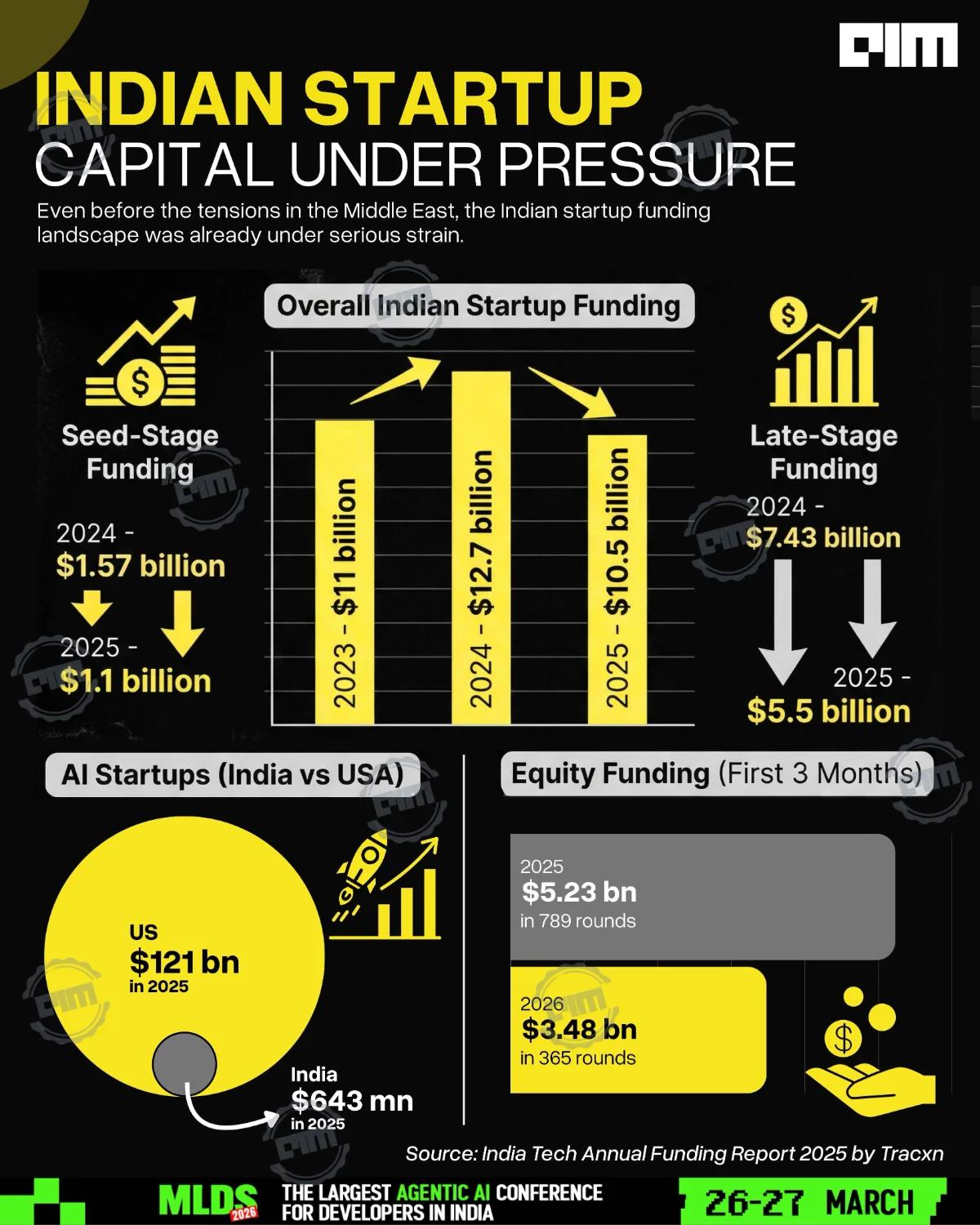
Even before geopolitical shocks compounded the situation, India's startup funding landscape was already under serious strain. According to a report by Tracxn, Indian startup funding fell to $10.5 billion in 2025, down 17% from $12.7 billion in 2024 and $11 billion in 2023.
The number of deals fell 39% year-on-year to 1,518 in 2025. Similar results were seen in seed-stage funding, which was down 30% from 2024, impacting innovation. Late-stage funding saw a 26% decline to $5.5 billion in 2025. Meanwhile, AI startups in India raised just $643 million across 100 deals vs $121 billion in the US (141% surge).
In 2026, year-to-date figures show that Indian startups have only raised $3.48 billion across 365 equity funding rounds. This is a 33% drop from the same period last year, when $5.23 billion was raised across 789 rounds in India, according to a report by Tracxn.
Into this already-fragile ecosystem, the West Asia conflict has introduced new pressures: slower decision-making in global boardrooms, delayed technology budgets, and rising input costs that will cascade through India's supply chains.
“For our Indian startups, the effects [of the war] will mostly be indirect but still meaningful. Higher fuel and electricity costs can squeeze margins for sectors such as mobility, logistics, and quick commerce. These already operate at razor-thin margins,” says Kriti Singh, Associate Director at the policy think-tank The Dialogue.
“Global uncertainty also makes investors more cautious, which could slow funding cycles in the short term,” she adds.
The war has knocked on the borders of the Gulf Cooperation Council, forcing them to reassess how they deploy trillions of dollars from sovereign wealth funds. According to Reuters, three of the top four economies in the region—Saudi Arabia, the UAE, Qatar, and Kuwait—are reassessing future and current investments. Sovereign wealth funds in the region deployed $9 billion in Indian startups over the last five years, according to Tracxn.
"This year, we are witnessing an unpredictable period when it comes to investments; most of the capital investments are held back due to the ongoing war. With COVID-19 and the previous recession, we are working on a system to adapt to unpredictable times,” says Nirad, Founder and Partner, 100X Venture Capital firm.
The Tech Budget Freeze
Gaurav Vasu, CEO and Founder of market intelligence firm UnearthInsight, has been watching the interplay of geopolitics and funding with growing alarm. In his assessment, the current conflict will be a structural drag on the very revenue streams that Indian startups depend on.
"In the wake of the West Asia conflict, rising oil prices are likely to slow revenues across sectors globally. This could further weaken the US and European economies, impacting discretionary and technology spending across the ecosystem, especially in the startup space, from product companies and cloud providers to tech services, AI, and GCC,” he observes, adding that the global tech spending growth will moderate to 4–5% from an earlier 5–7%.
For companies in India, it’s a dramatic deceleration. India's startup sector, which contributes 10–12% of the country's GDP, employs roughly 2 million professionals, according to DPIIT data. It managed 20% year-on-year revenue growth in FY25. However, Vasu doesn’t believe the sector will sustain the momentum this year.
For the thousands of B2B SaaS startups, AI tools companies, and tech service providers that feed off enterprise contracts from US and European clients, a further compression to 2–3% growth means the pipeline does not just slow, it can effectively stop.
The US Federal Reserve is also not expected to slash interest rates.
"During the pandemic, many companies capitalised on temporary demand and easy money, but as normalcy returned, cracks in their foundations became evident. We can expect the same this year as well,” observes Gaurav Prasad, Founder at Arom Venture Partners.
First Casualty: Manufacturing
The closure of the Strait of Hormuz is not just constricting energy supply and creating an LPG shortage in India; it has also impacted global supply chains.
Indian battery manufacturers, who built their companies on the back of growing demand in electronics, with electronics export jumping 42% YoY per the Economic Survey, are one of the few players in the sector that directly depend on logistics.
However, their biggest concern is not a direct supply disruption, says Satendra Shukla, Chief Business Officer of Maxvolt Energy Industries, but the indirect impact on shipping routes, energy prices, and raw-material costs.
“Many of the critical battery materials, such as lithium, move through complex international trade routes before reaching manufacturing hubs in Asia. Any instability around key transit corridors increases freight costs, insurance premiums, and delivery timelines. This can place additional pressure on manufacturers who rely on predictable supply chains to meet growing demand from the electric vehicle sector,” he adds.
The MSME Vulnerability
Veerendra Jamdade, Founder, Director, and CEO, Vritti Solutions, says that concerns are not limited to large-cap technology companies. In a sector-by-sector analysis, he identifies India's MSMEs and early-stage startups as uniquely and acutely exposed to the oil-driven shock—far more so than the multinationals that can weather the storm with cash reserves.
The reason is structural: Indian MSMEs operate on just-in-time inventory models with razor-thin margins.
“MSMEs typically do not hold large inventories; they purchase only what they immediately need. This makes their supply chains highly vulnerable; if shipping or logistics are disrupted, operations are badly affected,” he explains.
He highlights that in sectors such as engineering, even a small increase of around 10% in input costs can have a severe impact, as they lack the financial capacity to absorb such losses over time.
Opportunity Within the Crisis
While the warfare will continue to have ripple effects for weeks, months, and even years on investment flows and structures, there’s also a silver lining.
“I also see significant technological opportunities. For example, we must have anti‑drone systems in place and develop predictive technologies for industrial faults, geopolitical tensions, and emerging risks,” says Niharika Kolte, Founder and CEO of drone tech company Volar Alta.
India’s defence technology sector recorded its highest-ever annual funding in 2025, attracting $247 million, nearly double the previous year’s inflow, according to Tracxn.
Singh also agrees that there’s an economic opportunity on the horizon. “Periods like this also create opportunities, especially for startups working on energy efficiency, electric mobility, and climate technologies,” she notes.