
India’s soaring AI ambitions require a comprehensive investment in AI infrastructure, particularly in upgrading the internet infrastructure to enable low-latency connectivity.
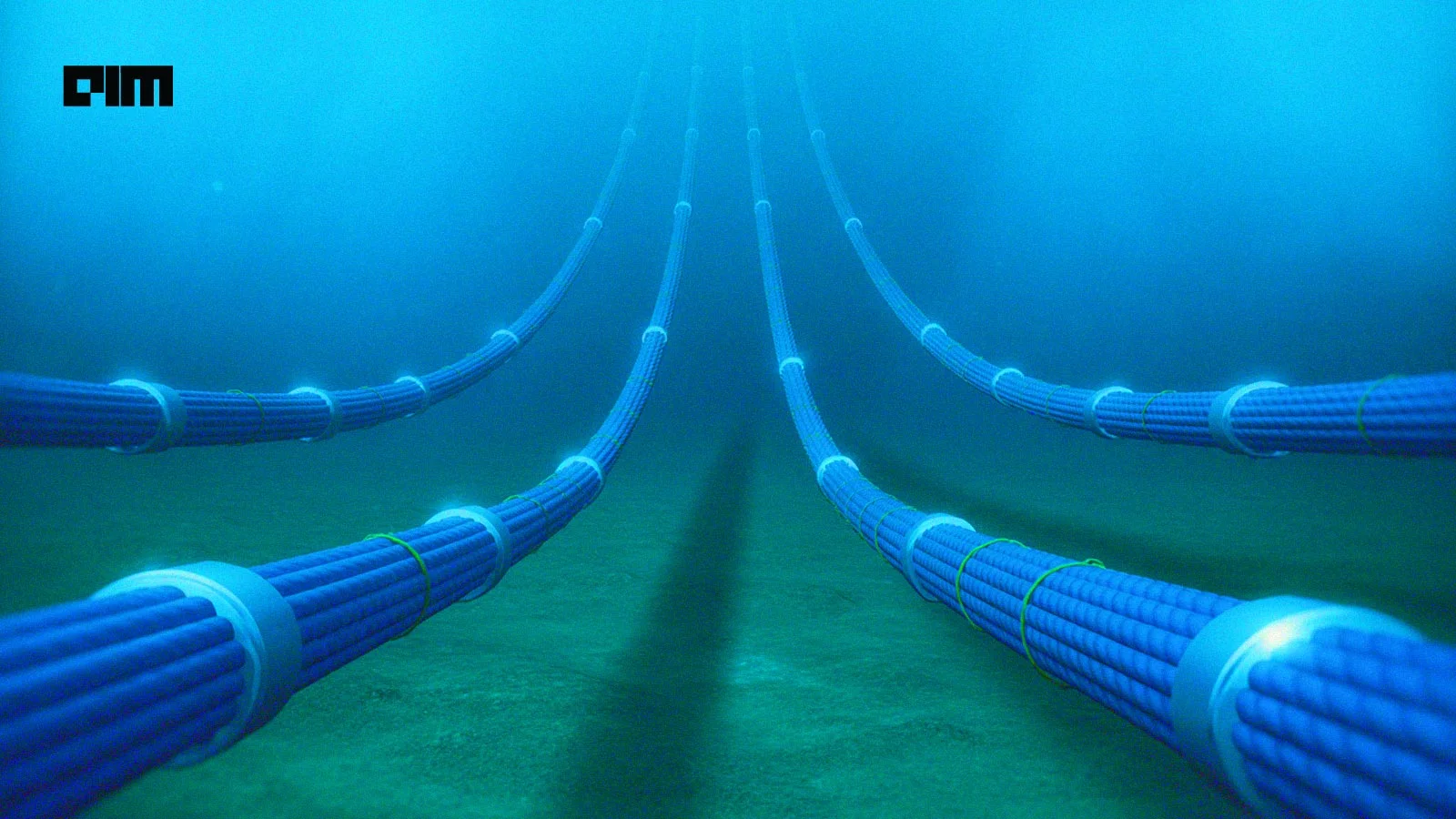
Big Tech has its eye on tapping India as a connectivity hub. Google has committed $15 billion to its America-India Connect initiative, including laying out three new subsea paths to connect India to Singapore, South Africa, and Australia. Meta is also laying 50,000 kilometres of cable network through Project Waterworth, with landing points in Mumbai and Vishakhapatnam. Airtel, alongside the Adani Group's joint venture, AdaniConneX, is establishing a cable landing station (CLS) in Visakhapatnam to host new international submarine cables.
While high-capacity cables from India can prevent data bottlenecks, the connectivity story is far more complicated, with approvals stuck in bureaucratic relay races, last-mile fibre gaps, and a capacity pipeline that doesn’t match the demand that has actually landed on Indian soil.
The Bureaucratic Obstacle Course
Fifteen of India's 17 operational subsea cables land within a six-kilometre stretch of Mumbai's Versova coastline. It is the result of a licensing regime so fragmented that international cable consortia have repeatedly chosen that single familiar corridor over the administrative effort of choosing a new landing station.
“Getting a cable into Indian waters currently requires upwards of 50 clearances spanning the Department of Telecommunications, the Ministry of Defence, the Ministry of Home Affairs, coastal state environmental bodies, and local port authorities. The Coastal Regulation Zone framework alone can consume 12–18 months for a foreshore environmental clearance. Projects that are ready at sea routinely wait on paperwork ashore, pushing back go-live dates that data centre customers have already written into capacity contracts,” Sunil Tagare, Founder and CEO of telecom infrastructure company OpenCables, tells AIM.
The 2Africa Pearls Gulf extension, with a designed capacity of up to 180 Tbps, offers another example of the infrastructure disconnect.
It was expected to land in Mumbai in 2026 to boost the country's bandwidth capacity. By November 2025, the core 2Africa ring was complete, touching 33 countries. The Pearls extension lay substantially in place on the seabed. Then the US-Israel-Iran conflict rendered the Persian Gulf cable-laying operationally dangerous. Alcatel Submarine Networks, which was installing the undersea fibre-optic communication cables, invoked force majeure. India had to then forfeit the capacity it had spent years constructing, not because approvals had failed, but because the pipeline had no slack to absorb a single external shock.
Moreover, India's multi-authority approval process was designed to diversify the cable network.
TRAI Chairman Anil Kumar Lahoti, at the First International Subsea Cables System Conference in New Delhi, said, "To safeguard our strategic and commercial interests, geographical diversity of subsea cables and increasing Cable Landing Stations are important. Recent global cable disruptions have underscored the necessity of a robust network."
However, instead of diversifying, the cable networks are concentrating on a few select locations. A part of the reason is the Captive Telecommunication Services Rules, finalised in early 2026, that allow hyperscalers to build dedicated subsea networks without a full telecom licence. TRAI's new two-tier CLS model lets operators set up a faster CLS Point of Presence (CLS-PoP) inside a private facility without the full maritime permit burden.
The Bandwidth Maths
India's current lit subsea capacity stands at approximately 193 Tbps across 19 international cable systems, up from 138 Tbps at the end of 2022. The national ambition is a fourfold increase, placing India at roughly 750–800 Tbps of available international bandwidth this decade.
The pipeline is credible. The India-Asia-Xpress and India-Europe-Xpress add high-capacity routes to Southeast Asia and Europe. Airtel’s SEA-ME-WE-6 landed at Chennai last year. Google's Blue-Raman cable, in partnership with Sify Technologies, landed in Mumbai.
“Meta's Project Waterworth—a 24 fibre-pair architecture—will be among the highest-capacity systems on the planet once complete. Google's America-India Connect adds three further systems at a new gateway in Visakhapatnam, including the first-ever direct India-Australia link.
The honest question is whether supply is matched by activated demand. Data centre capacity stood at 1.3 GW in early 2025 and is projected to exceed 4.5 GW by 2030, with more than $23 billion in investment announced,” notes Ajay Varma, Data Centre Operational Specialist with NTT Data.
But as the Lowy Institute noted in 2026, "there is a temptation to frame these developments as indicators of an imminent AI revolution in India. That would be premature." The compute actually generating live international traffic today is a fraction of what has been announced.
“India has tremendous potential to become a foremost global transit node for subsea connectivity. For this, there is a need to increase the capacity of our subsea infrastructure by 4–5x, improve resilience, and introduce redundancy in our subsea cable networks, following global trends," comments Aruna Sundararajan, Chairperson of Broadband India Forum.
How the Deals Work
The traditional model is the consortium IRU—an Indefeasible Right of Use. A 20-to-25-year grant of exclusive, non-returnable capacity on a cable segment, with an upfront capital payment plus ongoing maintenance costs. This is how Airtel acquired capacity on 2Africa and how Tata Communications has monetised positions in cables like TGN-Intra Asia.
Costs are predictable; stranded capacity risk is real if routing shifts.
The model setting the template for the hyperscaler era is vertical integration with equity co-ownership. Google's America-India Connect is not a capacity purchase. Google is building its own cables, its own landing station in Vizag, and co-locating adjacent to its own gigawatt data centre campus. This eliminates backhaul tolls entirely.
Previously, a cable landing at a telco's CLS carried a premium charge to move data inland. Under the new CLS-PoP framework, Google's fibre runs directly from shore into its own facility. The Airtel-Google Vizag venture is neither a pure IRU sale nor a traditional telco build.
The third model is private equity-backed independent infrastructure. Datawave Networks' January 2026 announcement of the Singapore-India-Gulf system, backed by Cerberus Capital Management, is the archetype: an independent operator building open-access cable and selling capacity to carriers without owning data centres at either end.
What India Must Actually Do
India's geography is exceptional for a transit hub. Positioned between Europe and East Asia, flanking the Indian Ocean on both coasts, it sits astride the dominant trunk routes of global internet traffic. Singapore achieved hub status not through superior geography but through regulatory speed and open infrastructure. India holds just 1% of global cable landing stations.
The gap can be narrowed, but the current single-window clearance system, with a statutory 90-day ceiling for cable landing approvals, still requires roughly 50 individual sign-offs.
Then there’s the question of maintaining the subsea cables.
“India has two vessels capable of responding to cable faults. Foreign ships from Dubai and Singapore take three to five months to reach fault sites. A TCIL study proposed a procurement budget of Rs 3,000 to Rs 4,000 crore—a rounding error against the sector's Rs 3,72,097 crore annual revenue. It’s deferred every year,” laments Santosh Agrawal, MD at IT computing infrastructure provider Esconet Technologies.
Alongside the need to geographically expand landing infrastructure, such as Odisha's plans for a CLS at Puri, the focus should also be given to terrestrial last-mile fibre.
“A cable landing without high-capacity inland connectivity to data centre campuses in Bengaluru, Hyderabad, and Pune is an expensive dead end. The invisible constraint on subsea investment resolves on its own,” adds Agrawal.
Singapore's dominance rests on it being the correct routing waypoint, not merely because Singaporeans need bandwidth. India's southern coastline and the Andaman Islands offer transit routing potential that remains almost entirely commercially undeveloped. There lies the treasure of building a capacity pipeline.

Your reaction
Discussion
What's your take on this story?
No comments yet — be the first to share your view.