

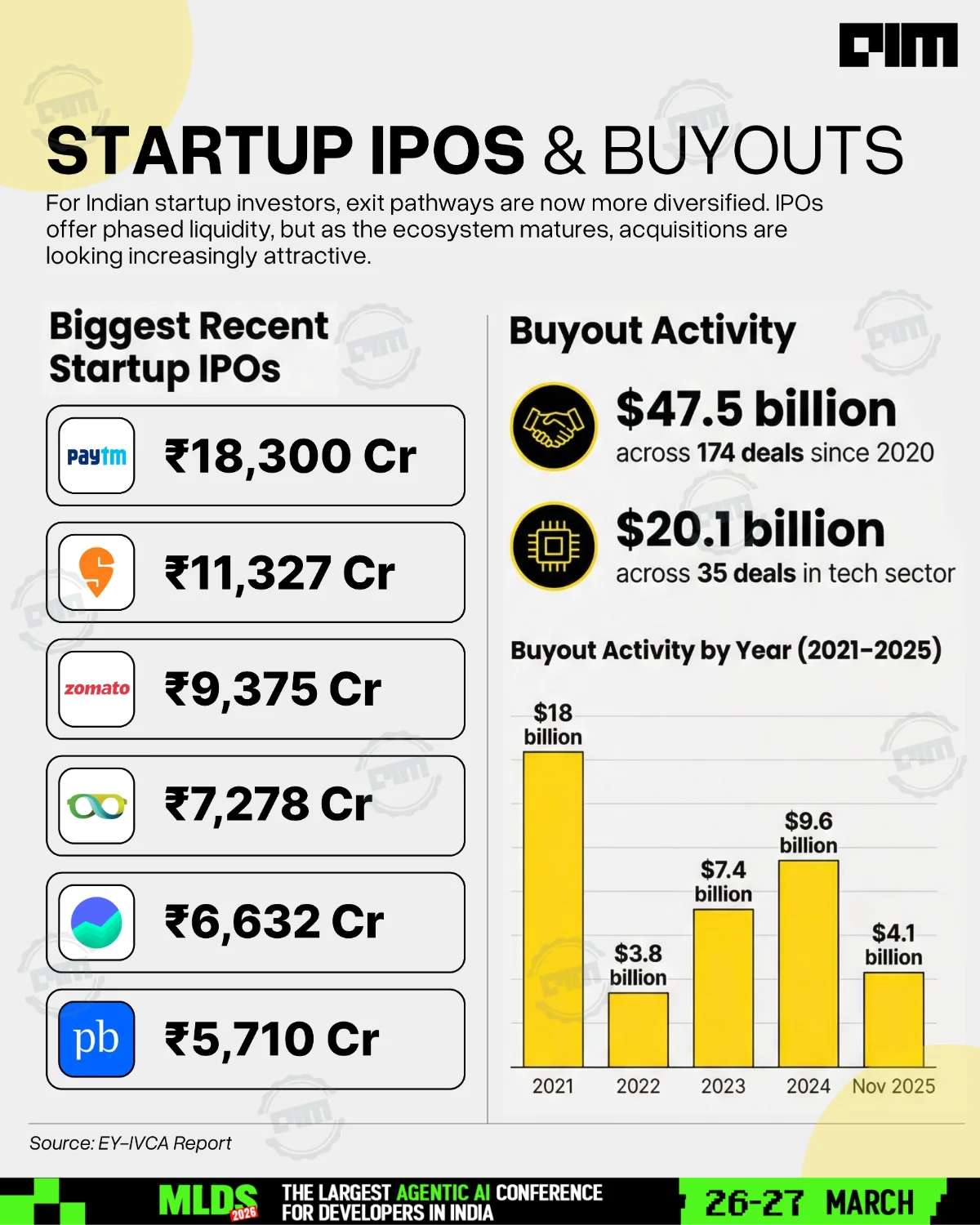
As India’s buyout ecosystem matures, exits have evolved from celebratory milestones to stress tests—for both companies and investors. After a decade marked by public market exuberance, valuation spikes, abundant liquidity, and then abrupt corrections, private equity investors are confronting a harder truth: liquidity cannot be assumed, and IPOs are no longer the endgame.
Now, strategic sales are gaining prominence.
The new playbook emphasises strategically engineering exits from the very beginning. It advocates for discipline over greed, prioritising EBITDA over superficial optics, and valuing certainty over compelling narratives.
At the IVCA Buyouts Summit in February, the most animated conversations were not about entry multiples, sector bets, or fundraising momentum. It was about exits. At the conference, some of India’s most seasoned investors, with several buyouts up their sleeve, dissected what liquidity now means in a market that has seen both IPO euphoria and sudden volatility.
IPOs: Aspirational, But No Longer Assumed
Public listings once symbolised arrival. Now, investors tread them caution rather than confidence.
Imran Jafar, Managing Partner and Executive Director, Gaja Capital, made a stark observation. “Can you bet on IPO markets? No… there’s 20 years of data, and therefore optionality is an important part of our underwriting.”
Similarly, Sumeet Narang, Founder, Managing Director and Co-CIO, Samara Capital, reinforced that IPOs rarely represent full liquidity. “When you’re taking your business public, 100% ownership has to be a phased exit… you need to have a three- to four-year horizon,” he said, emphasising that listing is a liquidity platform, not an endpoint.
The structural tension between innovation-led companies and public markets is even more pronounced in AI and deep tech sectors. Vivek Soni, Partner and National Leader - Private Equity Services at EY, tells AIM, “India’s public markets have historically been somewhat misaligned with the business models of AI and deep tech companies.”
He explains that these companies are R&D-intensive, capital-hungry, and operate on long gestation cycles, while Indian public markets have traditionally rewarded capital-efficient, cash-generative businesses with near-term earnings visibility. That mismatch, he says, creates valuation pressure for firms prioritising IP creation and experimentation.
At the same time, Soni adds that regulatory reforms, higher institutional participation, and growing investor familiarity deep tech innovation are gradually improving alignment.
Certainty Over Sentiment
At the summit, Pancham Mukim, Head of India (PE) and Senior MD at Everstone Capital, reflected that exit thinking begins at entry. “We almost do underwriting of the exit thesis as much as we do underwriting of the asset,” he said.
In practice, sponsor-to-sponsor transactions, or secondary buyouts, have often proven to be the fastest route, particularly for mid-market funds. Speed and certainty are often more valuable than theoretical valuation upside.
Jafar shared a candid lesson from the sale of John Distilleries. After initially overestimating private equity appetite for the sector and losing nearly a year, his team pivoted to a dual-track strategy, running an IPO alongside a strategic sale. Ultimately, he said, “The strategic option not only had better commercial terms but also a better fit.”
Soni says the growing tilt toward strategic sales and roll-ups is partly cyclical and partly structural. Strategic buyers, he says, offer valuation support based on synergies and integration potential rather than on pure market sentiment. In volatile IPO conditions, that certainty becomes especially attractive.
Roll-Ups and Continuation Vehicles
Newer mechanisms are also reshaping how exits are executed.
Continuation funds, once rare in India, are becoming part of the toolkit. They are special investment vehicles created by PE funds to hold onto high-performing portfolio companies beyond the original holding period. Narang said they are only relevant in exceptional cases, “one in ten” businesses, where funds seek to monetise partially while continuing to ride long-term growth.
Mukim, however, emphasised discipline. “Deliver distributions to paid-in capital (DPI). Move on. Our first fiduciary is to our LPs,” he said. Seller’s remorse, he implied, cannot override fund economics.
On roll-ups in AI and deep tech, Sanjay Bansal, Founder and Managing Partner at Aurum Equity Partners, tells AIM, “Roll-ups have been a very effective value creation strategy in more mature markets.”
However, he cautions that India’s deep tech ecosystem remains relatively early-stage. Many companies are still stabilising their core offerings and building organic scale before consolidation becomes viable.
Integration complexity across technology platforms, product architectures, and talent remains a significant challenge, he says. Consolidation may become meaningful over time, but the ecosystem must mature further.
Operations Over Optics
Despite persistent debates about overvaluation, panellists said the need is to focus on fundamentals.
“The biggest driver of our multiple on invested capital and DPI (distributions to paid-in capital) has been operating leverage… we describe our business as buying revenue and selling EBITDA,” Jafar framed it succinctly.
Pankaj Patwari, Managing Director of Advent International, echoed that view, arguing that while multiples may appear high, operational improvement—not multiple expansion—drives outcomes.
Market timing, in this framing, is less about predicting valuation peaks and more about discipline. As the leaders put it, when the lights are green, you sell.
Structural Overlay: Currency and Tax
Beyond markets, structural drags remain part of the equation. Rupee depreciation continues to affect the internal rate of returns in dollars. Some funds are underwritten in rupees; others explicitly factor in annual depreciation when modelling returns.
On taxation, Narang acknowledged that recent judicial developments have introduced interpretive complexity, turning structuring into a more process-driven exercise. He was hinting at the recent Supreme Court decision in the Tiger Global case, where the apex court emphasised that investment decisions, not Tax Residency Certificates, would determine capital gains tax.
These variables reinforce why diversified exit pathways are no longer optional. As Soni tells AIM, secondary buyouts, strategic sales, and consolidation are now embedded components of the ecosystem rather than fallback options in case of disappointing IPOs.
The leaders had crystallised a clear set of guiding principles: prioritise underwriting optionality and ensure value certainty while expanding EBITDA. Additionally, the goal is to deliver DPI when conditions are favourable.
“Keep your options open,” Jafar advised. “Optionality is a very powerful tool in your exit strategy.”
India’s buyout ecosystem is not retreating from IPOs, but it is no longer dependent on them.
- India’s Frontier AI Race Gets a 240M Model That Beats Liquid AI
- The AI Slowdown Narrative Doesn’t Reflect Enterprise Reality
- India’s Enterprises are Scaling AI. Is the Infrastructure Ready?
- Industry Wants Faster Approvals and Cheaper Power in India’s Data Centre Policy
- Inside Jio Platforms: Its Tech Bets, Loss-Making Subsidiaries and Hidden Risks
- India’s GCCs to Add 1.4 Million Jobs, Drive 170 Million Sq. Ft. Office Demand by 2031