
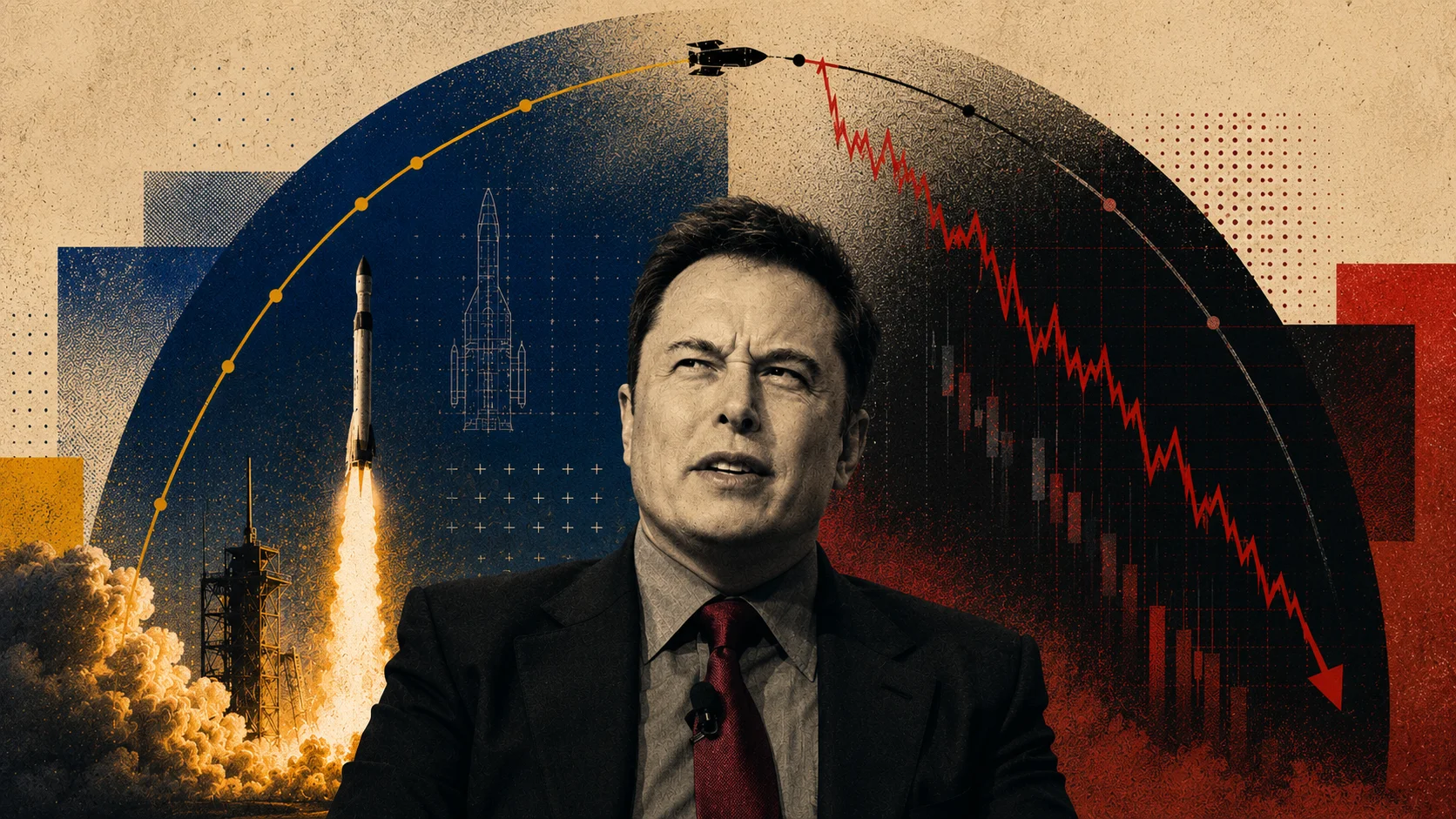
Elon Musk’s blockbuster SpaceX IPO debuted at $135 per share, and within two trading sessions, demand drove the price above $200.
At its peak valuation, the company—whose empire now spans reusable rockets, AI coding tools, and the controversial social media platform X—was hit by a brutal sell-off that wiped nearly $1 trillion off its market capitalisation in just a few days. This decline represents one of the fastest capital contractions in market history.
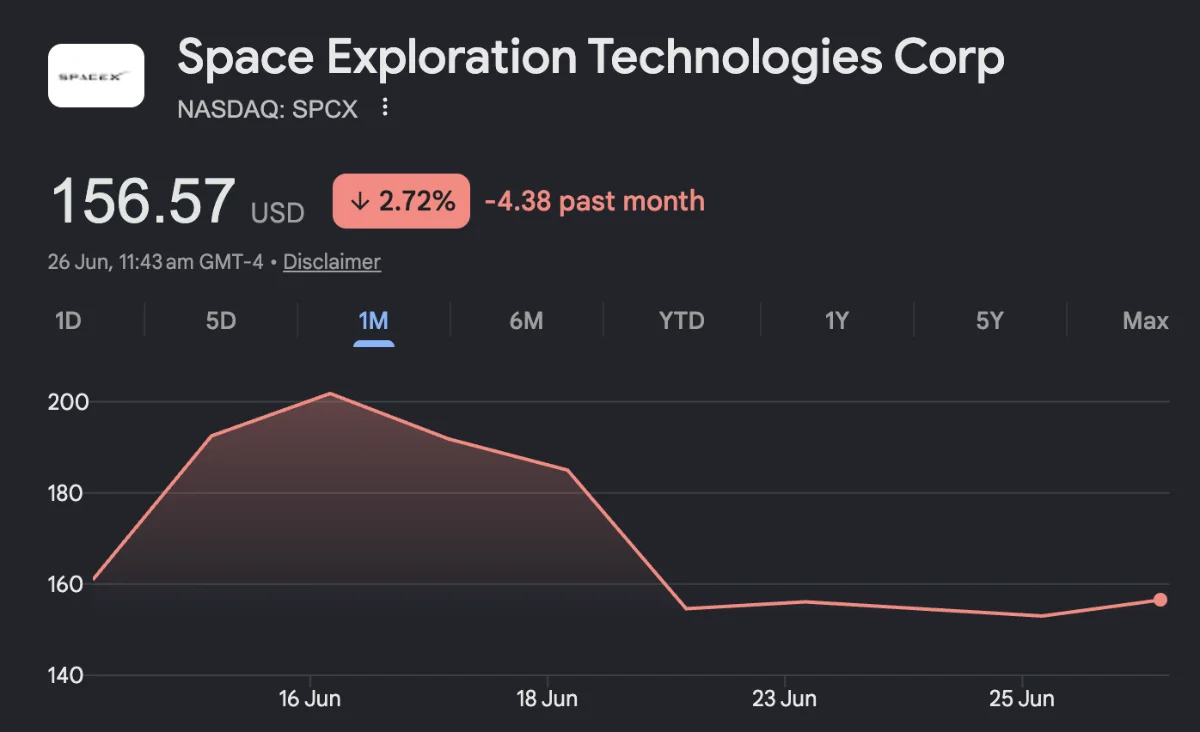
However, investors are still debating what triggered the sell-off. Some blame SpaceX's announcement of its first-ever investment-grade bond sale, which aims to raise $25 billion to refinance an earlier bridge loan. Instead of creating new shares, which would shrink the value of what current investors own, SpaceX is essentially taking out a massive, lower-interest corporate loan to pay off its older debts.
Campbell Harvey, a Canadian economist and a professor of finance at Duke University, isn’t surprised that the company is going to the bond market. “It is well documented that after an IPO, on average, the ratings for borrowing improve,” he tells AIM.
How IPO Improved SpaceX’s Rating
SpaceX’s balance sheets will soon be public, with its second-quarter earnings right around the corner. This has prompted the major credit agencies to open the door to institutional investors. Moody’s assigned SpaceX a first-time investment-grade Baa1 rating, while Fitch issued a BBB+ and S&P Global stepped in with a BBB.
“This means that post IPO, the interest rate that they would pay on corporate borrowing decreases,” adds Harvey.
Numerous academic studies have demonstrated that an IPO establishes what economists call ‘value certainty’. By subjecting its balance sheet to rigorous public disclosure, a newly public firm slashes information asymmetry for lenders, allowing it to migrate away from expensive private debt and unlock highly favourable institutional credit terms.
Beyond restructuring older debt, Harvey also observes that looking at other companies across the broader economy makes it clear that a major capital expenditure push is underway.
SpaceX is among many firms turning to the bond market to raise the immense capital required to build out massive computing capacity. AI infrastructure companies, including hyperscalers, data centre operators, and semiconductor firms, raised roughly $159 billion in debt this year already.
Across multiple bond offerings since late 2025, Amazon has raised roughly $57 billion from debt markets, while Alphabet raised over $52 billion to fund its physical infrastructure footprint, even taking the rare step of issuing a highly secure 100-year ‘century bond’ to fund its multi-decade AI computing timeline.
Meta too tapped the debt market with a massive $30 billion investment-grade bond initiative, choosing to lock in institutional debt to power its immense GPU clusters rather than relying strictly on operational cash flow or stock issuance.
Following its consolidation of xAI and its recent blockbuster acquisition of the AI coding platform Cursor, SpaceX's financial footprint has fundamentally shifted from a traditional aerospace operation to an AI infrastructure behemoth.
SpaceX’s AI capex hit a staggering $7.7 billion in just the first quarter of 2026 alone, positioning its annualised AI spending at over $30 billion.
To feed this insatiable appetite for AI clusters like its massive Colossus megadata centre, SpaceX is tapping the public bond market alongside other tech titans.
Moreover, the $25 billion bond deal isn’t actually piling new debt onto SpaceX's back.
“The bond is a refinance of the bridge loan, which removes an uncertainty about when that might happen and won’t add to the debt burden as the bridge is being paid off,” notes Nicolas Owens, equity analyst at financial services firm Morningstar.
Instead, the bond is a direct swap. SpaceX is using this multi-part bond sale to permanently wipe out the temporary $20 billion ‘bridge’ loan it took out earlier to clean up high-interest debt from its xAI and X mergers.
By trading a short-term, ticking-clock loan for long-term corporate bonds, the company completely eliminates the risk of a sudden cash crunch when the old loan comes due in 2027, all while keeping its total debt balance unchanged.
However, other experts suggest that borrowing such a massive sum right after hitting peak valuation signals deep underlying pressure on cash flow. They point out that for a venture as capital-intensive as SpaceX, the spectacular post-IPO momentum has quickly evaporated, and the brutal costs of running its empire are now hitting hard.
The Double-Edged Sword Called Thin Float
Besides, SpaceX went public with an incredibly thin public float, meaning only a tiny fraction of its total shares were actually available to trade on the open market.
When a generation-defining company with a massive cult following hits the public market, the sheer volume of buy orders creates an extreme demand squeeze.
“I think the thin float, especially for such a high-profile company, has a big effect on the share price volatility, probably both on the upside and the downside,” says Owens.
The lack of available shares was a massive double-edged sword, supercharging the initial rally when buyers flooded in, but completely removing the floor during the sell-off. Analysts consistently cite this exact mechanic when evaluating historic, low-float IPOs that experienced massive boom-and-bust cycles.
A few years ago, Rivian and Arm Holdings both experienced sharp post-listing rallies as limited public floats amplified buying pressure, prompting analysts to argue that scarcity, rather than fundamentals alone, was driving valuations. As additional shares became available and investor enthusiasm cooled, those stocks experienced significantly greater volatility than companies with larger public floats.
In the case of SpaceX, its valuation has become untethered from traditional financial metrics, trading at a price-to-sales ratio near 104x—a figure nearly double that of the most expensive stocks in the S&P 500.
While the market has priced the company at over $2 trillion, analysts at Morningstar have placed its fair value significantly lower, at approximately $780 billion.
Cursor Deal is Pocket Change
Having said that, there is also a debate about whether the recent all-stock acquisition of Cursor may have triggered the downfall.
Days after its IPO, SpaceX announced that it would acquire AI coding startup Cursor for $60 billion, based on a previous agreement that stated SpaceX held the right to either purchase the company outright for that price or pay $10 billion for a joint partnership to integrate compute and AI-training resources.
However, analysts doubt whether this deterred the selloff. “The $60 billion acquisition is not surprising, it was expected. Furthermore, for a company that is worth over $2 trillion, $60 billion is a rounding error,” says Harvey.
“I don’t think that SpaceX’s recent stock declines are a reaction to the Cursor acquisition; more so, they seem related to overall market sentiment,” Owens concurs.
Besides, there are concerns that the acquisition, or the capital-heavy investments into compute infrastructure, will mark the major cash flow that Starlink provides to cross-subsidise the other initiatives.
Starlink, currently the company’s only profitable segment, hit 10.3 million subscribers by the end of Q1 2026. While the service remains a financial powerhouse, generating $1.19 billion in operating income for that quarter alone, its profitability is facing pressure as the business expands into price-sensitive global markets.
As of Q1 2026, Starlink’s average revenue per user (ARPU) has declined to $66, down from $86 a year earlier, signalling that the company is trading higher margins for aggressive subscriber volume to feed its broader AI ambitions.
In the long run, however, Harvey believes that it is wise for the company to protect this cash flow, despite its other ventures. “I don't think that SpaceX will do anything to compromise the viability of Starlink.”
Sinking Together
In recent days, the overall market sentiment has been shaped by a broad reassessment of the AI trade and heightened macroeconomic uncertainty. Investors have increasingly questioned whether the hundreds of billions of dollars being poured into AI infrastructure can ultimately generate returns that justify current valuations, even as soaring DRAM and HBM memory prices make AI deployments more expensive.
At the same time, lingering uncertainty following the Iran conflict and disruptions around the Strait of Hormuz has stoked fears that higher energy prices could feed into inflation, raising concerns that the US Federal Reserve may have to keep interest rates higher for longer or even tighten policy further. Although oil prices have since eased following signs of a truce and the gradual resumption of tanker traffic through the strait, the geopolitical uncertainty has kept investors on tenterhooks.
Investors are now busy locking in gains and rebalancing portfolios ahead of quarter-end, triggering a broad sell-off across AI and semiconductor stocks.
Alphabet suffered its worst single-day decline in more than a year following high-profile AI talent departures, NVIDIA slid more than 4%, while Micron Technology fell 13% in its worst trading session in over a year.
The rout spread globally, with Samsung Electronics and SK Hynix each dropping more than 12%, dragging South Korea's KOSPI sharply lower as investors rotated out of some of the market's biggest AI winners.
For SpaceX, a rebound may be on the anvil as Starlink’s revenue pipeline remains intact. However, it may not escape volatility just yet.

Your reaction