
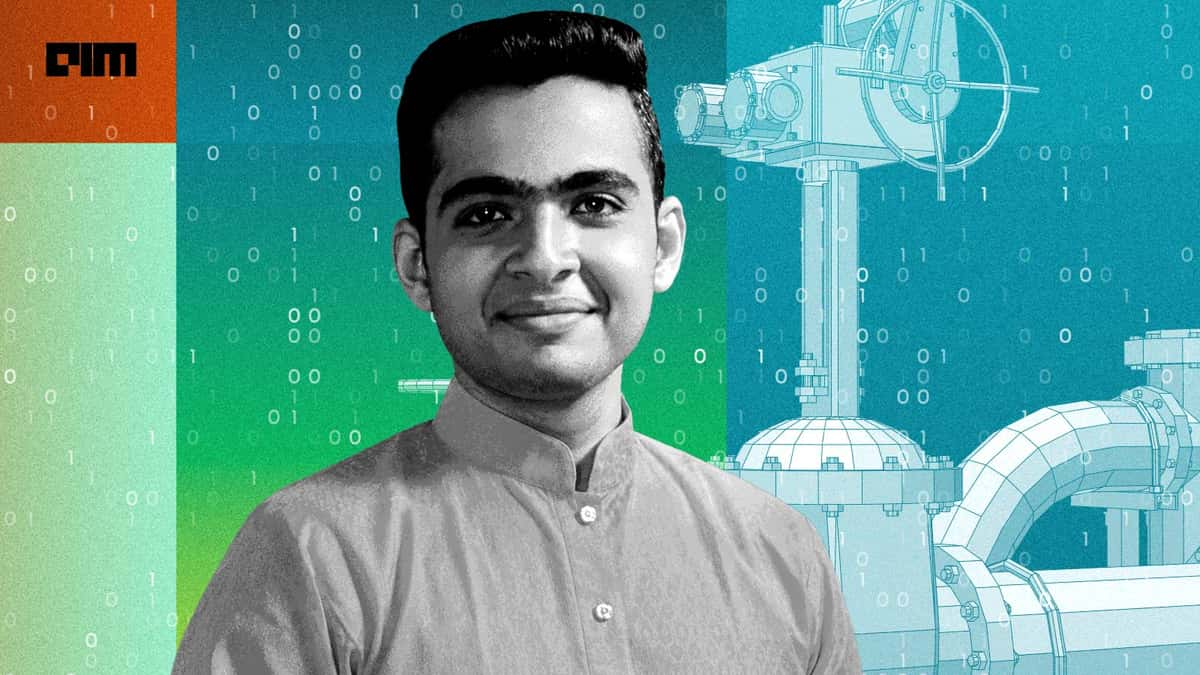

In India, pipelines carrying water, oil, gas, and chemicals often suffer from ageing infrastructure and third-party excavation damages, leading to environmental disasters. But an 18-year-old from Rajasthan may have the solution.
Maheep Purohit, who recently finished his Class 12 studies, has secured an Indian patent for an artificial intelligence-powered system that could help prevent pipeline failures.
His invention, called the Adaptive Intelligent Pipeline Integrity System (AIPIS), uses AI, sensors, and predictive analytics to monitor pipelines carrying water, fossil fuels, and industrial chemicals. The system is designed to identify early warning signs, allowing engineers to fix issues before they turn into expensive and potentially dangerous failures.
Purohit’s journey began not with a business idea, but with a simple question.
“Why do we repair pipelines after they fail instead of predicting failures before they happen?” he says in a conversation with AIM.
According to the US Pipeline and Hazardous Materials Safety Administration, pipeline failures average around 1.45 incidents per day, resulting in massive water loss, environmental damage, safety hazards, and financial losses for industries.
When he was 15, Purohit was exploring AI capabilities and wondered whether it could help industries move away from reactive maintenance. That curiosity eventually led him to develop AIPIS after years of self-learning, research, and experimentation.
AI-Powered Tracker for Pipelines
Pipeline monitoring is not a new concept, but Purohit believes many existing systems focus on monitoring individual parameters or detecting failures only after they have already occurred.
Take an underground water pipeline, for example. Most companies only know something has gone wrong after a leak develops or the pipe bursts. By then, valuable resources may already have been lost, and repairs become expensive.
AIPIS aims to change that. The system uses intelligent sensors placed along the pipeline to continuously collect information such as pressure changes, vibrations, and other operating conditions. AI then studies this data to understand what “normal” behaviour looks like.
“The current MVP of AIPIS uses XGBoost for predictive analysis and anomaly detection. As the technology evolves with real-world operational data, the AI framework is designed to continuously adapt and improve its understanding of pipeline behaviour,” Purohit adds, while choosing not to disclose the complete AI architecture and proprietary methodologies.
If the AI notices unusual patterns that may indicate corrosion, leaks, pressure abnormalities, or structural damage, it alerts engineers before the problem becomes critical.
“In simple terms, AIPIS acts as an intelligent health monitoring system for pipelines,” Purohit explains. He adds that AIPIS learns the normal operating behaviour of a pipeline and continuously analyses incoming data to identify subtle deviations that may indicate early-stage corrosion, pressure abnormalities, leaks, or structural degradation.
By identifying these warning signs early, industries can carry out predictive maintenance instead of emergency repairs, reducing downtime and preventing larger failures.
He also wants the technology to be more affordable so that advanced predictive monitoring could become accessible to a wider range of industries and public utilities.
According to Purohit, the Indian patent does not protect a single AI model or sensor. Instead, it covers the overall AIPIS architecture and methodology, including the integration of distributed AI, hybrid sensor networks, contextual self-learning, predictive analytics, edge intelligence, and intelligent communication.
“The innovation lies in how these technologies work together as one adaptive system to continuously understand pipeline behaviour and support proactive infrastructure management,” he explains.
From Prototype to Pilots
While AIPIS has received the patent and he has validated the technology using representative datasets and controlled prototype testing, Purohit says the work is far from complete.
“A software prototype and monitoring dashboard have also been developed to demonstrate the system’s capabilities,” the teenager notes.
The next objective is to move beyond testing and into real-world deployments. “We are looking to collaborate with municipal water boards and industry partners for pilot deployments under real operating conditions,” he remarks.
These pilot projects will help him validate the technology at scale, improve the AI using real operational data. and prepare the system for commercial deployment.
The first application of AIPIS will be municipal water distribution systems. Many Indian cities lose significant amounts of treated water every year because of ageing pipelines and undetected leaks.
“Our initial focus is on municipal water utilities, where reducing water loss and improving infrastructure efficiency can create immediate public impact,” he says, adding that he will start with his home town of Bikaner and also Jaipur.
In the long term, he envisions AIPIS becoming an intelligent operating layer for pipeline infrastructure—one that continuously understands pipeline behaviour, predicts failures before they happen and enables industries to shift from reactive maintenance to autonomous, AI-driven infrastructure management.
He is also actively seeking partnerships with infrastructure companies, technology organisations, and research institutions to accelerate product development and commercialisation.
Learning Across Disciplines
At just 18, developing AIPIS required Purohit to learn concepts across artificial intelligence, Internet of Things (IoT), sensing technologies, communication systems, pipeline engineering, and intellectual property.
“While I have received valuable guidance from mentors and experts throughout the journey, the research and development behind AIPIS has largely been an independent effort,” he comments.
A major challenge was developing a deeptech product with limited resources. “The biggest challenge was solving a multidisciplinary engineering problem,” he notes.
Looking back, he says every obstacle became part of the learning process, and the patent represents much more than an invention. It reflects years of dedication to solving a real-world engineering problem.
For Purohit, the larger goal extends beyond patents and recognition. It is about using artificial intelligence to solve everyday infrastructure challenges, helping industries save water, prevent accidents, reduce environmental damage and make critical infrastructure smarter.
- The AI Slowdown Narrative Doesn’t Reflect Enterprise Reality
- India’s Enterprises are Scaling AI. Is the Infrastructure Ready?
- Industry Wants Faster Approvals and Cheaper Power in India’s Data Centre Policy
- Inside Jio Platforms: Its Tech Bets, Loss-Making Subsidiaries and Hidden Risks
- India’s GCCs to Add 1.4 Million Jobs, Drive 170 Million Sq. Ft. Office Demand by 2031
- AI Can Be Cyborg or Centaur. But Can Enterprises Monetise It?