
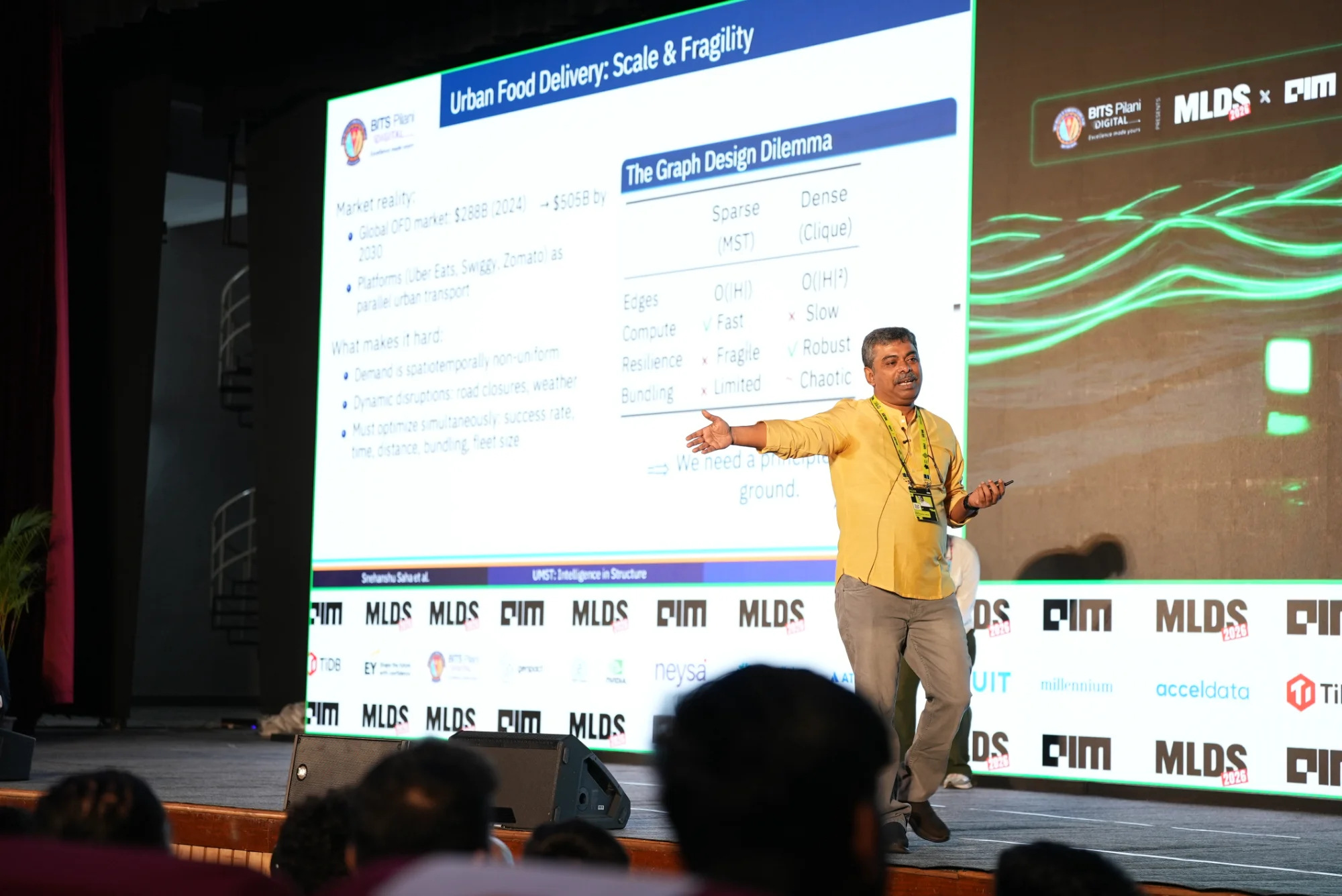
At MLDS 2026, organised by AIM in Bengaluru, two sessions by Head of AI Research (APPCAIR) at BITS Pilani, Snehanshu Saha, and Industry Expert Sreekanth Iyer from BITS Pilani offered a deeply complementary view of where agentic AI is headed.
While Saha argues that the future of intelligence lies in structure rather than increasingly complex models, Iyer approaches the same problem from a systems lens, emphasising the need for patterns and shared architectural vocabulary to make AI systems actually work in production.
Together, the sessions formed a coherent narrative about why the next leap in AI will not come from better models alone, but from better design.
From Models to Structure
Saha framed his keynote around a provocative thesis: “intelligence in structure, not policy.” His talk challenged the prevailing assumption that smarter agents necessarily require more training, larger models, or greater compute. Instead, he argues that the real breakthrough lies in designing environments that enable even simple agents to perform effectively.
Saha traces the evolution of agentic AI through three waves. The first, ‘policy intelligence’, focused on training increasingly sophisticated agents using reinforcement learning and neural networks, approaches that are expensive, fragile, and difficult to scale.
The second wave, which he calls ‘structural intelligence’, shifts the focus from the agent to the environment. Here, intelligence is encoded in the system’s design, particularly in graph structures that guide decision-making. The third wave, ‘hybrid intelligence’, combines lightweight learning with well-designed structures, offering what he described as “the exciting frontier.”
To ground this argument, Saha presents his work on the Union of Minimum Spanning Trees (UMST), a method for designing robust and efficient routing systems. Rather than relying on highly trained models, UMST constructs intelligence through graph design, combining multiple spanning trees to create resilient, efficient pathways. His results showed that this approach significantly reduces edge counts while preserving connectivity, enabling scalable routing at lower computational cost.
He contrasts this with existing approaches such as reinforcement learning and graph neural networks, which either fail to scale, require retraining across environments, or produce suboptimal outcomes, such as long delivery times. In one example, reinforcement learning improved routing efficiency by only 11%, compared to 43% achieved by UMST. The implication was clear: better structure can outperform better learning.
Saha also contextualises his argument within India’s unique constraints and opportunities. High demand, chaotic urban environments, and cost pressures make India an ideal testing ground for structural intelligence. “If your system works in Bengaluru, it works anywhere,” he suggests, pointing to the need for lightweight, efficient solutions over brute-force GPU scaling.
Patterns, Vocabulary, and Production Reality
If Saha’s talk redefined where intelligence should reside, Iyer’s session focused on how to operationalise that intelligence at scale. His talk, titled ‘From Singleton to Swarm: Patterns & Spec-Driven Delivery for Agentic AI’, addressed a critical but often overlooked problem: why most AI projects fail to reach production.
Iyer cites industry research, which shows that 80-85% of AI projects never make it to deployment, due to issues such as poor data pipelines, weak MLOps, and unclear value. However, he argues that the deeper issue is the absence of a shared pattern language, a standardised way of designing and communicating AI systems.
“It’s not the model. Not the data,” he emphasises. “The absence of a shared pattern language or vocabulary” is what holds the field back. This idea formed the core of his talk. Drawing parallels with previous technological eras, from structured programming to object-oriented design and cloud computing, Iyer showed how each wave succeeded because it developed a common set of patterns that engineers could reuse and understand globally.
In his talk, Iyer elaborated on the practical consequences of this gap. Many teams today can build AI demos quickly using tools like Copilots and cloud platforms, but struggle to scale them into production systems.
“You have a fantastic demo… but it is taking five days for you to understand what the agent has built and debugging,” he notes. This phenomenon, often referred to as “pilot purgatory,” reflects a lack of architectural thinking.
Iyer proposes that the solution lies in adopting pattern-driven development for agentic AI. Patterns, he explains, are reusable solutions to recurring problems, providing a shared vocabulary that accelerates adoption. Whether it is the Observer pattern in OOP or API gateways in microservices, such constructs allow developers across geographies to build interoperable systems.
Extending this idea to agentic AI, Iyer calls for a shift from isolated “singleton” agents to coordinated “swarms” of agents, governed by well-defined specifications and interaction patterns. This approach aligns closely with Saha’s emphasis on structure, suggesting that intelligence emerges not from individual agents but from the systems they inhabit.
From Smarter Agents to Smarter Systems
Another key insight from Iyer’s talk was the accelerating pace of technological change. He showed how each computing paradigm, from structured programming to AI, has arrived faster than the previous one, compressing the time engineers have to adapt. In this context, patterns become essential not just for building systems, but for learning and keeping up with rapid change.
Taken together, the two talks offered a unified message. Saha’s work on structural intelligence provides a theoretical and practical framework for building efficient AI systems without over-reliance on heavy models. Iyer’s emphasis on patterns and shared vocabulary provides the engineering discipline needed to scale those systems in the real world.
Both speakers also subtly challenged the dominant narrative in AI. While much of the industry remains focused on scaling transformers and increasing compute, these talks suggested that the real breakthroughs may come from rethinking fundamentals, system design, component interactions, and knowledge encoding.
At MLDS 2026, this convergence of ideas pointed to a future where AI is less about building smarter agents and more about designing smarter systems. In that future, intelligence is not just learned, it is engineered.

Your reaction
Discussion
What's your take on this story?
No comments yet — be the first to share your view.