Key takeaways
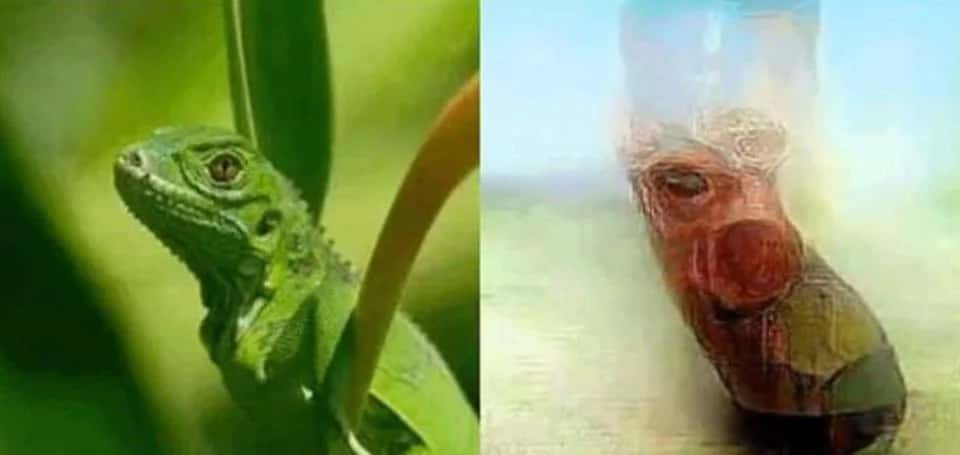
- Kyoto University researchers have demonstrated the ability to visualise perceptual content from human brain activity using fMRI analysis.
- The novel image reconstruction method optimises pixel values based on deep neural network features derived from brain activity.
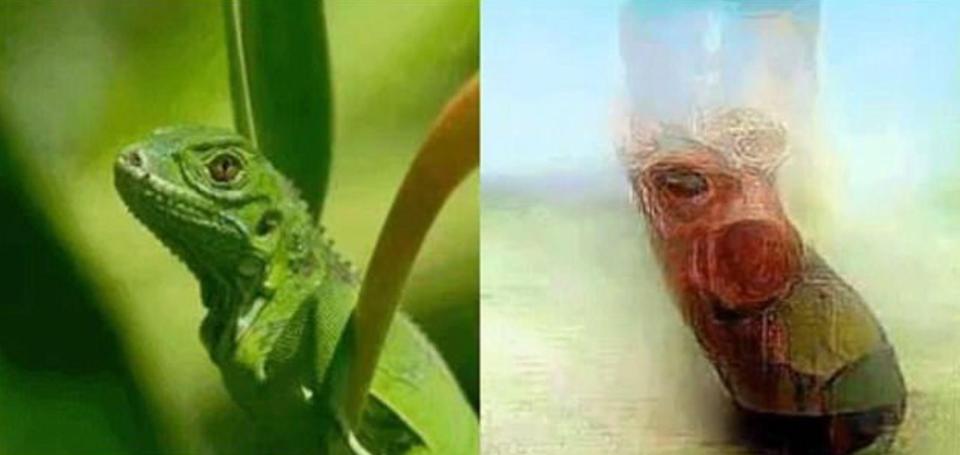
- Generated images closely resemble original stimuli, indicating successful reconstruction rather than mere matching.
- The study shows that hierarchical visual information in the brain can be effectively combined for perceptual reconstruction.
Visualisation : Greatest Challenge Of Neuroscience
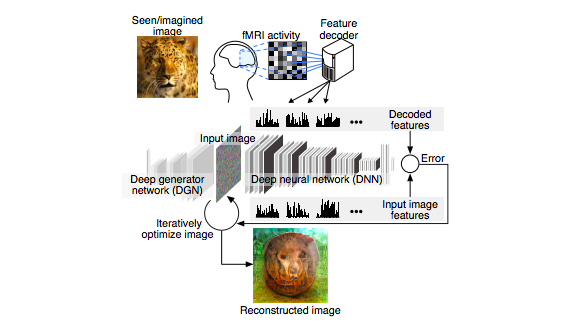
The externalisation and visualisation of states of the mind is a challenging goal in neuroscience. Although decoding and encoding methods that could render human brain activity into images existed, they were not very effective. But those methods were essentially limited to image reconstruction with low level image bases, hence failing to combine visual features of multiple hierarchical levels. The researchers present a novel approach, named deep image reconstruction, to visualise perceptual content from human brain activity. The researchers combined the feature decoding from fMRI signals and the methods for image generation recently developed in machine learning. The reconstruction algorithm starts from a random image and iteratively optimise the pixel values so that the DNN features of the input image become similar to those decoded from brain activity across multiple DNN layers. In this process the resulting optimised image is taken as the reconstruction from the brain activity. There was also a deep generator network (DGN) as a prior to make reconstructed images similar to natural images. The decoders are trained to predict DNN features of viewed images from fMRI activity.Stages of Experiments
The experiments that the researchers conducted were of 5 distinct stages :- Training natural image sessions,
- Test natural image sessions,
- Geometric-shape sessions
- Alphabetic-letter sessions
- Mental-imagery sessions
Effect of natural priors and multilayer networks on reconstructions
The effect of the natural image prior, with and without DGN was also measured. The results show that DGN based natural image prior is enormously useful and enhances perceptual similarity of reconstructed images. To understand the importance of having multiple layers of DNN a side study was also done. An independent rater was presented with an original image and a pair of reconstructed images, both from the same original image but generated with different combinations of multiple layers, and indicated which of the reconstructed images looked more similar to the original image. The assessment showed that reconstructions from a larger number of DNN layers were better rated.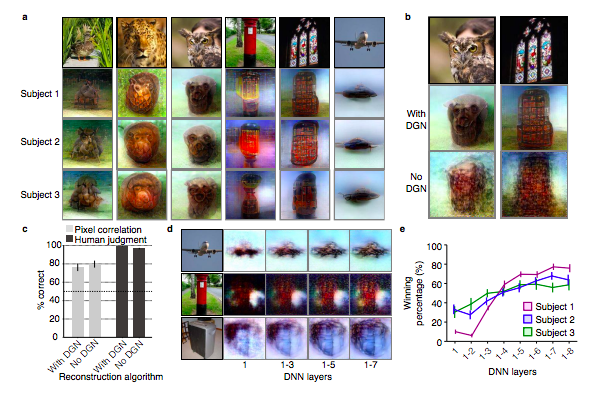
Conclusion :
This series of experiments in Kyoto developed a method to "see" inside people's minds using an fMRI scanner, which detects changes in blood flow in the brain. According to the team at Kyoto University, this breakthrough opens a "unique window into our internal world".Spotted an error? Tell our editors. Read our editorial standards and corrections.