
India’s AI story has been dominated by models, benchmarks and announcements. What has been missing is a serious conversation about what happens after deployment. The partnership between AI infrastructure companies Neysa and Pipeshift is trying to force that shift.
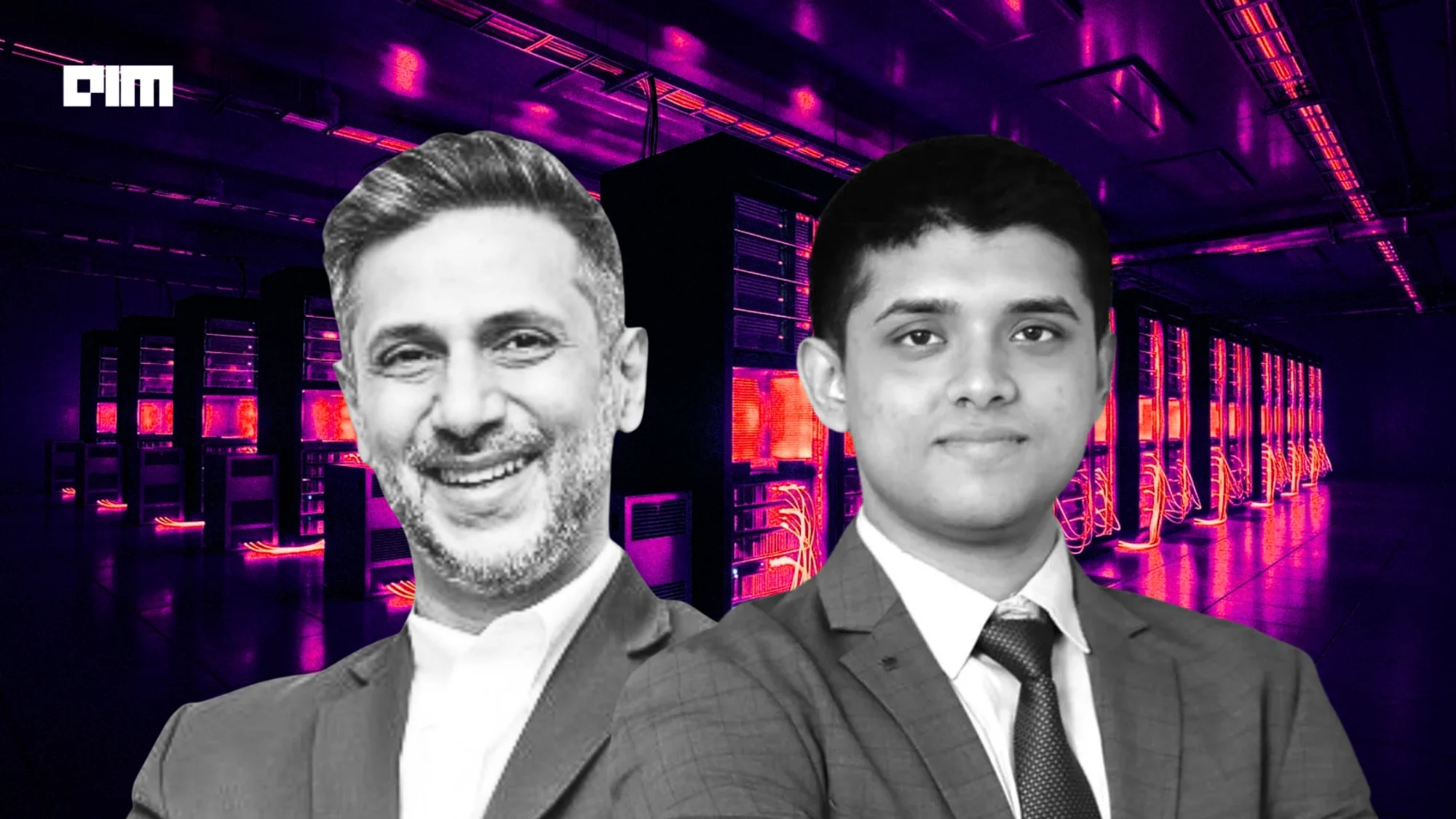
In an exclusive conversation with AIM, Neysa’s Chief Product Officer Karan Kirpalani and Pipeshift Co-Founder and CEO Arko Chattopadhyay repeatedly revisit the same idea: inference, not training, is where AI begins to break down.
The announcement positions the partnership as a production-grade, real-time inference stack fully deployed within India, designed for enterprises already scaling AI workloads. But the interview reveals why both companies think this moment matters.
“There is a clear line between AI that works in a demo and AI that works in production,” Chattopadhyay says. “Crossing that line takes more than a good model. It takes infrastructure that holds latency under load and keeps costs predictable at scale.”
That line, they argue, is exactly where most Indian enterprises are stuck today.
The Problem of Inference Economics
Kirpalani frames the partnership around what he describes as four core problems that enterprises face while scaling AI. “One is the runaway token cost… The sticker shock starts becoming exponentially more rude. It’s not linear,” he explains.
“Second is latency… performance is becoming a very critical bottleneck. Third are issues around compliance, governance, and sovereignty. And fourth is a problem around intellectual property rights.”
The release resonates with these concerns more formally, pointing to unpredictable latency, escalating token costs, shared infrastructure bottlenecks and overseas data routing as key barriers to production AI in India. The claim here is not subtle. This is not about improving models. The focus is on fixing the economics and control layer around them.
Kirpalani explicitly speaks about the company’s approach to the solution. “We look at this in terms of how do we solve not for two out of four or three out of four… how we solve for all four issues,” he says.
That is where the Neysa-Pipeshift stack comes in. Pipeshift brings the inference layer, while Neysa brings the AI-native GPU infrastructure. Together, they are trying to create a system where enterprises can run open-source models in single-tenant environments within India, without taking on the operational overhead themselves.
‘A GPU With an LLM is Not Equal to Production’
If Kirpalani’s argument revolves around economics and control, Chattopadhyay’s centres on engineering reality.
“There’s this whole narrative… ‘I’ll just get GPUs and use an LLM.’ But what they don’t understand is that just the LLM on a GPU is not equal to production,” he says.
He broke down what production-grade AI actually requires. Enterprises need ultra-low latency under high load, across percentile tails like P50, P90 and P99, while maintaining service level agreements at scale. They need infrastructure that can handle spikes without collapsing performance. More importantly, they need all of this to work consistently, not just in controlled demos.
That, according to Chattopadhyay, is the “last mile of inference” Pipeshift is trying to solve. To justify that claim, he points to the scale the company is already operating. “Pipeshift is processing like north of 40 billion tokens per day at the moment.”
The design of the joint platform reflects that focus. It is built for latency-sensitive workloads like voice AI, copilots and enterprise automation, expanding on Velocis, Neysa’s AI Acceleration Cloud System. It auto-scales during demand spikes and keeps data and inference within India, avoiding cross-region delays and compliance risks.
Early deployments on the platform already include production AI workloads across voice AI and enterprise automation. Nurix AI achieved a 3x reduction in Time to First Token (TTFT) for its voice AI deployments in India. “We needed sub-second LLM latency for voice agents in production, and real-time inference from Neysa and Pipeshift cut our TTFT 3x versus our prior setup in India,” said Pushkar Patel, Nurix AI.
The Shift from Training to Inference is Already Happening
One of the more telling moments in the interview came when the discussion moved towards where the industry is headed next.
“People are always talking about training models,” Kirpalani says. “Right now, we are actually coming to the part where we are going to talk about inference.”
He frames the distinction in financial terms. “Training is a capital expenditure, but inference is an operational expenditure. Inference is the one that dictates what your unit economics will be.”
This explains why the partnership is arriving at this particular time.
Indian enterprises are no longer experimenting with AI. They are deploying it. And once deployment begins, the cost curve and latency curve become immediate business concerns. Chattopadhyay reinforces that shift with a more blunt observation. “Nobody was looking at this from the perspective of what happens when real-time workloads break.”
That very gap is what Pipeshift is trying to bridge.
Not Every Prompt Needs GPT-5
A large part of the conversation focused on cost and the idea that enterprises are overusing frontier models.
Pushing back against the default approach, Kirpalani says, “Not every prompt, and not every request for every business use case needs to go to GPT-5 or Claude 4.7 or Gemini-3.5.”
Instead, he argued for a more deliberate model mix. Enterprises can route a significant portion of their workloads to open-source models running on dedicated infrastructure, while reserving frontier models for more complex tasks.
This is not merely theoretical. Kirpalani cited real numbers. “We worked with enterprises whose token bills were… $70,000, $80,000 a month,” which is close to a million dollars a year. He brought in a startup perspective, noting that even seed-stage companies are “spending ₹40-50 lakh per month on token bills”.
The implication is tough to ignore. AI is already expensive at scale, and the current pricing model is not stabilising in the way many initially expected.
Chattopadhyay was direct about that reality. “Token costs are not coming down… It is true that the token cost for the same model is going down, but that model gets deprecated, and the next model is more expensive.”
The Neysa-Pipeshift collaboration tries to change the dynamic. By shifting a large portion of workloads to optimised open-source models on dedicated infrastructure, enterprises can control both cost and performance without abandoning frontier models entirely.
India is Not Immune to the GPU Problem
Kirpalani acknowledges that India was initially somewhat insulated from the supply chain constraints. “India’s never been at that scale… somebody coming for 50,000 GPUs,” he says.
But that is beginning to change. “In the last four or five months, we’re starting to feel that capacity crunch ourselves,” he adds.
Rising hardware costs, driven by supply chain disruptions and memory constraints, are pushing infrastructure prices up. At the same time, newer GPUs are not always the right fit for every workload.
Kirpalani uses a simple analogy. “If you think that the NVIDIA B100 is a Ferrari… not everyone needs a Ferrari.” The more immediate problem, he suggests, is the availability of mid-tier infrastructure. Enterprises are now trying to lock in capacity earlier, in some cases extending contracts before they expire, just to secure supply.
This is another reason the partnership is being framed around predictability as much as performance.
From Pilots to Production
The final piece of the puzzle is where enterprises actually stand today. Chattopadhyay reveals the first question they ask customers: “What are you optimising for?”
Is it latency, cost, or throughput? Once that is clear, the architecture can be adjusted accordingly. The question may sound basic, but it reflects a shift in the market. Enterprises are no longer asking whether AI works. They are asking how to make it efficient.
The release backs this up with early deployments. Nurix AI reportedly achieved a 3x reduction in Time to First Token for voice AI workloads, while Arrowhead AI deployed its fine-tuned model as an inference endpoint within a day.
Those are not pilot metrics. They are production metrics.
What Neysa and Pipeshift are really betting on is that India’s AI story will not ultimately be defined by who builds the best model, but by who controls the infrastructure that runs those models at scale.
“This is not about replacing OpenAI or Gemini,” Kirpalani says. “It’s about not routing every prompt to them.”
Chattopadhyay put it even more simply: “How do you make it work for yourself? That’s where we come from.”
Between those two statements lies the real story. This is not another AI launch. It is an attempt to redraw where value in AI actually sits.
And for once, the focus is not on the model. It is on everything that comes after.

Your reaction