
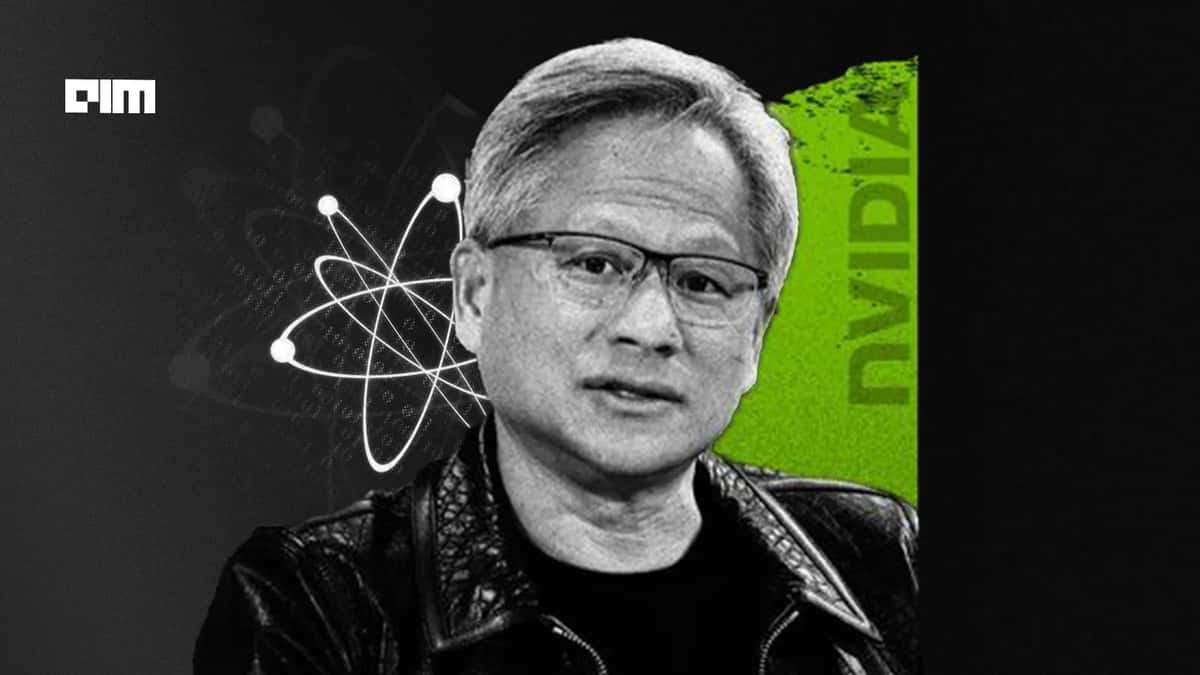

It took Jensen Huang forty years to go from working as a ‘dishwasher, waiter, busboy’ to starting NVIDIA and turning it into a trillion-dollar company by 2023.
But it took only a fortnight and a handful of investigative reports to unravel his charismatic leadership at one of the world’s most valuable companies—in what is now widely seen as one of the more humiliating resignations in Silicon Valley.
Over the last few days, he’s been the subject of reports about a romantic relationship with a Chinese spy. In an apology letter, he acknowledged that he was unfaithful to his wife.
In quick succession, came another report from The New York Times, which revealed he had an ‘extramarital affair’ with the company’s VP of Healthcare, Kimberly Powell. Barely a few hours into his resignation, Reuters reported that he had an intimate relationship with a second NVIDIA employee.
He saved NVIDIA from bankruptcy and led it through the gaming, crypto, and AI boom, and created $5 trillion in value. But his personal life choices and moral misgivings have tainted this historic journey.
The company’s shares are down approximately 12% since November 6, wiping out an estimated $540 billion in market capitalisation.
CFO Colette Kress has taken over as interim CEO until a permanent successor is named.
Can There Be a True Successor?
“It seems likely that the board of the company will attempt to recruit a semiconductor industry veteran to ensure that the firm is headed by a CEO who already has deep industry ties and something like the stature of Huang,” Paul Triolo, Partner at DGA Global, tells AIM.
Over the last week, there has been speculation among analysts and industry on who, if any, could succeed Huang, who has been at the helm of NVIDIA since 1993.
According to numerous analysts and industry experts, Ian Buck, NVIDIA’s VP of Hyperscale and High-Performance Computing, has emerged as a leading candidate.
A company veteran since 2004, Buck played a central role in developing CUDA and now oversees products for major cloud providers. Futurum Equities’ Shay Boloor told Reuters that Buck was the strongest long-term internal contender.
Among external candidates, Semafor mentioned Apple’s Johny Srouji, who led the development of its proprietary silicon.
A few surprising contenders floated by industry commentators include Arm CEO Rene Haas, a former NVIDIA executive, and even AMD CEO Lisa Su. US President Donald Trump, meanwhile, suggested another name in a Truth Social post: Apple CEO Tim Cook, writing that there was “only one man to take his place”.
But it would be difficult for any replacement to emulate Huang’s ability to shape the company’s long-term technology roadmap.
Kress, or whoever eventually takes the permanent CEO role, will have to lead NVIDIA through an increasingly uncertain AI economy, where questions about the sustainability of massive infrastructure investments and the possibility of an AI bubble are becoming harder to ignore.
“The change will not impact the firm's long-term direction,” says Triolo. But only “if the new CEO can quickly rebuild industry relationships and leverage the firm's substantial engineering capability, which remains intact.”
On the other hand, Stacy Ragson, Managing Director at equity research firm Bernstein, in an assessment shared with AIM before Huang resigned, said that NVIDIA is not an ordinary company and Jensen is not an ordinary CEO; he ‘is’ NVIDIA.
In a 2024 interview with Stripe co-founder Patrick Collison, Huang revealed that 60 people reported directly to him.
He deliberately kept the organisation relatively flat, arguing that information about the company's challenges, priorities, and future direction should reach senior executives simultaneously rather than pass through layers of management.
This made him the central point connecting NVIDIA’s engineering, product development, and commercial strategy.
The difficulty for his successor is replicating the alignment that allowed NVIDIA to move from gaming GPUs to CUDA, accelerated computing and, eventually, full-stack AI infrastructure.
“Wrangling more than 60 VPs to a cohesive vision of the company takes a certain kind of person; otherwise the firm’s direction risks dissolving into noise,” says SemiAnalysis, in its analysis post Huang’s resignation. “Our view is that the company was never built for him not to be there.”
SemiAnalysis also notes how Huang ‘woved’ to keep the company in a ‘startup mode’, where major decisions in product development and engineering could be made in the final moments before release. “For example, the GB200 design came together a lot closer to the product cycle than probably anyone would have liked,” says SemiAnalysis, citing a former executive at NVIDIA.
Under his leadership, NVIDIA became a major venture investor, startup financier, cloud infrastructure backer, and M&A participant.
Tomasz Tunguz, General Partner at venture capital firm Theory Ventures, described NVIDIA in his blog post as the “Central Bank of AI”. He argued that NVIDIA has become deeply embedded in the US AI economy, shaping how startups raise capital, how acquisitions take place, and how policy around the sector evolves.
“Under a CFO-led regime facing heightened board scrutiny, any tightening of those equity checks, payment terms or lease backstops will slow AI buildouts just as the broader economy slows when the Federal Reserve tightens credit,” Tunguz noted.
He also expects second-order effects on the startup ecosystem. “Under Huang, NVIDIA acted simultaneously as chip supplier, lead venture investor, anchor cloud customer, and lease guarantor across more than 200 startups,” he noted.
“Those deals ran on Huang's personal conviction and relationships. NVIDIA now needs a leader who can sustain these founder partnerships without the co-founder who built them. A sudden transition at the top introduces real uncertainty into the market and especially in startups.”
Despite record revenues, several neocloud operators are struggling with debt that outpaces cash flows, weakening bond-market confidence and fuelling a broader bearish outlook among investors. The ecosystem is now entering a post-Huang era, with mounting financial pressures
Huang backing of these cloud and AI compute providers went beyond supplying GPUs. Under his leadership, NVIDIA took equity stakes in companies such as CoreWeave and Nebius, invested in Lambda and Nscale, and helped them secure financing for large data-centre projects.
SemiAnalysis explained that neoclouds around the world had been able to raise capital largely because of Huang’s backing, rather than simply because they had evaluated NVIDIA’s chips and chosen them over competitors.
NVIDIA’s financial backstops, including revenue guarantees, landlord guarantees, and lease agreements, allowed operators without investment-grade credit ratings to borrow at investment-grade rates.
“If the Jensen pull is not there, there might be a large contraction in this ecosystem,” said SemiAnalysis.
What Happens to Open-Source?
Huang’s departure does not just concern NVIDIA’s technology roadmap. It could also affect the open-source AI ecosystem.
Huang has been one of the industry's most vocal champions of open-weight AI models. In July, NVIDIA joined Meta, Microsoft, and several other technology companies in signing an open letter urging US lawmakers not to impose premature restrictions on open models.
NVIDIA has backed this ambition with substantial capital. In September, it agreed to acquire Hugging Face, the open-source AI model repository, for $12.93 billion.
A month earlier, it committed $7 billion to coding-focused AI startup Poolside—comprising a $6 billion technology-licensing deal and a $1 billion equity investment—with more than 100 of its engineers joining NVIDIA’s open-source Nemotron project.
Melvin Mathew, AI and equities analyst and writer at Milk Road, believes the biggest beneficiaries could be frontier AI labs, particularly OpenAI and Anthropic.
“If NVIDIA becomes less aggressive about supporting open-weight AI and the US tightens access to advanced chips, I think the competitive environment could shift significantly in favour of the American frontier labs,” he noted in a post on X.
The early signs are already emerging.
The Information had previously reported that DeepSeek was using thousands of restricted Blackwell chips obtained through overseas data centres, allegedly circumventing US export restrictions.
Reuters reported on November 12 that Chinese AI companies were scrambling to secure NVIDIA-powered computing capacity at overseas data centres, fearing that Washington could tighten restrictions on remote access to advanced chips.
Open-weight AI is unlikely to disappear, particularly as China accelerates its domestic chip ambitions through companies such as Huawei. Moreover, leading tech companies and startups are leaning into open-weight AI models to reduce their AI spending.
But Huang’s departure could weaken the case for broader access to AI computing, potentially changing the competitive dynamics between American frontier labs and Chinese open-model developers.
Several frontier AI leaders, including Anthropic CEO Dario Amodei and OpenAI CEO Sam Altman, have pursued more cautious, largely proprietary approaches. Amodei had warned that increasingly capable open models could be difficult to control and safeguard.
For now, the investigations remain far from conclusive.
The company's independent board inquiry and the scrutiny from US lawmakers and federal authorities will have to establish what Huang knew, what role he played, and whether NVIDIA itself crossed any legal or regulatory boundaries.
NVIDIA has been through numerous nightmares over the last few decades. With this one, there’s no Huang to save the day.
- India’s Accessibility Rules are Forcing Software and App Design Rethink
- Succession, Scrutiny, and the Future of NVIDIA
- Can You Trust Your ‘Instinct’ and Not ‘Muse’ Over the Risks?
- Is AI-Powered Reverse Engineering the Death of Proprietary Software?
- Smaller Language Models Could Reshape How Enterprises Deploy AI
- Enmovil Plans to Quadruple FDE Team as Enterprise AI Hiring Moves Beyond Coding