
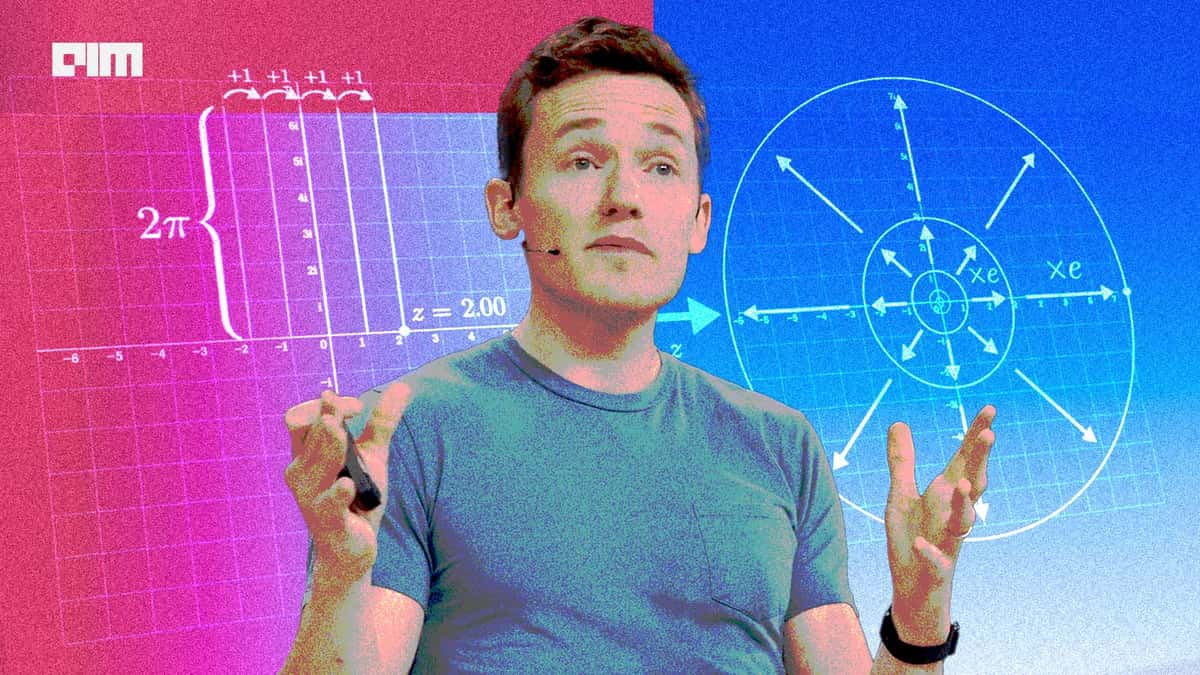

When Grant Sanderson, the creator of the YouTube channel 3Blue1Brown, took the stage at Figma Config 2026 in San Francisco, he did not begin by talking about AI, productivity, or the future of work.
He began with a maths equation.
For nearly half an hour, the math teacher guided a room full of designers through Euler’s identity, one of mathematics’ most famous equations. He spoke about circles, imaginary numbers, visualisation and somehow ended up at the Dutch graphic artist MC Escher.
Yet, beneath the mathematics sat a bigger question: how do humans understand difficult ideas? This is a question that has become increasingly relevant as AI systems grow better at explaining almost anything.
Sanderson, whose videos have helped millions understand concepts ranging from calculus to neural networks, believes the discussion around AI and learning is often framed incorrectly. The real challenge, he says, is not explanation. It is motivation.
“Explanation is one piece of it. Ultimately, the meaningful function of a teacher is more on the motivation side,” Sanderson told AIM during an exclusive interview after his keynote.
As large language models (LLMs) become capable of generating personalised explanations on demand, many educators have questioned what role teachers will play. Sanderson argues that access to explanations has never been the real bottleneck.
“Since the internet’s existed, since the printing press has existed, you have access to good explanations,” he added. Instead, he believes teachers help students understand why they should care about a subject in the first place.
The Business of Making People Curious
The idea surfaced repeatedly throughout Sanderson’s keynote as well. He told the audience that before anyone learns from you, they must first want to learn. “Education 101 is that before anybody is going to learn from you, they have to want to learn. You have to motivate the subject, and the best motivation is application.”
It is a principle that has shaped much of his own work. It is a philosophy that shapes the visuals behind 3Blue1Brown. Sanderson said every element in an explanation should serve a purpose. “Don’t just have an animation for animation’s sake or a visual for visual’s sake,” he said. “There should be an actual piece of math that is reflected in some way.”
Over the past 11 years, Sanderson has built an audience by turning abstract mathematical concepts into visual stories. During his keynote, he described his work as an “obsession” with finding “the right visual that somehow unlocks their underlying meaning”.
His argument to the designers in the room was simple. Mathematics and design are not as different as they appear, since both aim at the same general idea. Both disciplines, he argued, involve navigating complexity and finding clarity.
That philosophy also informs how he thinks about educational content. Early in his career, he wanted to showcase unusual mathematical ideas. His perspective changed after working at the Khan Academy and seeing how visual explanations affected students.
“My eyes were opened to the fact that even if you take topics, which are covered online... taking the style and taking the medium of let’s be aggressively visual about it... still stands to really help students,” he said in the interview.
Sanderson believes the arrival of AI requires a rethink of traditional homework.
“Stop grading homework if you can plug it into an LLM,” he said.
He argued that educators should assume students will use AI and adapt accordingly. Instead of trying to prevent students from using AI, homework should serve as practice, and schools should grade them on work that can be directly supervised. In his view, ungraded homework would encourage students to engage with the material for their own understanding rather than be incentivised to use AI simply to secure better marks.
What AI Changes and What it Doesn’t
Sanderson does not dismiss AI’s role in learning. In fact, he sees significant value in it. He uses AI tools in parts of his own workflow, particularly for research and coding, describing them as a “souped-up version of Google”.
But he also draws a line when it comes to writing. Even if AI eventually becomes a strong writer, he believes the act of writing remains inseparable from thinking. “The process of writing” is also “the process of thinking and clarifying thoughts”, he said.
He also believes that the latest models have become remarkably capable in mathematics, noting that their mathematical abilities have improved dramatically over the past two years. However, he sees AI’s most significant contribution elsewhere.
For students who are already motivated, AI creates what he calls “a huge unlock”. Instead of waiting for a teacher or searching through multiple resources, learners can immediately pursue follow-up questions.
“The real function that the teacher is serving is showing maybe why you should care, or offering the inspiration, basically saying, you can understand.”
Sanderson takes the argument even further. “Teaching is going to be the last job to go,” he said.
Even in a future where AI automates most forms of work, he believes human connection will remain central to education. “That’s probably one of the safest jobs when you think about the relational value to it.”
He believes that having the freedom to ask any question turns moments of curiosity into starting points for further exploration rather than places where learning ends. That shift, however, comes with a risk.
Sanderson worries that educational technology often benefits students who are already curious while leaving others behind. AI, he suggests, could amplify that pattern.
“If you’re not curious but you’re still given hoops to jump through, it gives you the ability to just not even engage.” The result is that curiosity itself becomes more important.
Another flip side is that occasional mistakes and imperfections in human educators, compared with AI explanations, may actually have educational value. Comparing a perfectly accurate source with one that is right most of the time, he said, learners often engage more critically when they know errors are possible. “That little grain of imperfection is an asset. It’s a feature, not a bug.”
The Question Economy
The irony of the AI era is that answers have become abundant. The challenge now is deciding what questions are worth asking.
Sanderson sees that shift playing out not only in education but also in engineering and creative work. While discussing AI engineers, he argued that the value of mathematics lies less in specific formulas than in learning to think.
“The reason to learn math is not necessarily that you’re going to apply that specific piece of math,” he said. “There’s a way of organising your thoughts, a way of understanding what’s a clean layer of abstraction.”
It is a perspective that feels increasingly relevant as AI systems handle more routine tasks. The future, in Sanderson’s telling, may not belong to the people with the most answers. It may belong to those who remain curious enough to keep asking questions.
And that, perhaps, explains why a room full of designers spent their morning listening to a mathematician talk about imaginary numbers.
- Smaller Language Models Could Reshape How Enterprises Deploy AI
- Enmovil Plans to Quadruple FDE Team as Enterprise AI Hiring Moves Beyond Coding
- Does the World Need a New GitHub?
- Can India’s AI Boom Reach Bharat?
- AI's Next Agritech Frontier Is India's Fragmented Supply Chain
- India’s Frontier AI Race Gets a 240M Model That Beats Liquid AI