
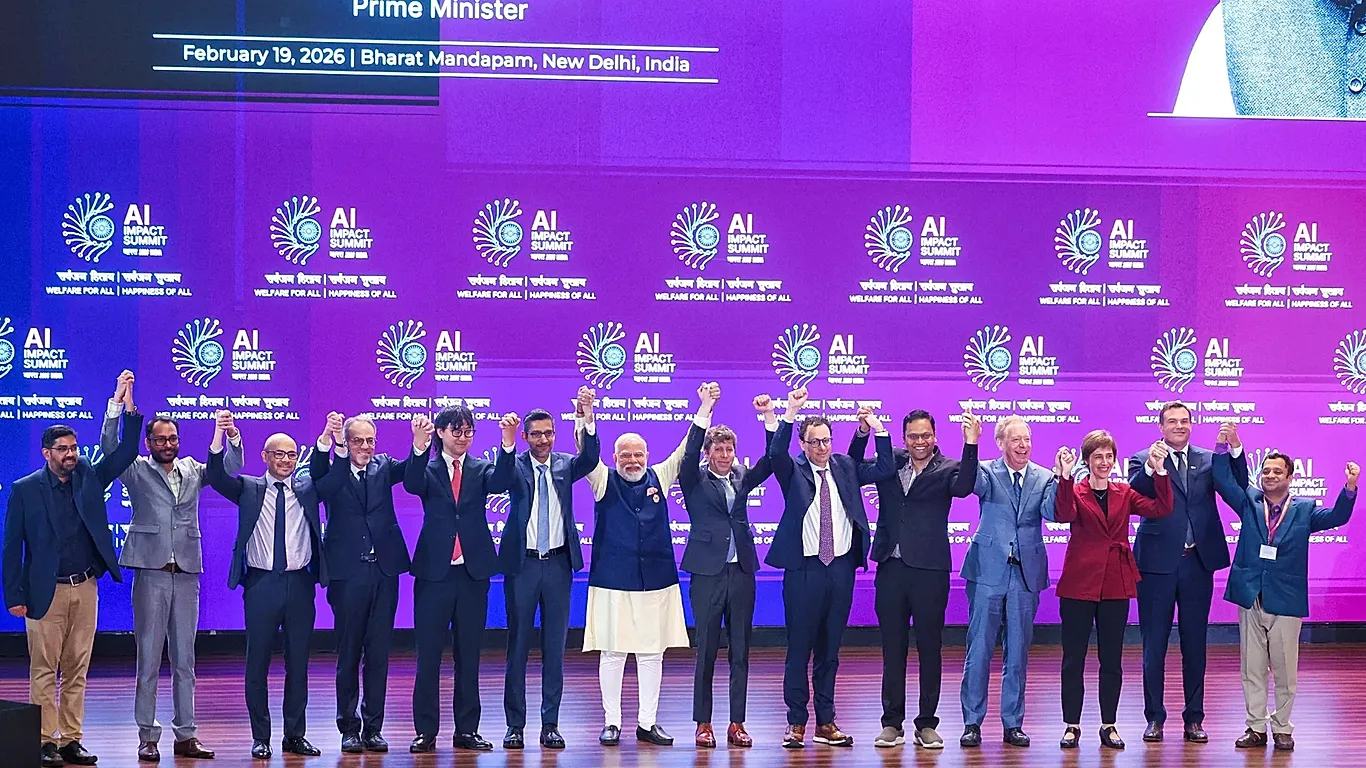
The most consequential day of the India AI Impact Summit was also its quietest. With public access suspended and the expo halls shuttered, the sprawling grounds of Bharat Mandapam wore a deserted look. Yet, behind closed doors, the real negotiations, declarations and capital commitments were unfolding at a pace that could define India’s AI decade.
Artificial intelligence was only discussed; it was demonstrated live. Prime Minister Narendra Modi’s inaugural address was simultaneously dubbed live into multiple regional languages using AI, while AI-enabled sign language interpretation ensured accessibility for hearing-impaired viewers. Clips of both feeds were promptly shared across social media, offering a glimpse of how India intends to deploy inclusive AI at scale.
Calling AI a “civilisational turning point”, PM Modi argued its impact would be faster and broader than any previous technological wave. “The real question is not what AI can do, but what humanity chooses to do with AI,” he said as he unveiled India’s MANAV Vision—a framework centred on human-centric, accountable and nationally transformative deployment of the technology.
One of the day’s earliest keynotes came from French President Emmanuel Macron, who used the platform to urge international action on child safety online. He invited India to join France’s push to restrict children’s access to harmful social media content.
“There is no reason our children should be exposed online to what is legally forbidden in the real world,” Macron said, calling for coordinated action by platforms, governments and regulators.
If policy set the tone, capital delivered the scale. Reliance Industries Chairman Mukesh Ambani announced a ₹10 lakh crore investment over a period of seven years to build AI infrastructure across India. Describing it as “patient, disciplined nation-building capital”, Ambani stressed that the commitment was not about chasing valuations but about laying the foundations of a sovereign AI ecosystem.
Tata Sons Chairperson N Chandrasekaran followed with plans for a partnership with OpenAI to build India’s first large-scale AI-optimised data centre. It is slated to begin at 100 megawatts and expand to one gigawatt—a signal of the compute capacity required to compete globally.
Google CEO Sundar Pichai called addressing the summit a “profound personal honour”, underscoring AI’s potential to improve the lives of billions and tackle complex scientific challenges. “The best outcomes of AI are not guaranteed,” he cautioned. “We must pursue AI boldly, approach it responsibly, and work together through this moment.”
OpenAI’s Sam Altman offered a more provocative outlook, predicting that by 2028, more intelligence would reside in data centres than outside them. He argued that AI could eventually outperform CEOs and scientists in many domains. At the same time, he emphasised that AI must not be concentrated within a single country, reiterating the importance of democratisation.
Anthropic CEO Dario Amodei, in a fireside conversation with Infosys Co-Founder Nandan Nilekani, offered a bullish assessment of India’s prospects. He suggested that India’s vast developer base and digital public infrastructure could uniquely position it to convert frontier AI breakthroughs into a broad economic transformation. He noted the rapid use of Anthropic’s Claude models for coding and technical tasks in India.
From Meta, Chief AI Officer Alexandr Wang outlined the essentials for building next-generation AI systems and highlighted India’s expanding role in the global ecosystem. He confirmed that Meta would release new models in the coming months, deeply integrated into its products.
Microsoft Vice Chair and President Brad Smith proposed a three-pronged strategy for the Global South: large-scale infrastructure investment in data centres, compute and power; coordinated public–private capital; and a strong focus on skills and linguistic diversity so AI works as effectively in every language as it does in English. Microsoft, he said, is on track to invest $50 billion by the end of the decade to advance AI across the Global South, with India among the principal beneficiaries.
Bill Gates was notably absent, withdrawing at the last minute amid renewed scrutiny over his past association with the late financier Jeffrey Epstein.
Devoid of spectacle but rich in substance, the summit made one point unmistakable: India’s AI ambitions are no longer aspirational. They are now being capitalised, institutionalised and internationalised in real time.

Your reaction
Discussion
What's your take on this story?
No comments yet — be the first to share your view.