
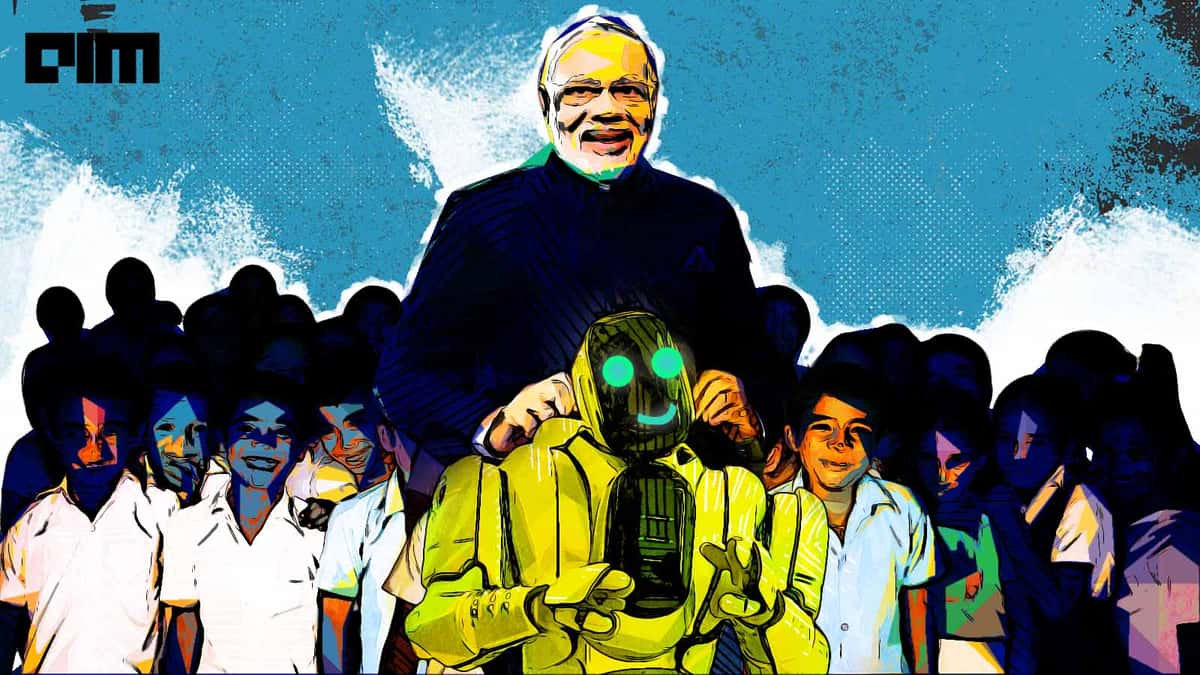
Indian Prime Minister Narendra Modi has launched key initiatives marking the first anniversary of National Education Policy (NEP 2020). The live webcast featured the Prime Minister along with members from Ministry of Education, NCC-New Delhi, IIT Kharagpur, IIT Madras, UGC, AICTE etc. The major announcements include the AI for All initiative by the central board of secondary education(CBSE) in collaboration with Intel, SAFAL assessment framework etc. AI For All is a four-hour, self-paced learning program that demystifies AI in an inclusive manner.

“I remain inspired by your forward-thinking leadership to help your great nation bridge the digital skills gap in AI.”
Intel’s CEO Pat Gelsinger on PM Modi
CBSE is assisting the government’s ambitious goals laid out in NEP 2020.The program aims to introduce AI to 1 million citizens in its first year. “National Education Policy 2020 acknowledges the importance of AI and emphasises on preparing everyone for an AI driven economy. AI For All is one of the largest AI public awareness programs worldwide and will help demystify AI in an inclusive manner strengthening India's position as a global leader for emerging technologies,” said Dr Biswajit Saha, Director Skill Education and Training, Central Board of Secondary Education, Ministry of Education, Government of India.
As part of the ongoing efforts to revolutionise education in India, CBSE has proposed the SAFAL framework to assess students. The assessment system, according to CBSE, is designed to promote development of students and suggests a shift from testing rote memorisation to competency-based learning. NEP 2020 proposed an annual school examination for all students in Grades 3, 5, and 8, which will focus on testing core concepts, application of knowledge and higher order thinking skills. The exam is to get feedback and not for promotion of students to the next grade.
Consensus based assessment is not new. For example, Australia's The National Assessment Program–Literacy and Numeracy (NAPLAN) framework is developed based on competencies and proficiency levels. With SAFAL, schools affiliated to CBSE board can use the data for targeting academic support and database management. According to CBSE, SAFAL will provide a reliable and comparable ‘absolute’ measure of learning for parents, schools and state officials to assess school performance on core concepts.

Going forward, the CBSE plans to provide the teachers with secure access to student level data on the competencies tested through the SAFAL examinations. The reports will help teachers understand a student’s learning levels and the proficiency descriptors with regards to various subjects. SAFAL has the potential to shake up the age-old rote methodology and produce talent of global standards. But, diagnostic tools storing sensitive student data can also be misutilised. We saw last year the prestigious International Baccalaureate botching up grades with their statistical tool. However, CBSE said it wouldn’t disclose raw or percentage scores to prevent misuse of data for promoting/ failing a child.
Launched last year, NEP 2020 aims to introduce AI and other modern day technologies right from the grassroot level.
“Mathematics and mathematical thinking will be very important for India ’s future and India’s leadership role in the numerous upcoming fields and professions that will involve AI, machine learning, and data science.”
NEP 2020
The Ministry of Human Resources Department(MHRD) stated in their draft that mathematics and computational thinking will be given increased emphasis throughout the school years, starting with the foundational stage, through a variety of innovative methods, including the regular use of puzzles and games that make mathematical thinking more enjoyable and engaging. “AI's disruptive potential in the workplace is clear, and the education system must be poised to respond quickly. One of the permanent tasks of the NETF will be to categorize emergent technologies based on their potential and estimated timeframe for disruption, and to periodically present this analysis to MHRD. Based on these inputs, MHRD will formally identify those technologies whose emergence demands responses from the education system,” read the NEP 2020 draft.
The implementation of previous policies on education focused largely on issues of access,equity and universal elementary education. NEP 2020 has its foundations in scientific temper and creative thinking. It is designed to accommodate lofty global ambition of accelerated digital transformation and skill development.
Watch the full video here:
- Industry Wants Faster Approvals and Cheaper Power in India’s Data Centre Policy
- Inside Jio Platforms: Its Tech Bets, Loss-Making Subsidiaries and Hidden Risks
- India’s GCCs to Add 1.4 Million Jobs, Drive 170 Million Sq. Ft. Office Demand by 2031
- AI Can Be Cyborg or Centaur. But Can Enterprises Monetise It?
- AMD’s Server CPU Business Faces a New AI Boom
- How an Engineer Is Using AI to Bridge the Accessible Education Gap