
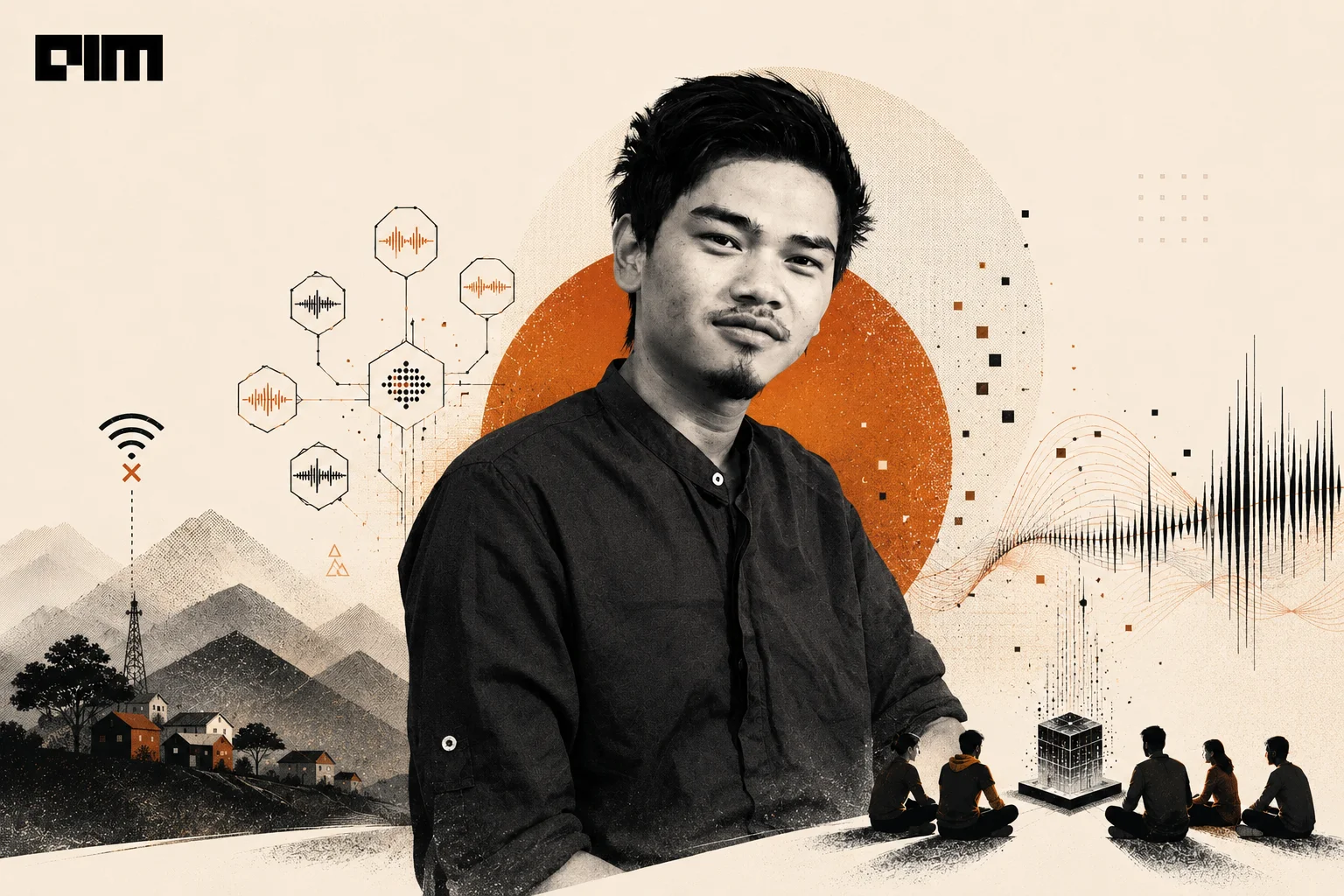
India’s AI story is skewed. AI innovation is often concentrated in metros like Bengaluru, Hyderabad, Mumbai, or Delhi. The Northeast rarely makes the map. But six people in Shillong are trying to change that.
MWire Labs, a small AI lab based in Meghalaya, has built a multilingual speech AI system for languages including Khasi, Garo, Mizo, Kokborok, Assamese, and Nagamese, using more than 1,000 hours of field audio. It is designed for the conditions that most mainstream speech models struggle with: regional accents, code-mixing, low-resource languages and, importantly, places where the internet can disappear after a short walk.
The speech system is part of a broader stack the lab is building for Northeast India. That includes Kren-M, a 3B generative Khasi-English model; NE-BERT, a multilingual model covering nine Northeast languages; along with OCR, translation, speech, and embedding models.
The models are being released openly through Hugging Face and India’s AIKosh library.
For a six-person team, the scale is unusual. MWire Labs currently ranks 18th on AIKosh by number of contributions, putting it ahead of much better-funded labs.
The Missing Data
But the more interesting part is not the ranking, but why the team had to build these models in the first place. It was all because of the missing data.
Badal Nyalang, Director and Researcher at MWire Labs, worked in IT services and software development, including on government projects, before turning more seriously towards AI. When the team tried using existing AI systems for a local project in Meghalaya, they found that while a model could technically understand Khasi, it did not necessarily sound or feel like something built for people who actually spoke it.
“We kept on digging in. We decided to look more—what can be done, what are the alternatives? We tried fine-tuning smaller models. The biggest problem that we faced was there weren’t enough datasets,” Nyalang tells AIM.
The conclusion was inevitable. If they did not have the data, they would have to go and collect it themselves.
That meant starting from the ground.
Northeast India is not homogeneous. It is a patchwork of languages, dialects, and communities, many of whom have relatively small populations of just 60,000 or 1,00,000 people.
Even a language spoken across a single tribe can change considerably from one village to another.
“It changes somebody’s understanding. But when an outsider listens, you won't be able to get it,” Nyalang explains.
That makes building a speech model very different from simply scraping the internet and throwing the data into a training pipeline.
MWire Labs narrowed its initial work to six languages and began collecting voices. The recordings came from paid contributors and collaborators, and used their voices consensually for language research and model training.
The team deliberately limited each person's contribution to roughly 30 minutes to one hour. It also tried to build demographic and geographic diversity into the dataset rather than letting the model to learn one particular accent or dialect.
The contributors ranged broadly in age, although the team says it still needs more data from people over 50.
The Problem of Trust
Some community members were reluctant to participate because they were worried their language could be misrepresented or misused.
“The block, the brick wall that we face was okay; we don’t want our language to be misrepresented or misinterpreted,” Nyalang says.
That may be one of the biggest differences between building AI for a globally dominant language and building it for a low-resource regional language. The challenge is not only technical. It is social.
The lab’s answer was to build the data collection process around consent and community participation while gradually expanding the number of languages.
The target is ambitious: 30-plus Northeast Indian languages by 2027.
The other technical constraint is connectivity.
In parts of the Northeast, internet access cannot be taken for granted. Badal says even in Shillong, connectivity can disappear after moving only a short distance.
That makes cloud-dependent voice AI less useful.
MWire Labs is therefore working on an offline speech system and an offline device that can process speech without requiring a constant connection. The team is developing a prototype with support from Meghalaya’s Science and Technology Department and expects the current prototype to be completed in about a month.
The basic workflow is simple: record locally when there is no connectivity, and transfer the data once a stable connection becomes available.
But taking the same philosophy into deployment means shrinking the AI stack enough to run on a device.
That is where the lab’s broader model ecosystem becomes important.
NE-BERT provides multilingual language understanding across nine Northeast languages. The lab has also built models for automatic speech recognition, speech embeddings, translation, OCR, language identification, named-entity recognition, and embeddings.
The idea is not to build one giant model that does everything. It is to assemble smaller, specialised components that can work for specific regional use cases.
That has already pushed the team into agriculture, healthcare, and citizen services.
Nyalang explains that the startup has a use case for government services. A citizen may not read English or Hindi, but they may be perfectly comfortable speaking their own language. A voice interface that can explain a government scheme in that language could turn an otherwise inaccessible service into something usable.
The lab is working with different partners across these areas, including agricultural institutions, a company working on a healthcare project in the Northeast, and a third party involved in public services.
The models are also being benchmarked against larger multilingual systems. MWire Labs says its NE-BERT work outperformed Google’s mBERT and IndicBERT on regional Northeast Indian languages in its evaluations.
The work was submitted as a research paper, reviewed, and published through an ACL workshop, and the underlying data has been made available on Hugging Face so others can reproduce or check the results.
That Openness is Deliberate
For MWire Labs, open sourcing is not just about getting visibility. It is about making sure languages that are often invisible in mainstream AI development at least become visible to researchers and developers.
The team is also not particularly interested in fighting bigger AI labs. Nyalang sees collaboration as the more practical route. If a larger initiative has access to funding and datasets, while a smaller lab has local knowledge and additional language data, combining the two could produce a much stronger model.
The bigger question is what happens when language stops being a barrier to technology adoption.
If people can interact with technology in their own languages, the opportunity is not limited to translation. It can open the door to new businesses, services, and eventually startups built around communities that have largely been left out of the AI boom.
For MWire Labs, this is also what sovereignty means.
India’s sovereign AI conversation often begins with GPUs, data centres, chips, and compute. Those are important. But sovereignty also means deciding whose voices, languages, and cultural context get represented in the systems being built.
“We want to make sure that while doing the language, we don’t miss out on the cultural aspect. Absolutely not.”

Your reaction
Discussion
What's your take on this story?
No comments yet — be the first to share your view.