
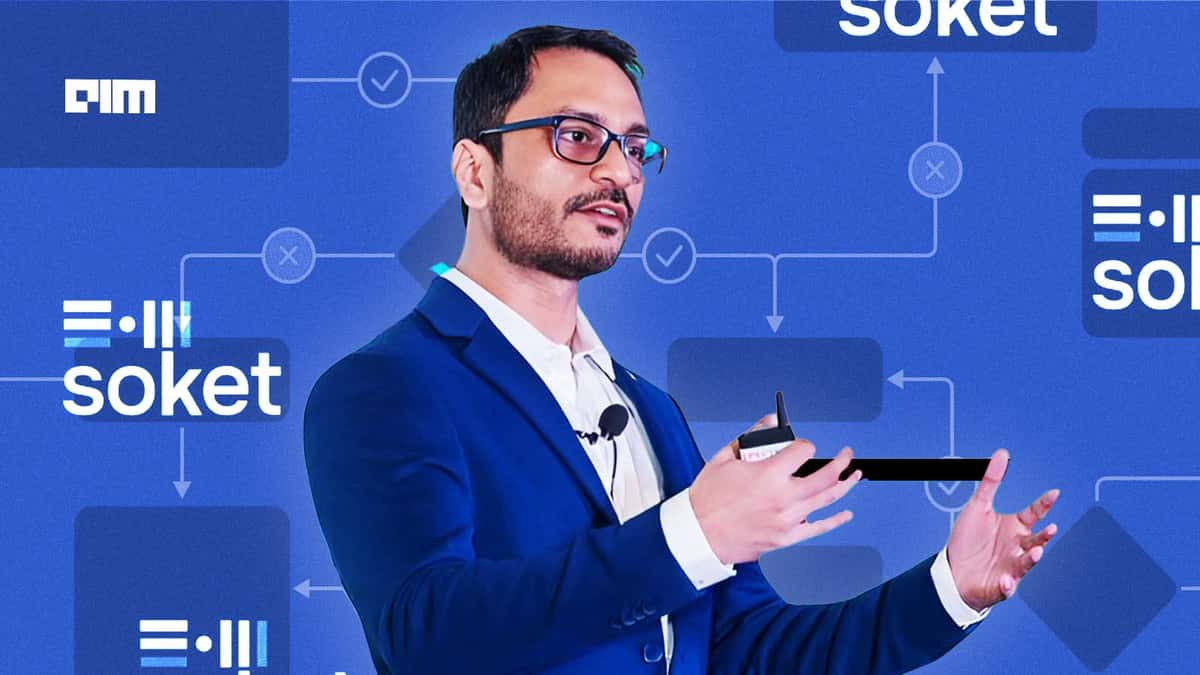

By the end of September, a 13-member startup from Bengaluru may put its stamp on India’s AI ambitions with its own frontier model.
Soket AI Labs, one of the 12 startups selected under the IndiaAI Mission, plans to unveil the first phase of what Founder and CEO Abhishek Upperwal describes as an Indian sovereign AI stack built not merely for chatbots and assistants, but for cybersecurity, defence, reasoning systems, and critical infrastructure—a counterweight to Anthropic’s Fable and Mythos models.
The model, expected to be in the 22–25 billion parameter range, is being built as the first stage of a much larger ambition under Project EKA, Soket's effort to create AI models optimised for India's languages, the Global South, and high-trust enterprise use cases.
For Upperwal, the upcoming launch is less about joining India's growing list of large language models and more about proving that India can still participate in the frontier race.
“We are not shying away from saying that we want to build an Anthropic out of India,” he tells AIM. “Why should we only aspire to catch up? India should be building the best models in the world.”
That confidence sounds unusual in an ecosystem that spent much of the past two years debating whether India should even attempt to build foundation models. Now, firms like Sarvam, BharatGen, Tech Mahindra, and Soket AI Labs are trying to compete on a global scale.
How Does Soket Do It?
“It wasn't about defeating Sam Altman," Upperwal says, while talking about OpenAI’s comment on how it is hopeless to compete with GPTs. "It was a challenge to understand why building AI was considered so difficult. If people from India are already building these systems in Silicon Valley, why can't they build them here?"
The answer, he discovered, was not talent. It was data.
When Soket began experimenting with multilingual models, the team quickly ran into a problem that continues to haunt almost every Indian AI initiative: the internet simply does not contain enough high-quality Indian language data.
Upperwal points to the widely used multilingual C4 corpus, a foundational dataset used globally for training language models.
"It barely contains 0.1% representation of India's 22 scheduled languages," he says. "We are the largest population in the world and yet our languages barely exist on the internet in machine-readable form."
That realisation pushed Soket into one of the least glamorous and most expensive parts of AI development: data curation.
The company has collected nearly 40 trillion tokens of raw data and processed it down to roughly 15 trillion high-quality tokens for training—comparable to leading open-source models.
The work took months. It also forced Soket to become creative with infrastructure. Before IndiaAI support arrived, the company survived by moving training jobs across cloud providers and exhausting free compute credits wherever it could find them.
Upperwal still remembers transporting checkpoints from one provider to another simply to keep experiments alive.
"We moved across three cloud providers just to train one of our early models," he says. "The entire ecosystem helped us. It was very much a community effort."
That early experiment became Pragna, a 1.25 billion parameter model built initially as a proof of concept. The objective was to understand what intelligence looks like while it is being formed.
"It was fascinating to watch," Upperwal says. "Initially, the model produced random words that made no sense. Then sentences started appearing. Then higher-order concepts emerged. It almost feels like watching a child learn."
That experience shaped Soket's philosophy, and the company began with languages but gradually expanded its ambitions.
Today, the focus extends beyond multilingual capabilities into mathematics, coding, and reasoning.
"Mathematics, coding, and reasoning together create agentic capabilities," says Upperwal. "Conversation alone is not enough anymore." That is also what separates Soket from others like Sarvam and BharatGen, which are increasingly reliant on making language and conversation their moat.
Soket AI is optimising its models for environments where hallucinations are not merely inconvenient but dangerous, such as when making an incorrect vulnerability assessment inside a military network. That is also where Upperwal believes sovereign AI stops being an ideological argument and becomes an operational necessity.
He points to the growing restrictions around access to frontier models such as Anthropic Mythos and OpenAI’s GPT 5.6. "What happens if access disappears?" he asks. "What happens if the best cybersecurity model in the world is simply not available to you?"
Those concerns are no longer theoretical.
R&D Takes Time
The AI industry is increasingly being shaped by geopolitics, export controls, and national security considerations, igniting conversations around AI sovereignty and overcoming compute dependencies.
Upperwal argues that India is uniquely positioned in this new world.
"If oil doesn't exist in your country, it doesn't exist," he says. "AI is different. India already has the data. We are the data factory of the world."
The missing ingredient, according to him, is the willingness to invest patiently in research. "India's challenge isn't money. It's patience," he says. "Hardcore R&D doesn't produce outcomes in 12 months."
That is perhaps the most uncomfortable conversation in India's AI ecosystem.
Indian startups are expected to show traction quickly. "It takes years to build the foundations," Upperwal says. "Someone has to do the zero-to-ninety work."
The irony is that the technology itself may be moving faster than India's institutional timelines. Upperwal believes India could produce globally competitive frontier models within two years.
"We already know the recipe," he says. "Building frontier models is not a one-shot problem. It's iterative."
The bigger challenge may not be algorithms but infrastructure. India currently possesses only a fraction of the compute capacity available to American and Chinese frontier labs. Training trillion-parameter systems requires thousands of GPUs connected together with extraordinary reliability.
"One thousand GPUs are not enough," Upperwal says. "You need 10,000 GPUs working together." That is why developments around India's GPU infrastructure matter.
Upperwal believes India will eventually get there. "The good news is that India is getting access to the best hardware available globally," he says.
Soket, however, is trying to solve the problem from the efficiency angle as well. The company claims its architecture differs significantly from existing open-source approaches and is optimised for lower compute consumption.
According to Upperwal, early benchmarks suggest inference efficiency is roughly three times better than DeepSeek's and training costs could be 30–40% lower. Those numbers remain to be independently verified after launch, but the philosophy behind them is unmistakably Indian.
"If AI is going to reach every Indian, the economics have to work," Upperwal says.
That is similar to what BharatGen’s Ganesh Ramakrishnan told AIM earlier: one has to think of the last mile as the first mile. That affordability argument also explains Soket's interest in agriculture.
The company recently partnered with the International Crops Research Institute for the Semi-Arid Tropics (ICRISAT) to build AI systems capable of generating personalised agricultural advisories. The existing system relies heavily on human experts analysing weather data, field reports, and crop conditions before issuing recommendations. AI could potentially compress that cycle while personalising advice for individual farmers rather than districts.
The opportunity is enormous. Yet Upperwal resists the increasingly popular argument that India should focus only on local problems and leave frontier research to others.
"Economically, that argument makes sense," he says. "But ambition should be bigger than economics."
His answer is to do both. Build for agriculture and defence while simultaneously chasing AGI. Aim for frontier-minus-one if necessary. But keep aiming for the frontier.
Soket’s upcoming model is not designed to compete with Anthropic's largest systems or OpenAI's most advanced offerings. In an industry increasingly split between American scale and Chinese efficiency, Soket is betting that there is room for a third story. One built on multilingual intelligence, lower-cost architectures, and sovereign trust.
- Enmovil Plans to Quadruple FDE Team as Enterprise AI Hiring Moves Beyond Coding
- Does the World Need a New GitHub?
- Can India’s AI Boom Reach Bharat?
- AI's Next Agritech Frontier Is India's Fragmented Supply Chain
- India’s Frontier AI Race Gets a 240M Model That Beats Liquid AI
- The AI Slowdown Narrative Doesn’t Reflect Enterprise Reality