
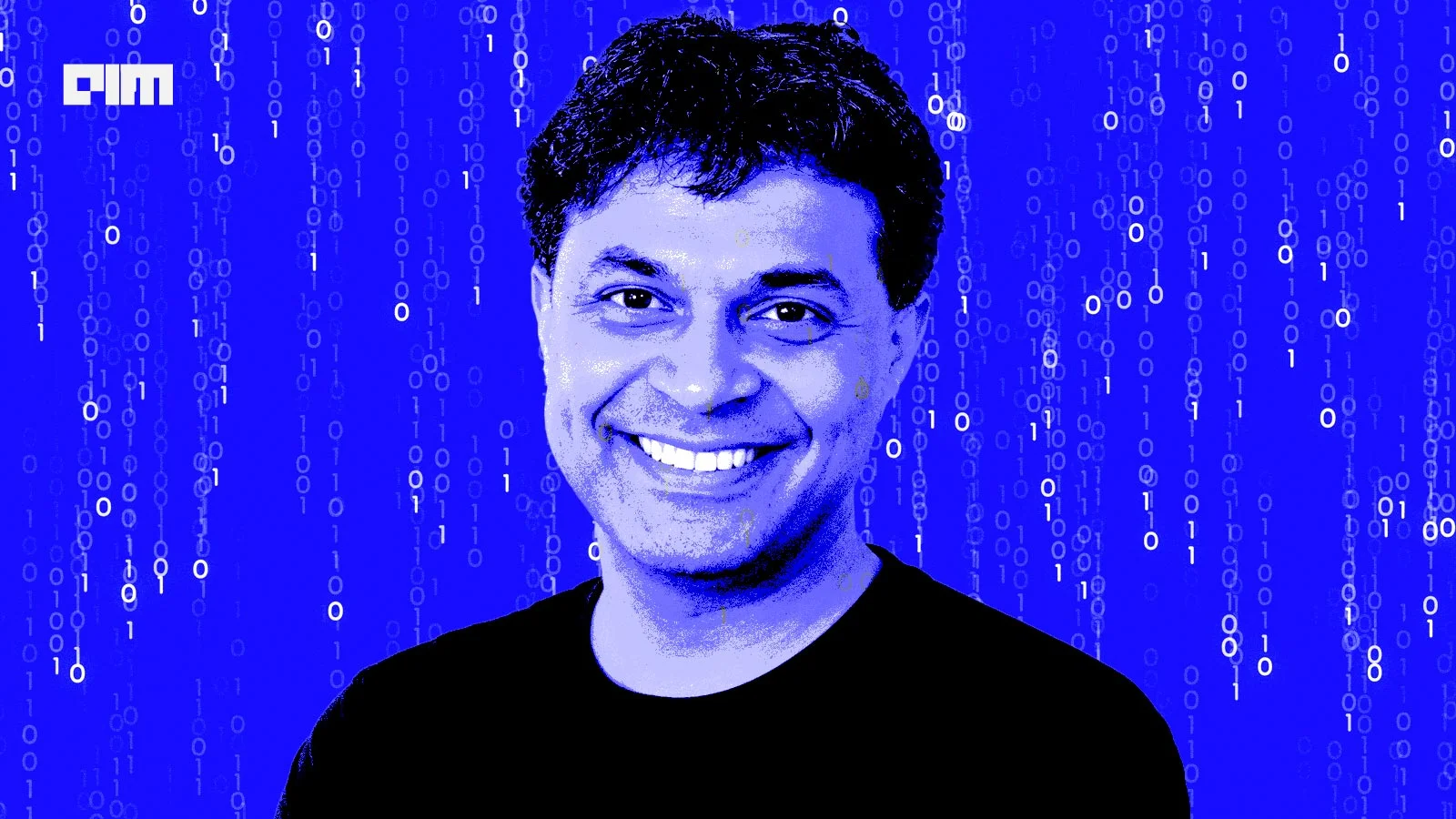
India’s AI ambitions received a major boost after Sarvam AI recently picked up a massive haul of $234 million at a $1.5 billion post-money valuation to build the next generation of AI models. The round led by HCLTech, which invested $150 million and acquired a 10.46% stake in the startup through the all-cash investment.
In an exclusive interview with AIM, Sarvam co-founder Vivek Raghavan shares that the conversation with HCLTech began at the India AI Impact Summit, held in February earlier this year.
“Their conviction in this has been very steadfast,” Raghavan says, adding that there will be strong go-to-market (GTM) synergies between HCLTech and Sarvam. “They believed in the sovereign AI story and they believed that Sarvam was the kind of company they wanted to back.”
A few weeks ago, a Bloomberg report claimed that Sarvam had also held discussions with investors including SoftBank, Prosus, Andreessen Horowitz, General Atlantic, and Accel, that turned down its pitch. While Raghavan does not confirm the report, he notes that Sarvam chose the investors that were the best fit for the company.
“I would say the names mentioned are still closely watching what Sarvam is doing,” he quips.
What it Takes to Train a Model
With the funding secured, Sarvam AI is now turning its attention to building larger foundation models. Co-founder Pratyush Kumar recently said the startup aims to develop trillion-parameter-class models, with future training runs targeting coding, agentic AI, and cybersecurity use cases.
Earlier this year, at the IndiaAI Impact Summit, Sarvam unveiled Sarvam 30B and Sarvam 105B, two foundation models trained from scratch using compute resources allocated under the IndiaAI Mission.
Raghavan also pushes back against the idea that India should focus only on small language models. Instead, he proposes a different strategy.
“You should build frontier minus one models,” he says, referring to developing models that are just a generation away from the newest models.
His argument is rooted in scale. If the world’s largest models are already operating in the range of 3–10 trillion parameters, India cannot expect 7-billion-parameter models to deliver comparable performance for strategic applications.
“You should aim to at least build a trillion-parameter model,” he says. Raghavan adds that organisations can then post-train and specialise such models using local datasets for targeted use cases.
At the same time, he emphasises that building a frontier model is extremely expensive and can often be cost-prohibitive.
“It’s not just about training models,” he says. “At the lowest level, we have to have the compute infrastructure.” Notably, Sarvam AI trained models on ~3,400 H100s.
Sarvam focuses on both training models from scratch and leveraging open-source and open-weight systems where appropriate. “You can’t say that I’m going to do everything from scratch. That's not the smart strategy,” Raghavan says.
He also cautions that post-training large models is far more difficult than many people assume. “To take even a 100-billion-parameter model and post-train it requires engineering chops which most people don’t have at this stage.”
What is Sovereign AI?
On the restrictions around Anthropic Fable, which the US government has since overturned, Raghavan says it validates concerns that access to AI systems can be restricted unexpectedly.
“This is something that we said would happen, and it has happened. I think this is just the beginning and there will be all different kinds of things,” he notes.
Raghavan’s definition of AI sovereignty differs from the conventional view. “My definition of a sovereign model is a model where the sovereign can actually audit the data that was used to train the model.”
According to him, the industry often frames sovereignty as a choice between closed and open models, but the reality is more nuanced. Closed models from companies such as OpenAI, Anthropic, and Google may offer state-of-the-art capabilities, but access can be withdrawn at any time.
“Tomorrow, if they decide not to let you use the endpoint, then your access is gone,” he says, referring to API-based models.
While open-weight models address part of that challenge by allowing organisations to download and run models on their own infrastructure, Raghavan argues they are not essentially sovereign. Citing research from Anthropic, he notes that even a small amount of poisoned training data can influence a model’s behaviour, making it difficult to fully trust systems whose training data cannot be audited.
Sarvam Goes to San Francisco
Despite positioning itself as an Indian AI company, Sarvam is establishing a presence in Silicon Valley. The goal, however, is not to chase customers but to tap into a pool of researchers with firsthand experience building frontier AI models.
According to him, India currently lacks people who have firsthand experience training frontier models simply because such models have not yet been built domestically.
“We want to find those top-notch researchers who actually have an intent to say ‘I want India to do great things’,” he says.
Anybody Can Vibe Code
Sarvam AI is now gearing up to release a coding model. Raghavan believes developers who understand software architecture and engineering fundamentals benefit the most from coding models.
“If you vibe code without understanding what software is about, your mileage will vary,” he says.
According to him, AI can accelerate development, but human understanding remains the differentiator. “Anybody can vibe code,” he says. “But if someone doesn’t understand the principles of software, they can build something very fast, but improving and maintaining it becomes a struggle.”
Raghavan believes the value of strong engineering fundamentals will only become more apparent.

Your reaction
Discussion
What's your take on this story?
No comments yet — be the first to share your view.