
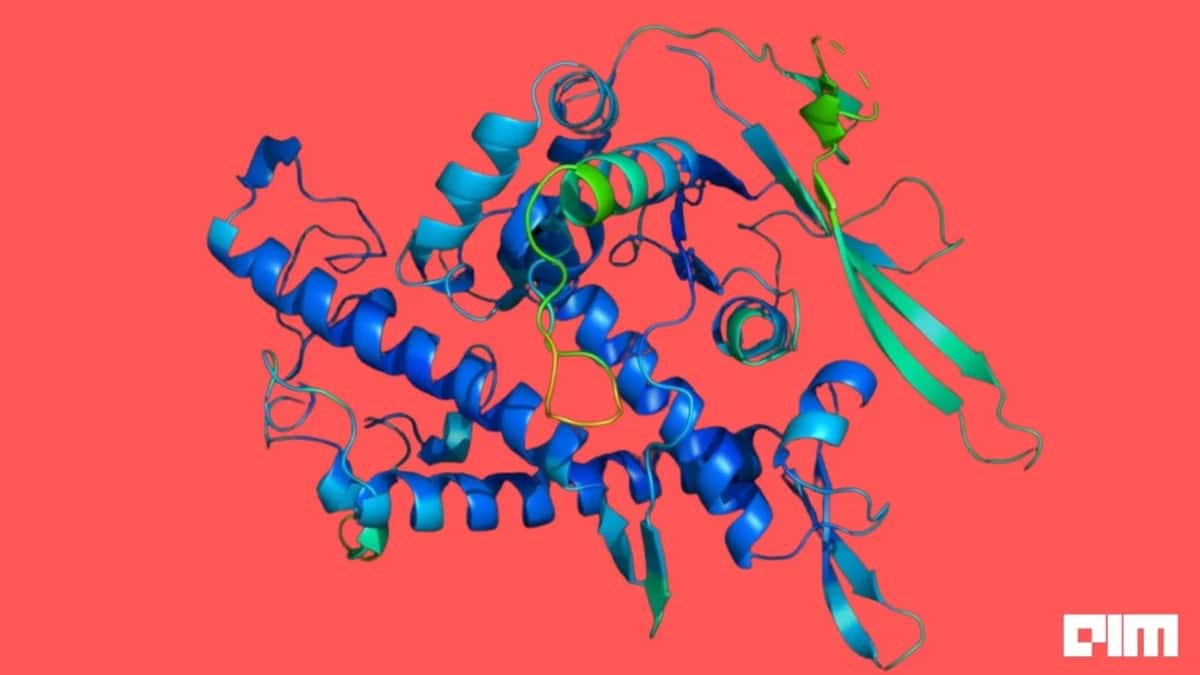
Until 1957, a group of scientists discovered special access to the molecular third dimension. After a long haul of experimentation for 22 years, John Kendrew from the Cavendish Laboratory in Cambridge (UK) revealed the first protein structure—myoglobin—using X-ray diffraction to determine its 3-dimensional structure.
Along with Kendrew, Max Perutz was honored with the 1962 Nobel Prize for their advancements on determining the protein structure. In the light of a dozen structures of proteins that were determined after this discovery, resolving the decade-old protein folding problem looked promising.
The twisted blueprint of myoglobin consisted of a stringy chain of 154 amino acids, which helps infuse oxygen into our muscles. As revolutionary it might seem to be, Kendrew had left the protein architecture floodgates unopened.
After 65 years of the Nobel winning breakthrough, scientists have now used AI to initiate this process. London-based DeepMind unveiled the prediction of structures for around 220 million proteins this year—which covers bacteria, plants, animals, and humans—encompassing nearly every protein known in science.
DeepMind founder and CEO Demis Hassabis said, “Essentially, you can think of it as covering the entire protein universe”. However, another tech conglomerate has planned to fill in the dark matter in the same universe and might have advanced further than DeepMind’s prediction.
Dark matter of the universe
Proteins are complex molecules that are responsible for the fundamental processes of life.
One of the new frontiers in natural science is metagenomics, which uses gene sequencing to discover proteins in samples from microbes living in the soil, deep down in the ocean, and even in our guts and skin. However, the same group of proteins are least understood on earth.
Decoding the structure of metagenomics can help researchers find proteins to cure disease, produce cleaner energy, and even resolve the long-standing mystery of human evolution.
To enhance this process, a group of researchers from Meta—with the help of artificial intelligence (AI)—have predicted the structures of over 600 million proteins from viruses, bacteria, and other microbes that had not been characterised.
Research lead at Meta AI’s protein team, Alexander Rives, said, “These are the structures we know the least about. These are incredibly mysterious proteins. I think they offer the potential for great insight into biology.”
The team has created the first database revealing the structures of the metagenomic world at the scale of hundreds of millions of proteins. The predictions were made using a ‘large language model’, a basic tool to predict text from merely a few words.

(Source: Meta)
Moreover, large volumes of texts are used to train language models. Rives and his team fed the models with sequences to known proteins by a chain of 20 different amino acids, where each acid was represented by a letter.
‘Autocompletion’ of proteins
Owing to the advancements in gene sequencing, it is now possible to trace billions of metagenomic protein sequences. Researchers may have discovered their sequences, but understanding their biology is a staggering challenge.
To determine the three-dimensional structures for millions of proteins in an experiment is a distant goal from the time-intensive techniques (like X-ray crystallography), which might take weeks or even years for a single protein. Computational techniques give insights on metagenomics proteins, which is not possible with experimental approaches.
Meta has released the 600+ million protein ESM Metagenomic Atlas—for the entire MGnify90 database—which acts as a public resource cataloguing the metagenomic sequences. Meta claims, “To our knowledge, this is the largest database of high resolution predicted structures, 3x larger than any existing protein structure database, and the first to cover metagenomic proteins comprehensively and at scale.”
This benchmark will enable innovators to search and analyse the structures of metagenomic proteins at the scale of hundreds of millions of proteins. This can help search for distant evolutionary relationships, identify protein structures that have not been characterised previously, and discover new structures that can be useful in medicine and other related appliances.

(Source: Meta)
The network was trained to ‘autocomplete’ proteins with a proportion of amino acids obscured.
Rives said, “This training imbued the network with an intuitive understanding of protein sequences, which hold information about their shapes.”
Faster, but not as accurate as AlphaFold
However, the second step in training the protein was inspired by none other than DeepMind’s protein structure called ‘AlphaFold’, combining insights about the relationships between known protein structures, to generate further sequences.
The team decided to shape the model on a database consisting of bulk and sequenced ‘metagenomic’ DNA from sources such as seawater, soil, skin and the human gut—among other habitats present in the environment. Majority of these DNA entries are derived from organisms that are unknown to science.
Undoubtedly, Meta has predicted the structures of 617 million proteins. The effort took two weeks for the team whereas AlphaFold can take only a couple of minutes to generate one prediction.
Meta’s network ‘ESMFold’ isn’t quite as accurate as AlphaFold. But Rives' team reported earlier this year that the model is around 60 times faster at predicting protein structures. “What this means is that we can scale structure prediction to much larger databases,” he said.
Renowned biologist from Harvard University at Cambridge, Massachusetts, Sergey Ovchinnikov analysed how ESMFold made millions of predictions with low-confidence.
He said that some structures may not be well-defined, while other structures might as well be a non-coding DNA which is mistaken as a protein-coding material. He says, “It seems there is still more than half of protein space we know nothing about.”
Sources say that DeepMind may not have any current plans on including the metagenomic structure predictions to its database. But with Meta’s new prediction model, researchers will be able to study how language models can be used across various disciplines, thereby opening doors to new breakthroughs on metagenomic structures in the universe.
Many, however, are yet to conform.

(Source: Twitter)
- India’s GCCs to Add 1.4 Million Jobs, Drive 170 Million Sq. Ft. Office Demand by 2031
- AI Can Be Cyborg or Centaur. But Can Enterprises Monetise It?
- AMD’s Server CPU Business Faces a New AI Boom
- How an Engineer Is Using AI to Bridge the Accessible Education Gap
- AI Agents are Making Human Customer Service a Specialist Job
- Why Nandan Nilekani-Backed F2A Believes India's Investment Opportunity Lies in Edge AI