
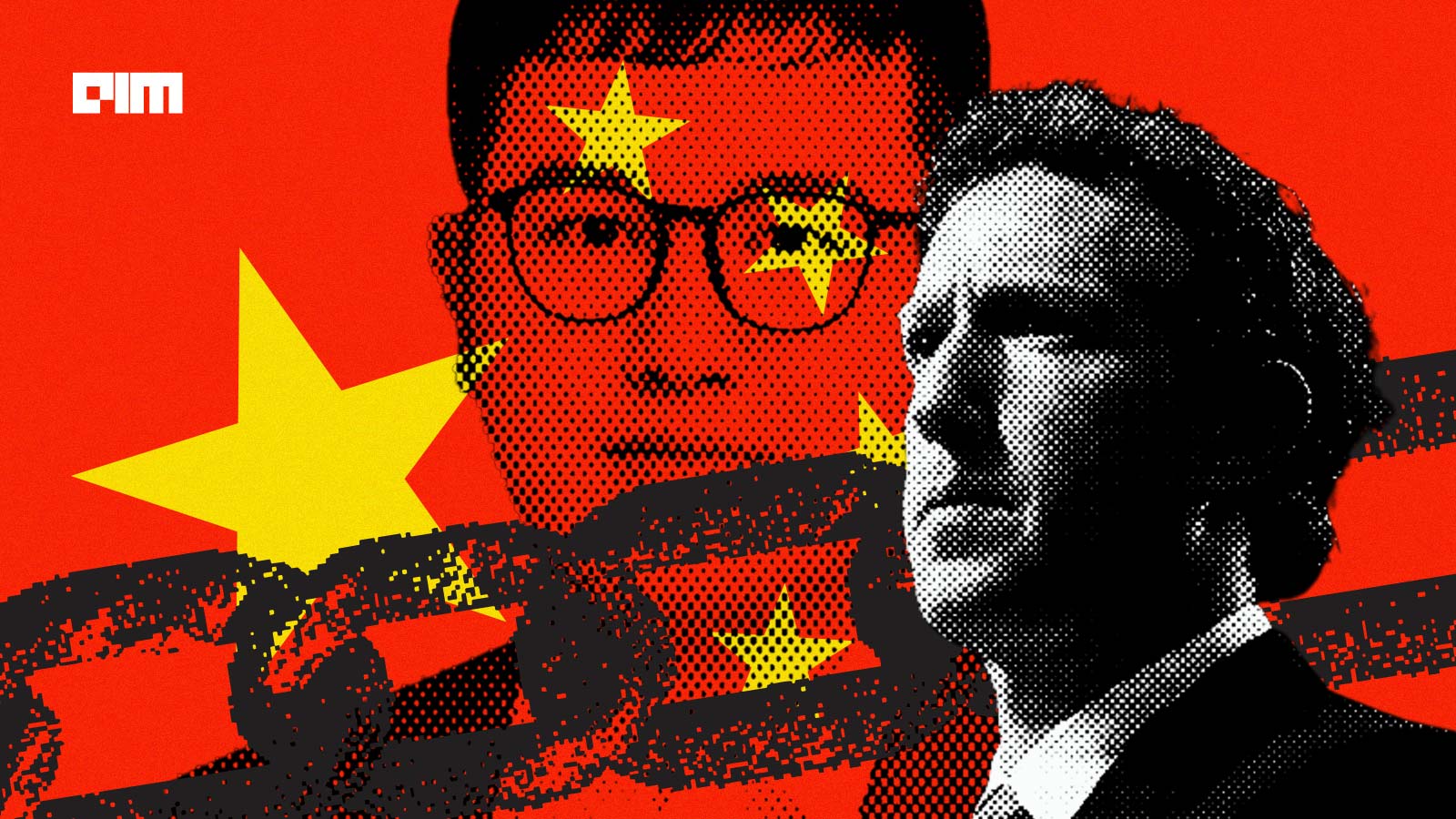
China's AI story has been shaped by open-source models—a necessity given the US export controls on both hardware and software. Now, in what appears to be giving Washington a taste of its own medicine, Beijing has blocked Meta's $2 billion acquisition of Manus, a Chinese AI startup that moved its base to Singapore the moment US venture capital came knocking.
China’s National Development and Reform Commission also barred Manus's founders from leaving the country.
This has raised questions about the legal authority China actually has over a deal it wasn't formally part of, and what this means for Meta, Manus, and the broader Chinese AI ecosystem.
China’s Heavy Hand
China wants to demonstrate that US firms cannot influence local startups and founders with lucrative venture capital deals.
“Beijing’s block on the Manus-Meta deal is aimed at sending a signal to other Chinese tech firms,” Kyle Chan, a fellow at the Brookings Institution in the John L Thornton China Center and an analyst of the Chinese tech and AI ecosystem, tells AIM.
“Beijing doesn’t want other Chinese firms to follow this same path and relocate out of China under pressure from US scrutiny.”
Another question many are asking is whether China has the power to block the deal—or, for that matter, any pending deals with companies like Alibaba—even after Meta acquired it, moved its base to Singapore, and ceased all China operations. “For Beijing, it doesn’t matter that Manus is now officially based in Singapore,” says Chan. Beijing continues to treat Manus as a Chinese company based on its origins.
He also explains that China wants its ‘star’ AI companies to list on stock exchanges in Hong Kong and Shanghai if they’re vying for more capital, but “not shedding their China staff and moving out of the country.” Beijing is pushing AI firms to raise capital domestically, with 85% AI-related IPOs in 2026 taking place in Hong Kong.
When Manus launched a year ago, it drew widespread attention across Chinese and international media for its capabilities as a general-purpose web-based AI agent. Today, Chinese startups are achieving parity, if not superiority, across LLMs, video generation, coding, and image models. As these firms grow more successful, Beijing now wants to treat them as national strategic assets.
Why Didn’t Meta See This Coming?
Now, Meta is preparing to unwind the acquisition following Beijing’s directive, according to Reuters, undoing months of work.
“I don’t think it’s fair to say this was something the company should clearly have seen coming,” observes Rui Ma, a China tech analyst and founder of the investor community Tech Buzz China.
“At the time of the acquisition, sentiment was actually quite positive. There was no visible pushback from regulators, and much of the discourse framed the deal as a validation of Chinese AI talent.”
However, China has been increasingly scrutinising cross-border transactions. After ride-hailing platform Didi Global listed on NASDAQ in 2021, the Cyberspace Administration of China ordered the removal of Didi’s apps from stores and halted new user registrations, ultimately forcing its delisting.
Meanwhile, in the US, the Committee on Foreign Investment in the United States blocked Broadcom (then headquartered in Singapore) from acquiring Qualcomm because it was perceived to be close to Huawei. More recently, the US halted the Lumileds deal involving Chinese and Malaysian buyers and forced divestment at EMCORE Corporation due to Chinese-linked control.
“In that context, one could argue that a more conservative approach, including additional regulatory review upfront, might have been prudent,” says Ma.
The Meta-Manus deal stands in sharp contrast to how ByteDance (parent of Douyin and TikTok) expanded internationally. Founder Zhang Yiming kept domestic and international operations separate while retaining ownership and control of core recommendation algorithms.
Conversely, Manus founder Xiao Hong wanted to treat AI as a transferable asset.
“I see a lot of people making statements as if it's obvious (that the deal would come under scrutiny), but frankly, the currents of geopolitics are so difficult to predict,” observes Chon Tang, Founding Partner of UC Berkeley’s SkyDeck Fund and Co-founder of Chinese enterprise tech startup Catchpod/Kaiqiaole. “They made their best guess based on what was possible at the time.”
What’s Next for Meta, Manus, and China
Tang explains that Manus and Meta have a few options going forward.
Manus may continue building without the acquisition, with whatever capital it is left with, or even open-sourcing its IP. Or Meta may hire Manus’ key members without bringing the company or its intellectual property with them.
Although the United States has blocked comparable cross-border deals, China’s response has been more stringent, such as imposing exit bans on founders. One is reminded of Jack Ma, who largely disappeared from public view for months after criticising Chinese regulators in 2020, coinciding with the abrupt suspension of Ant Group’s IPO and a broader tech-sector crackdown.
But the deal’s collapse may reshape the Chinese startup ecosystem’s relationship across the Pacific, given how wary Beijing is of cross-border activities.
“I don’t think that any Chinese tech company today would seriously consider Western capital at this stage, just as no Western tech company would seriously consider Chinese capital,” Tang says.
“The two will evolve separately from an ownership/legal perspective. But in other ways, collaboration will continue as usual,” he adds.
But the deal isn’t expected to have an outsized impact. Talent will continue to move between the two countries.
Recently, several high-profile researchers returned to China from US labs. Wu Yonghui left a senior role at Google DeepMind to lead ByteDance’s Seed AI lab, while Yao Shunyu, who left OpenAI, joined Tencen. At least 85 established scientists (many in AI and related fields) moved from US institutions to Chinese research roles or companies in 2024–2025, per research published in the PNAS journal.
“There's been an absolute flood of Silicon Valley folks headed to China for the first time in six years this year, and I think that will continue,” Tang remarks.
On the other hand, numerous Chinese talents have moved to the United States. Recently, Hui Binyuan left Alibaba (head of Qwen Code / coding-focused research) to join Meta. According to think-tank MarcoPolo, Chinese-origin researchers now comprise 38% of the leading AI researchers in the US.
Besides talent, technology has also been seamlessly moving between China and the United States. For instance, the recently announced DeepSeek-V4 family of models includes day-zero support on various US cloud and AI platforms.
Google, for example, has included optimised versions of Alibaba’s Qwen models on its local, small AI models platform. Leading, publicly listed companies such as Airbnb and Shopify have switched from closed-source AI models to using Alibaba’s Qwen models in their tech stack.
On the other hand, NVIDIA, despite export controls, is actively pushing to retain access to the Chinese market and has even built custom versions of its GPUs—the H800 and A800—to comply with US restrictions on chip performance and interconnect speeds.
More recently, popular agentic AI platforms like OpenClaw and Hermes, both originating in the United States, have found widespread use in China, where OpenClaw in particular has seen explosive adoption. Local governments in cities like Shenzhen have offered subsidies and incentives to accelerate OpenClaw’s deployment. In some cases, thousands have queued for installations, and Chinese firms have built entire cloud and developer ecosystems around it.
Ma also believes the impact of this deal may be smaller than expected. “Many Chinese AI companies tend to focus on consumer or prosumer use cases,” she says.
While they can have a breakout success, they are generally not the primary focus of global, especially US, venture capital. The US dollar tends to favour enterprise use cases; however, Chinese startups often don't work on B2B AI applications or enterprise software, as it's often concentrated within large tech companies and legacy players.
Even when Chinese entrepreneurs aim to expand internationally, Ma says, “They are more likely to target nearby markets such as Japan or Southeast Asia, where there is greater cultural and operational alignment.”
“Taken together, this suggests that transactions of this type (Meta-Manus) were already relatively rare, and the number of comparable cross-border acquisitions would likely have been limited regardless”, she concludes.

Your reaction
Discussion
What's your take on this story?
No comments yet — be the first to share your view.