
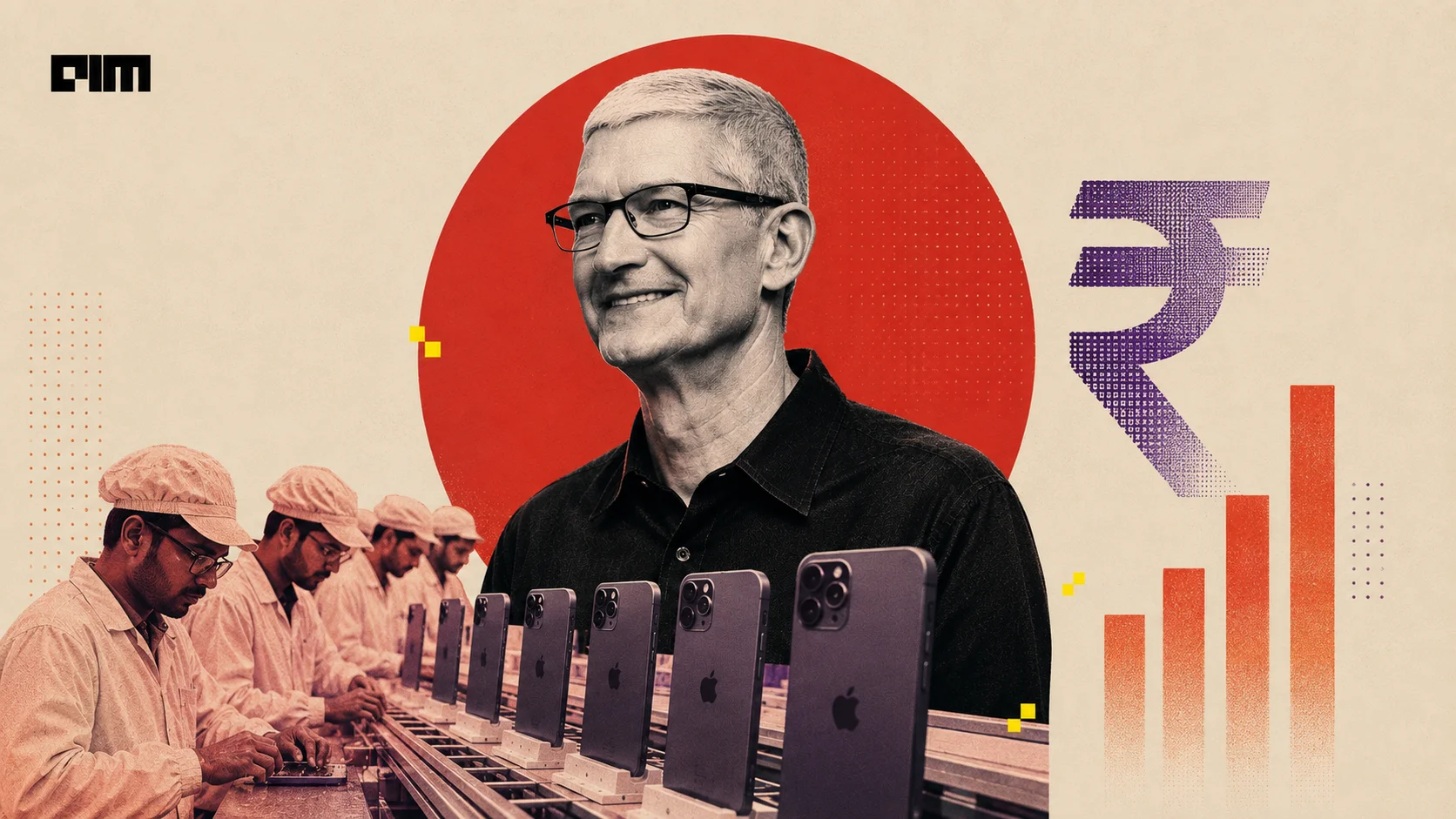
The last few months of Tim Cook’s tenure at Apple were perhaps by far the most challenging.
AI became a sticking point as Apple grappled with modernising Siri and pushing an AI overhaul to its legacy code that created far more downstream problems for the company.
Then came US President Donald Trump’s increased scrutiny of import tariffs on products from China, which meant that if Apple imported iPhones and hardware made in China, it would at one point be liable to pay a 145% tariff. This aligned with Trump's goal of shifting manufacturing to the US and pressuring China, both aimed at giving the United States an AI edge.
Also, Cook continued to deal with ongoing memory shortages, which have pushed up prices across its Mac lineup.
However, the most recent tariff issue means Cook spent his last few months moving a considerable amount of iPhone assembly from the world’s erstwhile most populous country to the current most populous country—India.
Currently, about 25% of iPhones are assembled in India, with Apple producing around 55 million iPhones there in 2025, compared with 36 million in 2024. For FY26, 78% of the value of iPhones produced in India was exported to the US, while Apple’s India production was worth about $25 billion and iPhone exports reached a record ₹2 trillion.
Apple’s manufacturing network in India now spans Tamil Nadu, Karnataka, and Telangana, with Foxconn and Tata Electronics as its main partners.
Foxconn’s Sriperumbudur facility remains one of India’s largest iPhone plants, while Tata operates assembly facilities in Karnataka and Tamil Nadu. Foxconn has also begun producing AirPods in Hyderabad, while its newer Bengaluru facility near Devanahalli is being built as another major iPhone hub.
The expansion has created more than 250,000 direct jobs across Apple’s ecosystem in India, including around 100,000 women workers. At Foxconn’s Devanahalli facility, women make up around 80% of the workforce.
But the India expansion was years in the making. It started during Cook’s fifth year as Apple CEO, when he first visited India.
May 2016: Cook Makes the India Push
Tim Cook visited India for the first time as Apple CEO in May 2016 and met Prime Minister Narendra Modi. Apple saw India as a growing smartphone market with the potential to follow a ‘China-like trajectory’ and offer fewer geopolitical risks.
Apple also expanded its non-manufacturing presence in India in 2016, opening a development centre in Hyderabad focused on Maps and related software work. This showed that Apple's India strategy was broader than simply assembling iPhones.
May 2017: First iPhone is Assembled in India
A year after Cook’s India push, Apple took its first concrete manufacturing step. In May 2017, Apple began assembling a small number of iPhone SE units at Taiwanese manufacturer Wistron’s Bengaluru facility. It was the first iPhone assembled in India, with the initial devices intended for Indian customers.
January 2018: Apple Pushes for Concessions
In January 2018, Apple executives including Priya Balasubramaniam, its Global VP of Operations, met Commerce and Industry Minister Suresh Prabhu as the company sought manufacturing concessions.
June 2018: Apple Expands Beyond the iPhone SE
Wistron began commercial production of the iPhone 6s at its Bengaluru facility, expanding Apple’s local assembly beyond the iPhone SE.
November 2019: Foxconn Enters India
Foxconn began assembling the iPhone XR at its facility near Chennai. Apple started manufacturing a relatively recent, higher-end iPhone in India, which was also beginning to serve export markets.
India increased the customs duty on imported mobile phones to 20%, strengthening the incentive for Apple to manufacture more of its devices locally rather than rely on fully built imports.
July 2020: Produces Current-Generation iPhone
Foxconn began assembling the iPhone 11 in India. The move showed Apple was becoming more comfortable manufacturing newer and more complex iPhones in the country.
September 2020: Apple’s Suppliers Commit to India
Foxconn, Wistron, and Pegatron committed nearly $900 million in investments over five years under India’s new Production-Linked Incentive (PLI) scheme.
The programme incentivised Apple’s suppliers to increase local smartphone production.
September 2021: Production Commitments reach ₹3.6 lakh Cr
Foxconn, Wistron and Pegatron had committed to producing about ₹3.6 lakh crore worth of smartphones in India over five years under the PLI scheme, with roughly 80% expected to be exported.
2022: China’s Lockdowns Change Apple’s Strategy
India’s manufacturing operation began scaling rapidly, with Apple’s India-made iPhone shipments growing 65% by volume and 162% by value in 2022.
Apple’s share of India’s smartphone production by value rose from 12% in 2021 to 25%.
But 2022 also changed the strategic calculation. COVID-19 lockdowns in Shanghai and major disruptions at Foxconn’s Zhengzhou plant exposed the risks of concentrating production in China. India increasingly became Apple’s “Plan B” for iPhone manufacturing.
February 2023: India Exposes Difficulty of Scaling
Apple’s manufacturing expansion encountered a quality-control problem at a Tata Electronics facility producing iPhone casings in Tamil Nadu, where only about half of components reportedly met the standard needed to be sent to Foxconn.
By FY23, however, India’s iPhone exports had reached roughly $5 billion.
Apple and Tata responded by ramping up engineering and manufacturing expertise at the facility, including hiring specialists and bringing in Apple engineers and designers from California and China to train local teams and establish production processes.
The problem did not stop the expansion. By 2023, Tata was moving into iPhone assembly itself, and by September 2024, Apple was manufacturing the iPhone 16 Pro and Pro Max in India.
April 2023: Apple Opens First Indian Stores
Apple opened its first official retail stores in India in April 2023, starting with Apple BKC in Mumbai on April 18 and Apple Saket in Delhi on April 20. Tim Cook attended both openings, marking another major step in Apple's expansion in the country.
September 2023: India Reaches Global iPhone Launch Cycle
Apple progressed from producing older, lower-cost iPhones in India to manufacturing newer flagship models.
By 2023, customers could buy India-made iPhones on the same day as their China-made counterparts.
October 2023: Tata Enters iPhone Assembly
Tata Electronics completed its $125 million acquisition of Wistron’s iPhone manufacturing operation in Karnataka, making Tata the first Indian company to assemble iPhones for Apple.
April 2024: India makes 1 in 7 iPhones
Apple assembled about $14 billion worth of iPhones in India in FY24, representing roughly 14% of global iPhone production—about one in every seven iPhones. India’s iPhone exports crossed $10 billion.
September 2024: Apple Makes Pro iPhones in India
Apple began manufacturing the iPhone 16 Pro and Pro Max in India, meaning the entire iPhone 16 lineup was now being produced in the country.
This marked the first time Apple manufactured its Pro models in India.
January 2025: Tata Takes Greater Control
Tata Electronics acquired a 60% stake in Pegatron’s iPhone manufacturing operation near Chennai, with Pegatron retaining 40% and providing technical support. The deal brought another major Apple manufacturing facility under Tata’s control.
April 2025: Apple Expands Beyond iPhone
Foxconn began producing AirPods at its Hyderabad facility for export. India no longer just an iPhone assembly base; Apple was beginning to build a broader product-manufacturing ecosystem there.
March–May 2025: Escaping China
As US tariffs threatened China-made iPhones, Apple sharply increased exports from India to the US. Between March and May 2025, 97% of Foxconn’s India-made iPhone exports went to the US, worth about $3.2 billion.
Tata also sent about 86% of its India-made iPhones to the US during March and April.
The company also chartered cargo flights to transport 600 tonnes of iPhones from India to the United States. As a result, Indian airport authorities reduced the customs clearance time for the aircraft from 30 hours to six hours.
FY26: India Becomes Major Apple Export Hub
Apple’s India iPhone production reached roughly $25 billion in FY2026, while iPhone exports reached a record ₹2 lakh crore. About 78% of the value of iPhones produced in India was exported to the US.
Government trade data also show India’s smartphone exports to the US reached $19.67 billion in FY26.
The China Problem Hasn’t Disappeared
Apple may be moving iPhone assembly out of China, but India’s manufacturing ecosystem is still heavily dependent on China.
Foxconn’s India operations reportedly rely on Chinese-made machinery for 70–80% of their equipment, including testing machines, precision metal components, assembly tracks, circuit boards, and tool-making equipment.
And it is not just equipment. China has also supplied the skilled workers needed to get these factories running.
In January 2025, Foxconn stopped new rotations of Chinese employees to its Indian iPhone plants, with sources saying that both “equipment and manpower” were being restricted from moving to India.
Then, in July 2025, more than 300 Chinese engineers and technicians had reportedly left Foxconn’s Indian factories after being asked to return to China.
And India is still largely doing FATP, final assembly, testing, and packaging rather than reproducing the enormous supplier ecosystem that exists around Apple’s factories in China.
During his tenure, Cook was vocal about the need to diversify Apple’s supply chain and reduce its dependence on any single country.
And while Apple now has a manufacturing base in India that would have been difficult to imagine when Cook first visited the country in 2016, the next question is how far that diversification goes.
That decision now sits with John Ternus, who is set to announce the iPhone 18 lineup in a few weeks.

Your reaction
Discussion
What's your take on this story?
No comments yet — be the first to share your view.