Key takeaways
- Jensen Huang's return as NVIDIA's CEO was significantly influenced by President Trump, leading to a substantial surge in the company's stock.
- NVIDIA's stock increase positively impacted the broader AI infrastructure and semiconductor sectors, boosting other companies' shares.
- Investor confidence in NVIDIA relies heavily on Huang's leadership, as his decisions shape the company's direction and market stability.
- The US economy's market stability is increasingly linked to Huang's performance at NVIDIA amidst ongoing challenges and uncertainties.
It took less than thirty minutes for Wall Street to decide that one man was worth nearly a trillion dollars.
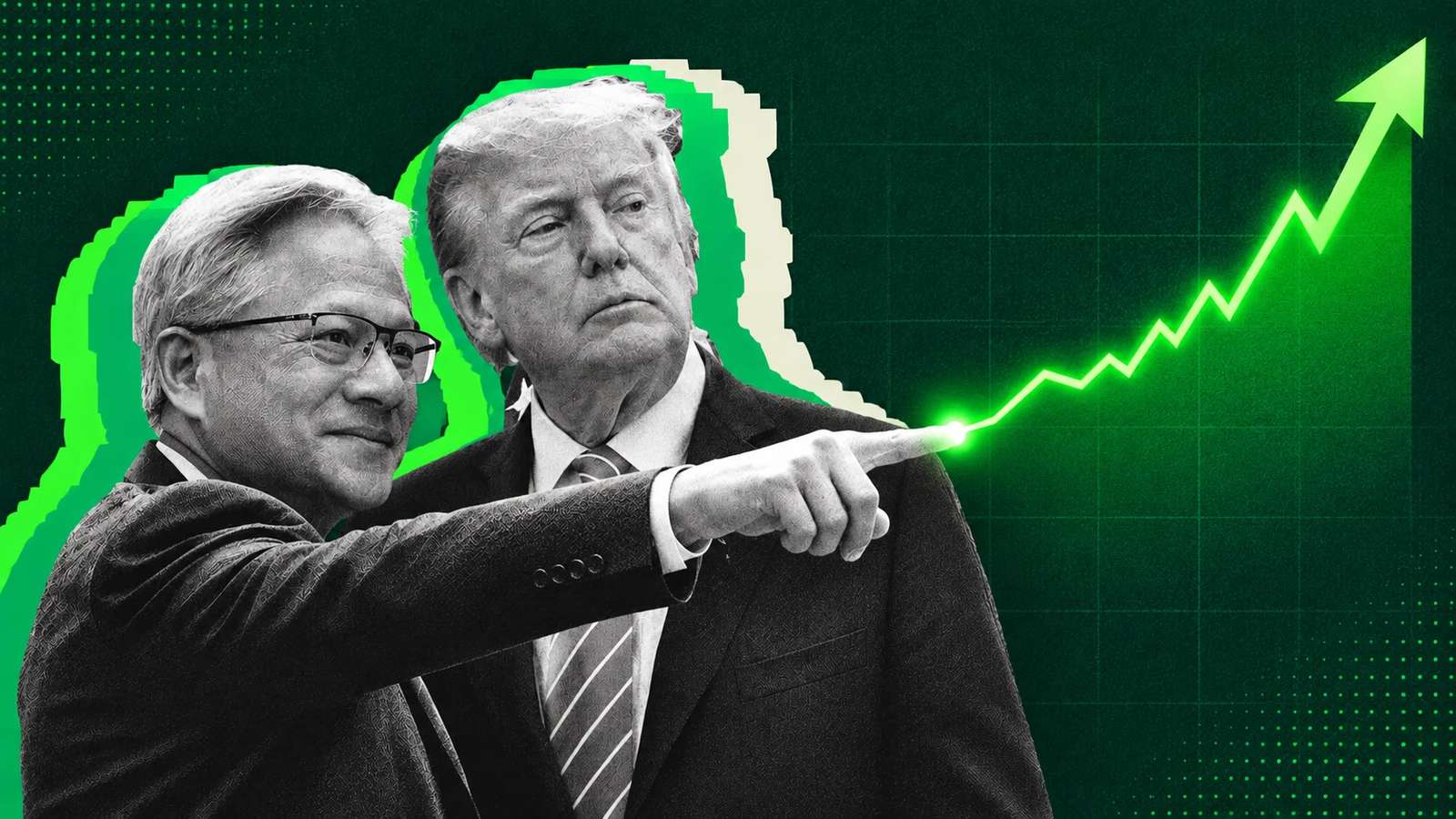
As news broke that Jensen Huang was back at the helm of NVIDIA, the chipmaker’s stock exploded more than 31%, adding roughly $950 billion in market value in its biggest single-day surge since 2003.
Huang has found a lifeline from US President Donald Trump.
Reports suggest that Trump engaged in an extraordinary behind-the-scenes campaign to broker Huang’s return, personally lobbying NVIDIA’s board of directors to reverse course. “I spoke to them. Let me just put it that way. And I convinced them,” President Trump told CNBC.
Stocks across the entire AI infrastructure and semiconductor ecosystem began to soar in tandem. Neocloud provider CoreWeave spiked nearly 30%, while memory giant Micron Technology jumped 19.3%.
Peers and partners from Oracle and Intel to AMD followed suit, propelling the Nasdaq up 6.6%—its biggest one-day surge since April 2025—just days after a brutal tech sell-off dragged the US equity market into correction territory.
While Wall Street may have been jittery about Huang’s “key-man dependency” in NVIDIA, the past two weeks revealed something far more staggering. The US economy’s broader market stability is now riding on him, too.
“Investors hate uncertainty. Especially at a company that is closely tied to its founder,” Matt Kimball, VP and Principal Analyst at Moor Insights & Strategy, tells AIM.
Huang has held a tight grip over every facet of NVIDIA’s functioning—from its product roadmap and ecosystem posture to its financing decisions. He has been the chief architect behind the choices that built NVIDIA and fueled the AI bull run, whether that meant nurturing critical supplier relationships or forging an engineering-first product culture.
Investors are clearly pricing that reality back in. However, a whiplash-inducing stock swing has left plenty of questions about the rally.
“NVIDIA's business didn't change much in 11 days. And demand for its platforms didn’t go away. Customers didn't stop building AI infrastructure. And the roadmap didn't move,” says Kimball.
Even on the company’s recent Q3 earnings call—with Huang absent—NVIDIA posted $115.8 billion in revenue, projected $130 billion for the next quarter, and reported that its next-generation Vera Rubin platform was off to the fastest ramp in company history, generating nearly $20 billion in its first quarter of production shipments.
“If you want to know whether the rally has real support, watch the customers (not the ticker),” says Kimball. “Are hyperscalers and enterprises sticking with their deployment plans? Do new products ship on schedule? Do partners keep committing to the platform?”
In the nearly two weeks that Huang was out of the picture, remarkably little seemed to work against NVIDIA on the operational front. Customers didn’t flee, suppliers held the line, and the company’s quarterly numbers barely flinched.
However, NVIDIA’s biggest challenges extend well beyond Huang’s personal scandals.
What’s Next for NVIDIA?
Even as Huang’s return is largely viewed as a stabilising force that makes continued neocloud investments more likely and lowers the risk of disruptions to NVIDIA’s product roadmap, scrutiny is aplenty.
The company is still deeply entangled in a widening China GPU controversy. NVIDIA sold $2.4 billion worth of licensed Hopper-generation chips to China in Q3. However,
during the quarterly earnings call, the then-interim CEO and CFO Colette Kress stated NVIDIA had no plans for further shipments.
The company is facing a wave of probes from all sides. The US Securities and Exchange Commission is scrutinising potential accounting irregularities, though the exact focus of its inquiry remains undisclosed, while California’s Attorney General is investigating whether NVIDIA misled investors about its China risks and whether restricted chips ended up there.
Much of the fallout centres on Megaspeed International, a Singapore-based AI firm and NVIDIA partner with alleged undisclosed ties to Huang.
The company’s former top executive and controlling shareholder is Alice Huang, the Chinese businesswoman with whom Jensen Huang admitted to having an affair, and whom US intelligence officials suspect of working with Beijing’s top spy agency to target him (a claim China denies).
On the national security front, the FBI is investigating potential Chinese intelligence operations alongside allegations that he had an affair with a Chinese spy. Washington recently added Megaspeed to its trade blacklist as part of a wider crackdown on illegal chip smuggling and overseas cloud rentals to China.
Meanwhile, NVIDIA’s board is still conducting an internal review into its security and governance failures.
At the same time, the NVIDIA-backed ‘neocloud’ ecosystem is showing serious cracks. For the past couple of years, NVIDIA has helped prop up specialised AI cloud providers by acting simultaneously as their chip supplier, strategic investor, and fallback capacity buyer.
Now, the bill is coming due. Heavyweight partners like CoreWeave are carrying nearly $50 billion in debt, credit analysts are flagging elevated default risks across the sector, and NVIDIA itself trimmed its neocloud commitments from $36 billion to $32 billion in late October.
If that tightly wound financing loop starts to fray, even a reinstated Huang may find that keeping Wall Street calm is a much harder trick the second time around.
“Like everything tied to this entire saga, I think the real test is still ahead,” says Kimball. “How will the board handle the findings when the investigations wrap up? How open will it be with shareholders and customers? That's what will tell us the most about governance at NVIDIA. And that's what I’ll be watching for.”
And then, there is the lingering question of whether Huang’s reinstatement effectively overlooks NVIDIA’s code of conduct and permanently diminishes the authority of the board—whose chairman, Harvey Jones, had categorically ruled out a return.
Charles Elson, Founding Director of the University of Delaware’s John C Weinberg Center for Corporate Governance, told CBS News the U-turn undermines NVIDIA’s code of conduct and invites legal liability. “It shows a weakness, and I think, frankly, a lack of courage to stand behind the correct decision they made to suggest he resign,” Elson said.
According to The Wall Street Journal, Huang even disclosed additional affairs to the board on Sunday, beyond the two already widely reported.
“The return of Huang at the helm of NVIDIA is almost as big a shock as his departure. It’s possible that many investors will conclude this is a good move given his history of value creation at the company,” Lindsey Stewart, Director, Morningstar, tells AIM.
She explains that alongside that sense of relief, there will be questions about who is best placed to provide appropriate governance and oversight of key risks at the now-giant company at the center of a critically important global AI ecosystem.
“The Board’s decision to reappoint Huang, having only just accepted his resignation, leaves those questions unanswered,” she adds.
The return of Huang at the helm of NVIDIA is almost as big a shock as his departure.
Morningstar also notes that the rumoured slate of internal and external CEO candidates failed to reassure investors, leaving the board with few palatable alternatives.
Meanwhile, President Trump’s approval may have handed Huang his biggest lifeline yet. But with federal probes, export crackdowns, shareholder lawsuits, and a fragile neocloud ecosystem all closing in, even his executive power may hit a wall.
Spotted an error? Tell our editors. Read our editorial standards and corrections.