


The discourse around India needing to strengthen its initiatives in sovereign AI models has largely been driven by the expectations set by the country’s demonstrated capabilities in building sovereign digital products, with UPI frequently cited as an example.
The technology that powers 24 billion transactions every month is built entirely using open-source technologies.
The parent organisation, the National Payments Corporation of India (NPCI), is giving back to the open-source community.
In a presentation at KubeCon CloudNativeCon India 2026 in Mumbai, Tittu Varghese, a senior specialist at NPCI, offered insights into both aspects.
Scale, Throughput, and Open Source Foundations
The underlying infrastructure processes 2,40,000 API requests per second across 684 member banks. The system spans four active-active datacenters to handle peak loads seamlessly.
Peak business transaction volumes hit 24,000 per second, with an average throughput of 17,000 transactions per second. Furthermore, internal processing P99 latency remains at 100 milliseconds, and real-time fraud checks are completed in 75 milliseconds.
“We launched UPI in 2016 and reached our first billion transactions by 2019. In a very short time, we scaled massively into a national payment system,” Varghese noted.
To achieve this scale, the architecture utilises a strictly open-source foundation.
“We operate a UPI infrastructure on a 100% open source stack. People used to ask, ‘Can we really scale and build infrastructure only with open source?’ UPI's growth is a testament to that. We can actually operate critical infrastructure using only open source at a massive scale,” Varghese noted.
Varghese emphasised the reliability of this approach, explaining that the setup ensures seamless failover, with any localised state breakdown immediately bypassed by the system. Therefore, a user’s subsequent payment attempt succeeds without interruption.
Varghese explained that UPI guarantees a P99 latency of 100 milliseconds at the internal processing layer.
He explained that the infrastructure operates entirely ‘in active-active’ configuration, because multiple data centres run simultaneously and share the workload, any localised transaction failure or state error is instantly bypassed, ensuring that a user’s subsequent payment attempt is routed through a healthy path and completed successfully.
To manage this scale without a single point of failure, the engineering team adopted a platform approach characterised by deep software abstraction.
Varghese explained that they consciously constructed an architectural model designed to standardise operational workflows, streamline backend visibility, and expose clear data pathways to internal teams. He pointed out that this structural diversity was intentionally engineered to eliminate single points of dependency or structural failure across the network.
Rather than relying on proprietary software, the stack is built using a diverse set of community-backed programming languages, robust database and caching solutions, and high-throughput messaging streams. Containerization and orchestration tools manage the deployment. Meanwhile, comprehensive observability and logging platforms ensure system health is monitored in real time.
Data Processing Pipelines and the AI Factory
Information moves from data sources through dual processing pipelines to handle the sheer volume of daily transactional records.
Varghese detailed how every core backend platform routinely publishes transactional events directly into a central streaming channel.
From there, automated engines pick up the logs, apply necessary transformations, and offload them into cost-effective object repositories.
“Every backend system writes directly into a Kafka stream, which we then read from,” Varghese explained. “We use an Apache stream processing system that parses every event and executes all the required transformations, before writing the data into simple object storage—either via S3 or a managed storage tier.”
A stream processor manages real-time data flow while a batch processor handles large-scale transformations.
Both tracks feed into unified storage and data repository layers. From this centralised storage, a federated query layer and an online analytical processing (OLAP) data service make the information accessible.
Varghese noted that this accessible format was deliberately designed to democratise access to internal intelligence. As a result, product, corporate, support, and engineering divisions can explore data and execute analytics autonomously.
This architecture also supports machine learning models and use cases, creating a unified flow from raw data ingestion to model inference.
Fraud prevention requires parallel AI processing integrated directly into the transaction flow. As request volumes grow, so does the probability of fraudulent activity. However, Varghese stated they successfully met this challenge by creating specialised internal intelligence teams as early as 2019 to handle high-velocity data training and inference workloads.
“Our team implemented models which created three types of fraud scenarios in real time, responding under twenty milliseconds. So, twenty milliseconds is a guarantee. It detects the fraud. It either declines or gives feedback to the bank so that they can take care,” he explained.
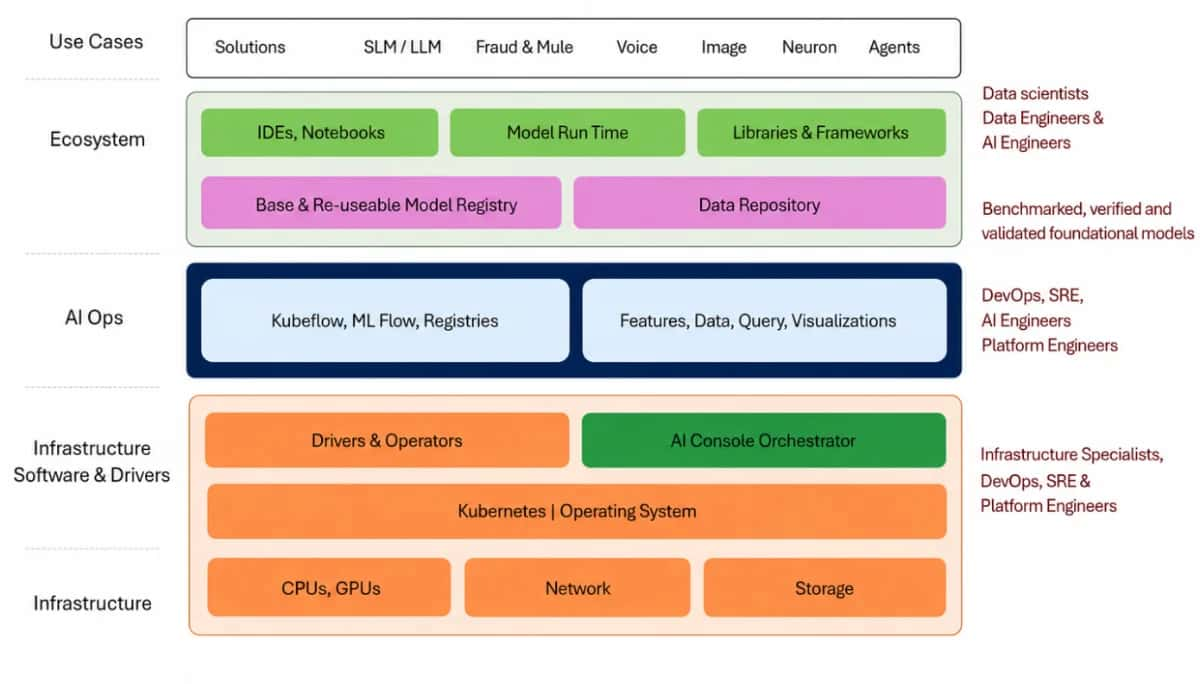
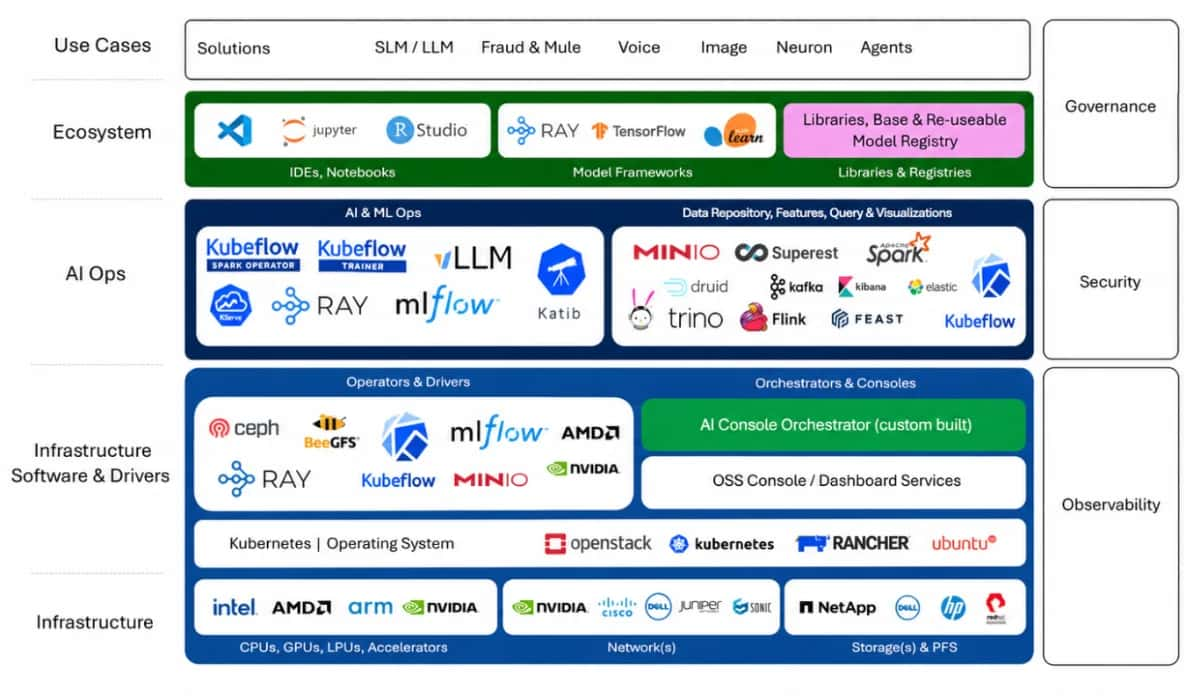
The AI environment organises into a comprehensive Full-Stack AI Factory.
Source: Presentation from Tittu Varghese at KubeCon 2026, Mumbai
Varghese discussed how separating the platform into highly distinct operational layers allowed them to establish clean abstraction lines. Furthermore, this gave engineers the agility to launch fresh production models daily without disrupting core application pipelines.
The platform is divided into distinct functional layers to separate hardware operations from machine learning workflows. The base infrastructure layer relies on a mix of standard CPUs, GPUs, and network-attached storage managed by infrastructure specialists. Above this, the software and drivers layer provides the operating system foundation and orchestration consoles.
The AI Ops layer manages data repositories, feature extraction, and model training pipelines. Finally, the ecosystem layer provides data scientists and engineers with the necessary IDEs, model frameworks, and registries to build and deploy solutions for specific use cases like fraud detection, voice recognition, and large language model integration.
Source: Presentation from Tittu Varghese at KubeCon 2026, Mumbai
Democratising Technology and Giving Back to Open Source
After years of customising open source tools to build this sovereign infrastructure, NPCI is returning its specialised developments back to the public domain.
The organisation hosts its open-source projects on GitHub as part of the broader digital public infrastructure ecosystem.
“Many of the open-source projects we use were initially customised for our own internal needs, but we have recently started giving them back to the community,” Varghese noted. “Practically all the enhancements we've built are now being open-sourced.”
The initial release includes four foundational tools. DRUNIX is a high-performance, enterprise-grade distributed ledger platform built to address scalability, reliability, and operational challenges in large-scale blockchain deployments and digital asset platforms.
Varghese noted that the platform was custom-tuned specifically to optimise transactional API throughput under massive, nation-scale demand constraints.
Meanwhile, FiMI is a domain-specialised small language model developed and fine-tuned for the Indian financial ecosystem, featuring multi-agent orchestration and tool-calling support.
According to Varghese, the model was designed to parse localised contextual nuances, natively understand transactional behaviour, and directly resolve customer disputes or payment queries.
FALCON serves as a template-based operator for managing and deploying production-grade blockchain networks at scale, reducing the provisioning time for network nodes by 80%.
The fourth project, VIGIL-AI, is a collection of open-weight models created for large-scale payment fraud detection, derived directly from the fraud modelling executed across various internal payment projects.
- Enmovil Plans to Quadruple FDE Team as Enterprise AI Hiring Moves Beyond Coding
- Does the World Need a New GitHub?
- Can India’s AI Boom Reach Bharat?
- AI's Next Agritech Frontier Is India's Fragmented Supply Chain
- India’s Frontier AI Race Gets a 240M Model That Beats Liquid AI
- The AI Slowdown Narrative Doesn’t Reflect Enterprise Reality