
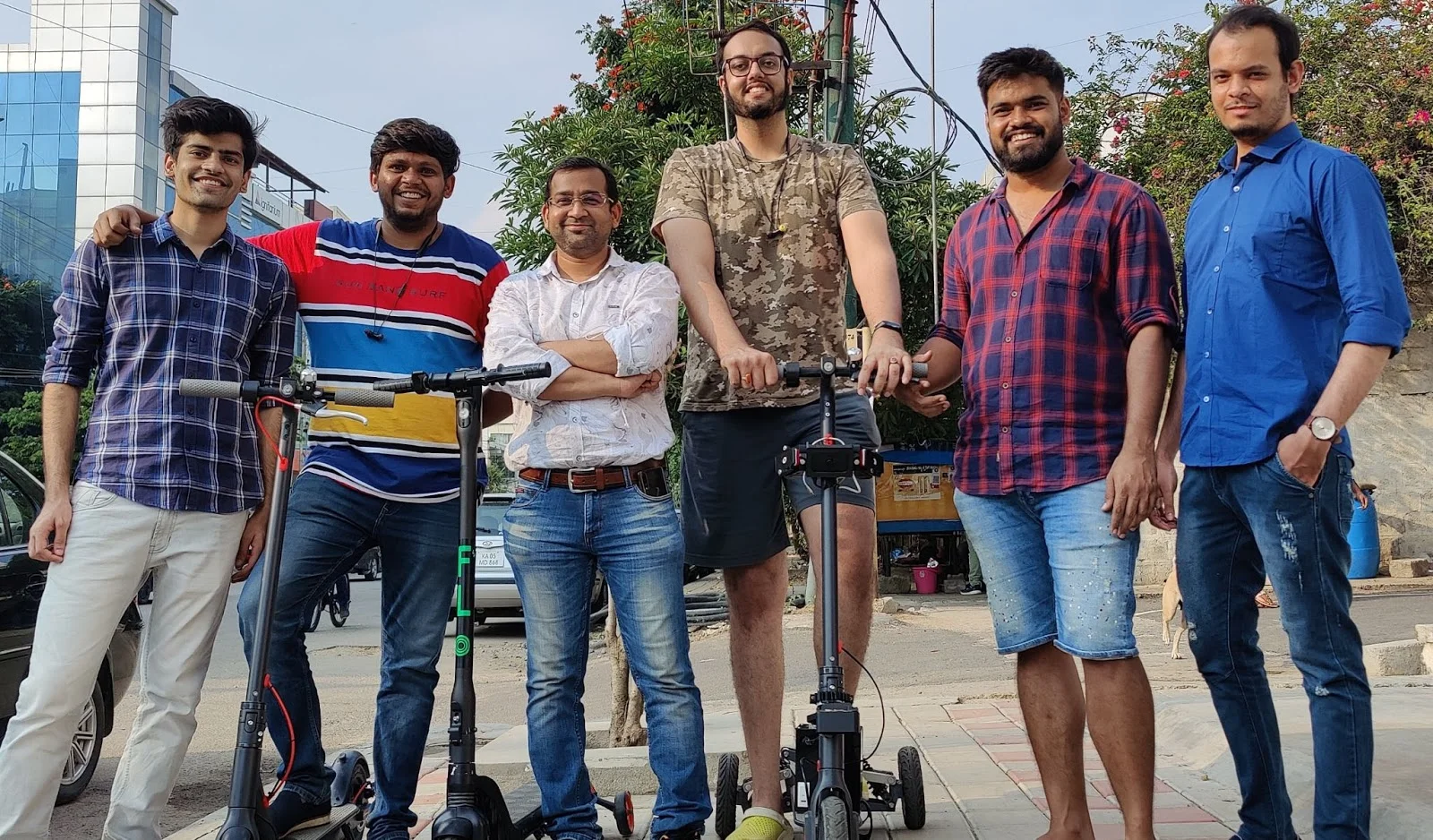
For this week’s startup feature, Analytics India Magazine spoke to Manesh Jain, co-founder and CEO at Flo Mobility to understand how the Bangalore-based startup is building smart and sustainable transport solutions for everyone.
Founded in 2019 by Manesh Jain and Angad Singi, FLO Mobility aims at automating e-scooters by controlling them without any on-field human intervention, solving electric vehicle fleet problems like optimising charge cycles, last-mile movement to match demand supply, vehicle cluttering and paving the way to build seamless micro-mobility operations.
The company’s vision is to build a completely autonomous, covered, self-balanced electric two-wheeler, to take riders to their destination by itself. Instead of riders reaching the pick-up spot, e-scooters reach riders’ location based on remote Teleoperated vehicle movement.
Flagship Products
The startup has come up with a Teleoperations kit called FLO-TOK that can be installed on existing electric two wheelers. The hardware includes cameras, sensors, electronics and communication modules, motors, support wheels etc. FLO’s teleoperation software can be integrated with prevalent ride-hailing apps. The software comes with an admin panel, the tele-ride allocation algorithm and haptic feedback bridging the interface between passenger app and back-end module in real-time.
Jain said, “As part of the ride-as-a-service offering, the company has come up with a driver training simulation module as well. FLO’s Unique Simulation-based training system will guide teleoperators to drive the e-vehicle hassle-free in varied weather conditions, across different terrains and surroundings.”
What’s The Differentiator
“Most of the other products in the segment rely on Lidar to do the sensing and create a point cloud. Lidar is ugly, costly, high maintenance and non-scalable. With the rapid developments in camera systems and camera vision, we believe a camera for sensing the environment is an apt tool. So, we rely on cost-efficient cameras for the sensing and then smarten up our algorithm to make up for the intelligence,” said Jain.
Jain added, “Another advantage we have is building this technology in the worst environment for self-driving cars. For egs, all our foreign competitors start with the detection of lanes. We have to develop our algorithms in a way that there are no lanes. Our algorithms detect the possible end of the road on the left side and control the vehicle in a way that is 50 cm away from the end in case of slow vehicles. Distance increases in the case of high speed or heavy vehicles.”
Use of AI & IoT at FLO Mobility
FLO Mobility uses feed optimisation algorithm, operator allocation algorithm, computer vision for object identification, and autonomous stack algorithms for perception, localisations, path planning, sensor fusion, etc.
The company has developed an autonomous repositioning solution for electric two-wheelers using an IOT and hardware stack consisting of cameras, sensors, sonar, edge processors and controllers. The core tech stack includes:
- Teleoperations, Computer vision, Embedded systems
- Tech Framework: Robot operating system (ROS), webRTC tunnelling, OpenCV based Object Detection, Edge video streaming and action relay.
Hiring at FLO Mobility
Jain said, “We cannot just rely on resumes and CV and will have to look beyond them. So, we now try to find out all the exciting projects done by university students and reach out to them for hire. We also plan to run some autonomous driving hackathons nationally to find the best talent possible out there. Since we are burdensome on research and development, we mostly look for the hunger for learning and execution while hiring. We look out for initiatives the person has taken. Other soft skills include very clear and apt spoken and written communication.”
Roadmap
“In the next 18 months, we plan to deploy autonomous e-scooters in 15 residential, educational and industrial campuses in India and expand the technology to the Middle East, Europe, the US and South Korea. The future roadmap is evident to us. We will deploy our autonomous hardware stack on smaller and slower form factors like electric scooters and delivery bots. Initially, these will be monitored by a human operator who will take control of the vehicles immediately in case they need assistance. Going forward, once our algorithms are trained with enough corner cases, our dependence on human operators will decrease, and the system will start becoming more and more autonomous. We will be able to attain full autonomy for small and slow vehicles in the next five years,” said Jain on a concluding note.

Your reaction
Discussion
What's your take on this story?
No comments yet — be the first to share your view.