

As Chinese open-weight AI models were beginning to see widespread adoption in the United States, Beijing is reportedly considering tightening its control over their global availability.
According to a Reuters report, Chinese authorities are discussing measures to restrict overseas access to the country’s most advanced AI models. The discussions reportedly involved China’s Ministry of Commerce, along with leading AI companies, including Alibaba, ByteDance, and Z.ai.
Chinese open-weight models have now emerged as an attractive alternative to increasingly expensive proprietary AI models from US companies. They offer comparable capabilities at a fraction of the cost, while also giving developers the flexibility to self-host, fine-tune, and deploy models on their own infrastructure.
Companies including Coinbase, Shopify, and Airbnb have publicly used or experimented with Chinese models such as GLM, Qwen, and Kimi, while millions of developers have embraced them through open-weight deployments or low-cost APIs.
On OpenRouter, a platform that lets developers access and compare AI models through a single API while routing requests to different providers, Chinese open-weight models have seen a sharp surge in usage over the last year. Their share rose from 20% in September last year to 55%, and is still growing, as of last month.
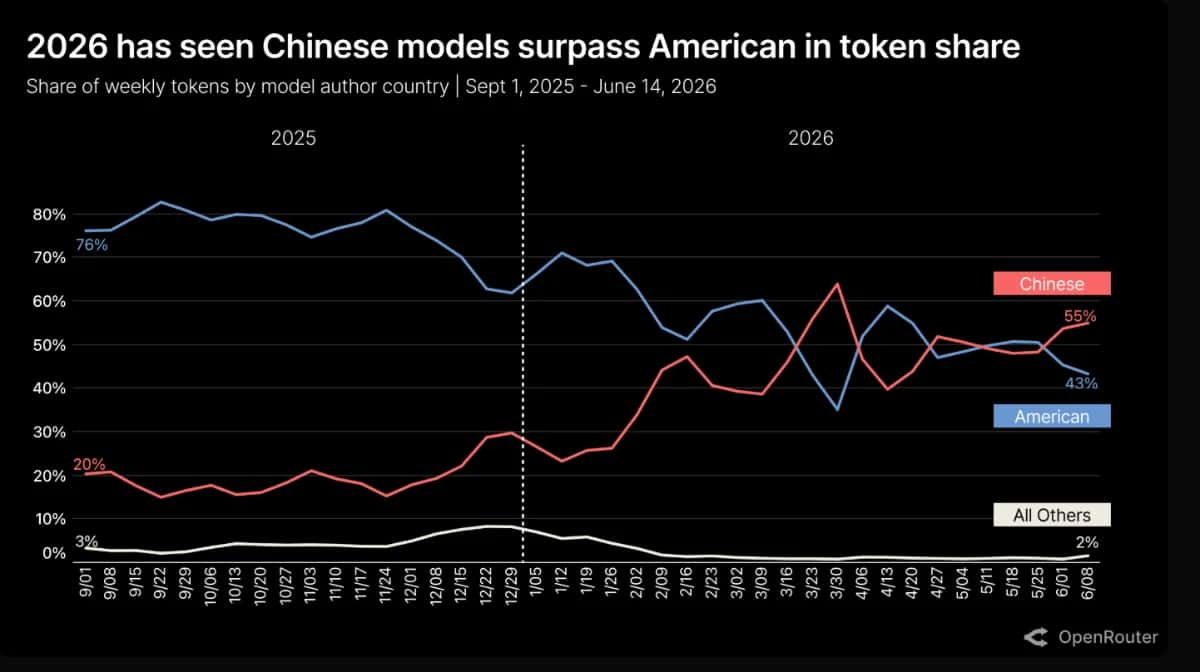
Image: OpenRouter
Earlier this year, Alibaba’s Qwen surpassed 700 million cumulative downloads on HuggingFace, a platform where developers can access open-weight models, overtaking Meta’s Llama. The Qwen3 family alone generated more monthly downloads than OpenAI, Mistral, NVIDIA, Zhipu, Moonshot, and MiniMax combined.
The Chinese restrictions may only apply to future models rather than those already released, and the country is considering stronger penalties for theft or leakage of frontier AI technology.
More importantly, the discussions, which were reportedly held in May, suggest that legal experts are proposing a tiered regulatory framework rather than a blanket restriction on open-source AI.
Basic open-weight models would largely remain accessible under filing or registration requirements, while increasingly capable models would undergo greater security scrutiny. Only the most advanced frontier models, particularly those with national security implications or risks of irreversible global dissemination, would face the strictest controls.
The released documents from the meetings also emphasise the need to balance openness with security, warning that once frontier model weights are publicly released, they cannot realistically be recalled or contained. Having said that, even if China does not impose a blanket restriction soon, prolonged discussions alone could mark the beginning of the end of cheap and accessible Chinese open-weight AI models.
Tit for Tat?
“I suspect a big part of it is simply policy parity,” Rui Ma, an analyst of the China tech ecosystem and Founder of TechBuzz China, tells AIM. “If the US increasingly treats frontier AI models like export-controlled assets, China may feel it should have the same policy tools.”
Similarly, Kyle Chan, a fellow at the John L Thornton China Center at the Brookings Institution, also suspects that this is a consequence of the heated debate in the US over AI regulation and export controls.
“In the US, the primary driver is concern that American frontier models could uplift bad actors, be they adversarial nations or non-state actors,” says Chan. “For China, the main concern may be about data security and tech leakage via the model weights themselves.”
Washington intervened in the release of Anthropic’s Fable and Mythos models, temporarily restricting foreign access due to cybersecurity concerns, while OpenAI reportedly delayed the broader rollout of its flagship GPT-5.6 Sol after discussions with the US government about national security risks.
The growing popularity of Chinese open-weight models in the US means Beijing is increasingly likely to view them through a national security lens.
Ma also believes that even if access isn’t restricted immediately, China would want to initiate dialogue to avoid being the only side without leverage. “It's less about ‘weaponising’ AI and more about ensuring reciprocity if frontier models are now viewed as strategic infrastructure,” she adds.
Not a Surprise
The discussions also echo China’s recent decision to block Meta’s acquisition of Manus and unwind the deal on national security grounds. Reports suggested that some AI founders and engineers, including those linked to Manus and DeepSeek, have faced travel restrictions amid concerns over technology leakage.
Dermot McGrath, Founder of Shanghai-based AI research and advisory firm ZenGen Labs, says the move isn’t surprising. He points to how the Ministry of Commerce has classified AI technologies under its export control catalogue since 2020, a provision notably used to complicate the transfer of TikTok’s recommendation algorithm.
More recently, China amended its Foreign Trade Law to introduce criminal penalties for unauthorised technology exports, while the government’s intervention in the proposed Manus acquisition established a fresh precedent for treating frontier AI companies and technologies as strategic national assets.
“The pattern is capital controls, then talent controls, now model controls. It's the same instinct applied to a different layer of the stack,” he says, pointing to how the Chinese government has historically intervened when capital and talent were being shipped out of the country.
He also adds that the adoption of Chinese AI in the US was a validation. “Qwen and DeepSeek proving they could compete on American developers' turf did more for China's AI credibility than any government report,” he says.
What Next?
“If restrictions come, they'd be a pre-release gate on future frontier models, not a recall of existing ones,” says McGrath.
He adds that the roadmap for mid-tier and small models is unlikely to change, and that they will continue to be released as open weights. “The scholars who proposed the tiered framework at the Supreme People’s Court roundtable in May explicitly acknowledged that released open weights cannot be recalled.”
They may follow the precedent set by Alibaba’s Qwen 3.7-Max. Even seven weeks after its launch, the company’s frontier model remains closed-source, available only via API.
Moreover, another event suggests that the country may eventually move towards a closed-door approach. In March, Lin Junyuang, the technical lead for the Qwen team who led the open-source strategy, resigned after Alibaba reorganised the team away from a research-first structure towards commercial goals. Several core contributors followed suit.
Besides, putting frontier models behind API pricing would also increase revenue for Chinese AI companies whose models were otherwise self-hosted.
“Open-source downloads and Hugging Face derivative counts no longer justify the investment; the team needs to drive revenue through Alibaba Cloud,” says McGrath.
Even as revenues of Chinese AI labs surge, both Big Tech and pure-play AI startups that have gone public still run their LLM businesses as loss-making divisions.
Alibaba’s ‘All Others’ segment, which is largely driven by Qwen, reported an EBITA loss of $2.94 billion in the second quarter of fiscal year 2026. Zhipu (Z.ai) reported a net loss of RMB 4.72 billion ($657 million) in 2025, driven largely by R&D spending and rising compute costs. MiniMax likewise posted a loss of $1.87 billion for the year, with R&D expenditure of $252.8 million far outpacing its $79 million in revenue.
Welcome Move for Chinese Companies?
Having said that, these restrictions would not be devastating for Chinese companies, as much of the global usage of Chinese open models has come from overseas inference providers or companies self-hosting them.
“So restricting a handful of frontier models wouldn’t eliminate their entire international footprint,” says Ma.
Moreover, Chinese AI models are seeing strong adoption domestically, while video generation and entertainment have emerged as major commercial opportunities.
Models such as Kuaishou’s Kling AI are already generating meaningful revenue, and platforms including ByteDance’s Seedance are driving monetisation through AI-powered content creation, advertising, and creator tools.
With OpenAI shutting down Sora, Chinese video AI models are leading the way in performance. These models occupy the top spots in rankings by Artificial Analysis, even outperforming Google’s Veo 3.1 models.
That gives Beijing clear leverage.
“If Beijing draws a clear line around what can and can’t be exported, companies can plan around it,” says Ma. “That's one advantage of regulatory clarity: even restrictive rules can be easier to manage than constantly trying to anticipate where policy is headed.”
If China can offer a policy that is more evolved and in line with the capabilities of frontier models than the United States’, it could make long-term planning easier for labs in China, adds Ma.
And perhaps the restrictions could also add another, less obvious dimension for these Chinese AI labs: positive marketing.
“If a model is treated as strategically important enough to warrant export controls, it reinforces the perception that it's truly frontier-class,” she notes.
- Industry Wants Faster Approvals and Cheaper Power in India’s Data Centre Policy
- Inside Jio Platforms: Its Tech Bets, Loss-Making Subsidiaries and Hidden Risks
- India’s GCCs to Add 1.4 Million Jobs, Drive 170 Million Sq. Ft. Office Demand by 2031
- AI Can Be Cyborg or Centaur. But Can Enterprises Monetise It?
- AMD’s Server CPU Business Faces a New AI Boom
- How an Engineer Is Using AI to Bridge the Accessible Education Gap