

For the last two years, enterprise AI has largely been an exercise in experimentation. Companies deployed chatbots for customer support, copilots for developers, and internal assistants for employees. Proofs of concept are abundant, but large-scale transformation remains elusive.
That gap between experimentation and execution is precisely what EY wants to solve.
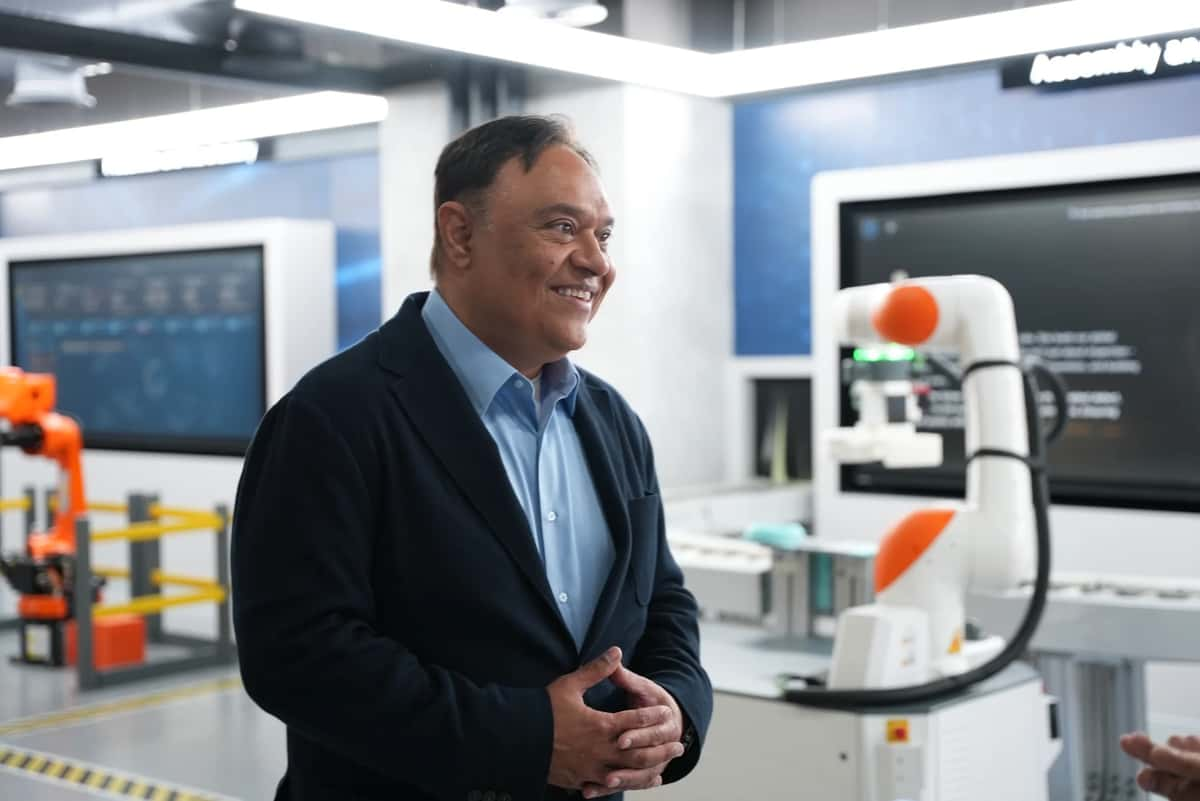
Last month, EY Global Delivery Services launched the ey.ai Center for Reimagination in Bengaluru, a 40,000 sq ft immersive experience centre designed to help enterprises understand what AI transformation looks like when it extends beyond individual applications and begins reshaping entire industries.
“AI is moving beyond experimentation,” Ajay Anand, Global Vice Chair of Global Delivery Services at EY, told AIM during an exclusive walkthrough of the centre. “We wanted to show an overall end-to-end impact of AI on different sectors.”
The launch comes as the consulting industry itself undergoes a significant transition.
For much of the generative AI cycle, consulting firms focused on helping clients identify use cases, build pilots, and establish governance frameworks. Increasingly, conversations have shifted towards execution, integration, and organisational redesign.
"The ey.ai Center for Reimagination is where strategy meets execution," Anand said during the launch. "Many organisations are still grappling with what transformation truly looks like at scale."
Inside the Bengaluru Centre
The Bengaluru centre is part of the $1.4 billion investment that EY announced in 2023 over the course of five years.
The experience starts with what EY calls the "Navi world", an environment designed around megatrends and possible futures, before moving into sector-specific demonstrations covering consumer products, industrial manufacturing, life sciences, banking, and energy.
"If you notice, each of the sectors has its own sector look and feel," Anand said during the tour. "Industrial [manufacturing section] looks and feels like a factory floor."
The idea, according to EY, is not to demonstrate individual technologies but to show how AI changes entire value chains.
One demonstration showed how generative AI can help consumer brands design products in real-time. During the walkthrough, the executive showed how a shoe was redesigned using AI-generated recommendations for materials, colours, and design elements, with a realistic prototype generated within seconds.
"This will let consumer companies collaborate with their contract manufacturers and really speed up design," Anand explained. "We've done this with watches as well."
Elsewhere, the centre showcased AI shopping assistants capable of recommending products, tracking customer preferences, and eventually managing household inventory.
"In the future, you won't even have to tell the system that you've run out of milk," he added. "It will understand consumption habits and automatically know when you need something."
The industrial manufacturing section perhaps offered the clearest indication of where enterprise AI spending may move over the next few years.
Unlike consumer AI applications, industrial AI focuses on factories, warehouses, logistics, and supply chains—areas that directly affect productivity and profitability.
"There is so much stuff going on in industrials," Anand said. "People sometimes think it is a boring sector, but when you look at the end-to-end value chain, there is enormous transformation happening."
Demonstrations included AI systems capable of identifying worker fatigue, detecting collision risks between machines and employees, predicting equipment failures, and automating quality inspections.
The centre also showcased what EY described as microfactories—smaller and more flexible manufacturing environments capable of responding quickly to supply chain disruptions.
"Your components are built in different parts of the world… but there are disruptions everywhere. Companies have to be nimble enough to redesign supply chains quickly."
That same philosophy extends into the energy sector.
One of the centre’s digital refinery demonstrations showed how AI could monitor industrial assets through IoT sensors, identify maintenance risks, and adjust production based on market conditions.
Anand used jet fuel demand as an example of how quickly production priorities can shift. "The AI can give the intelligence and recommendations," he said. "But the human still makes the decision."
Jobs and India's Role in AI
Despite growing concerns around automation and job losses, Anand believes the long-term future of enterprise AI will involve collaboration rather than replacement.
"The future is humans and machines," he said. "There will be new jobs created as well."
He compared the current AI transition with previous technological shifts that eliminated some categories of work while creating entirely new industries.
"We couldn't have imagined app developers or social media influencers twenty-five years ago. There will be other things that come up."
EY itself appears to be betting heavily on that outcome. The company is hiring aggressively across AI engineering, data science, cybersecurity, and emerging technologies.
According to Anand, adaptability may become more important than expertise in any single technology. "It is hard to predict exactly where things are going. Being able to learn and being adaptable are really important skills."
The centre also reflects a broader shift underway inside India's technology industry. Global delivery centres were once built primarily around cost efficiencies and operational scale. Increasingly, multinational companies are positioning India as a centre for engineering, product development, and innovation.
Anand sees that transition happening within EY itself.
"I wanted to bring the learnings that I had from Silicon Valley and bring that leadership here," he said. "Our people are not just doing delivery. They are doing innovation. We are the heart of the innovation engine."
Ultimately, the significance of the ey.ai Center for Reimagination may not lie in the robots, digital twins, or immersive experiences. Its role will be defined by how it enables enterprises to move beyond the age of AI experimentation. The next phase will be about redesigning businesses around intelligence rather than simply adding intelligence to existing systems.
- The AI Slowdown Narrative Doesn’t Reflect Enterprise Reality
- India’s Enterprises are Scaling AI. Is the Infrastructure Ready?
- Industry Wants Faster Approvals and Cheaper Power in India’s Data Centre Policy
- Inside Jio Platforms: Its Tech Bets, Loss-Making Subsidiaries and Hidden Risks
- India’s GCCs to Add 1.4 Million Jobs, Drive 170 Million Sq. Ft. Office Demand by 2031
- AI Can Be Cyborg or Centaur. But Can Enterprises Monetise It?