
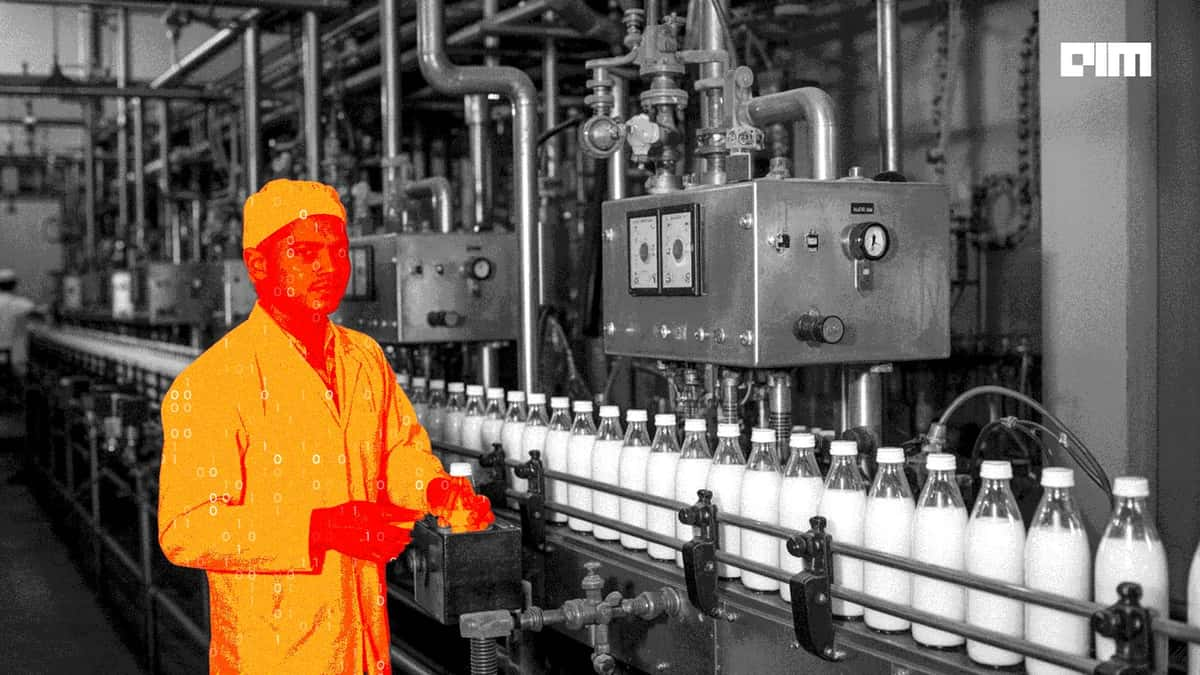

India's AI ambitions are often framed around GPUs, sovereign AI models, data centres, and large language models. Yet one of the country's biggest opportunities for AI-led transformation lies in a sector that receives far less attention: food processing.
Experts from industry, academia, and agritech argue that AI could play a critical role in reducing food wastage, improving quality standards, strengthening traceability, and increasing agricultural exports. However, they also caution that India's food-processing industry must first address fundamental challenges around storage, digitisation, automation, and data collection.
Food processing plays a significant role in India’s economy, with the IMARC Group estimating that the sector had crossed ₹33 lakh crore ($377 billion) in 2025. However, despite being one of the world's largest agricultural producers, India's food processing industry accounts for only 2–2.5% of global food exports.
Speaking to AIM, Shashidhar Subramanya, Head of Corporate Technology for South Asia, Bühler India, believes that the country's biggest opportunity lies not in producing more food but in increasing value addition.
"The export value of food out of India has increased from around $34–35 billion to about $50–51 billion. But if you consider the proportion of food where value addition is happening, it is hardly anything. Only about 20% of the food is getting value added through processing and then exported," he asserts.
Subramanya believes expanding value-added processing could unlock benefits across the entire agricultural value chain. This is where AI can help.
AI's Missing Role
Prasanna Rao, Co-founder and CEO of agritech startup Arya.ag, believes food processing deserves a much larger place in India's AI agenda.
"India is where a significant share of agricultural value is created or lost. It influences food safety, quality, traceability, and post-harvest losses," Rao shares.
"AI can transform the sector through objective quality assessment, contamination detection, intelligent inventory management, and end-to-end visibility into the origin and condition of commodities," he adds.
However, the entrepreneur argues that the industry's biggest challenge is not a lack of computing power. "The bigger constraint today is trusted, high-quality data," he states.
Agricultural commodities vary significantly, depending on geography, crop variety, seasonality, moisture content, storage conditions, and handling practices. Much of this information remains fragmented, manually recorded, or inconsistently measured.
"More GPUs cannot compensate for poor ground truth or inconsistent quality standards," Rao adds.
The observation comes at a time when both the central government and several states are investing heavily in AI infrastructure. While these investments are necessary, experts argue that sector-specific datasets and digital infrastructure may be equally important for unlocking AI's economic value.
From Prediction Engine to Decision Engine
Drawing from Arya.ag's experience across warehousing, quality assessment, financing, and agricultural commerce, he argues that digitisation allows AI systems to move beyond prediction and become operational decision-making tools.
"At Arya.ag, we've seen that when post-harvest operations from warehousing and quality assessment to financing and commerce are digitised, AI shifts from being a prediction engine to a decision engine," he states.
Such systems can forecast quality deterioration, optimise storage and logistics, match supply with demand, improve lending decisions and reduce wastage.
The benefits are not limited to processors or large agribusinesses. "Smallholder farmers and FPOs (farmer-producer organisations) can reduce losses, meet buyer specifications, and realise better prices through trusted quality and traceability data," he says.
Processors, meanwhile, gain greater visibility into available produce and can make more informed sourcing decisions.
How AI is Entering Food Processing
At Bühler, Subramanya has a front-row view of India's evolving food ecosystem. With a presence in India since the early 1990s, it employs around 1,500 people in the country and runs engineering and R&D centres focused on rice, wheat, pulses, coffee, spices, millets, and biscuit-processing technologies. He observes the industry has gradually moved from manually operated plants.
"You look at the number of plants that have been automated in India from the last 20 years until now. We see that in our data as well—from manually operated plants to fully automated plants and plants that are completely run on digital platforms," he believes.
Yet the pace of adoption remains slow.
"We are definitely seeing an uptake, but it is too far and few," he states.
Bühler works with organisations such as Invest India and skill-development initiatives to strengthen industry capabilities. Its approach to AI is built around what Subramanya describes as a three-layer digital architecture.
Its Bühler Insights platform aggregates data from processing equipment, production lines, and factory operations to generate actionable insights.
"It is a secure platform where we can collate data from machines, equipment, upstream and downstream processes and turn them into insights about processing," Subramanya adds.
One practical application is rice milling, where processors can pursue different business objectives such as higher yields, lower energy consumption or better quality.
"There are 10 or maybe 20 different ways that a miller can reach the end goal of producing white rice. One of them is optimised for energy, one is optimised for the highest yield, and another is optimised for the highest quality," he states.
AI can help processors identify the optimal route based on their specific goals and operational constraints.
Robotics Must Be Built for Indian Realities
While AI offers significant promise, Shashank Tamaskar, Associate Professor at Plaksha University, believes India must first solve more fundamental infrastructure challenges.
Tamaskar states insufficient cold-storage infrastructure remains a major bottleneck.
But AI is playing an important role in food quality assessment and spoilage detection before produce reaches consumers. "AI can be used for food quality inspection. Even before you are storing, through AI, you can analyse crop quality," he states.
Tamaskar believes robotics adoption in food processing and agriculture faces a different challenge—economics.
"Indian industry and agricultural stakeholders are very cost-conscious,” he explains.
While automation is already common in large processing facilities, robotics remains largely restricted to packaging and palletisation tasks.
Rather than replicating Western models, he argues that India must build solutions around local realities.
One area of opportunity is addressing labour shortages through affordable technologies that leverage equipment farmers already own. "Farmers already have tractors. If the robotic solution can be propelled by tractors, it can be built as an accessory to the tractor," he says, adding that affordability is critical to such adoption.
The consensus across industry and academia is that AI can transform food processing, but only after the sector builds stronger digital foundations.
- AMD’s Server CPU Business Faces a New AI Boom
- How an Engineer Is Using AI to Bridge the Accessible Education Gap
- AI Agents are Making Human Customer Service a Specialist Job
- Why Nandan Nilekani-Backed F2A Believes India's Investment Opportunity Lies in Edge AI
- India Needs to Build the AI 'Brain' for Robotics, Not Just Import Hardware
- Why Enterprise AI Prototypes Break in Production