
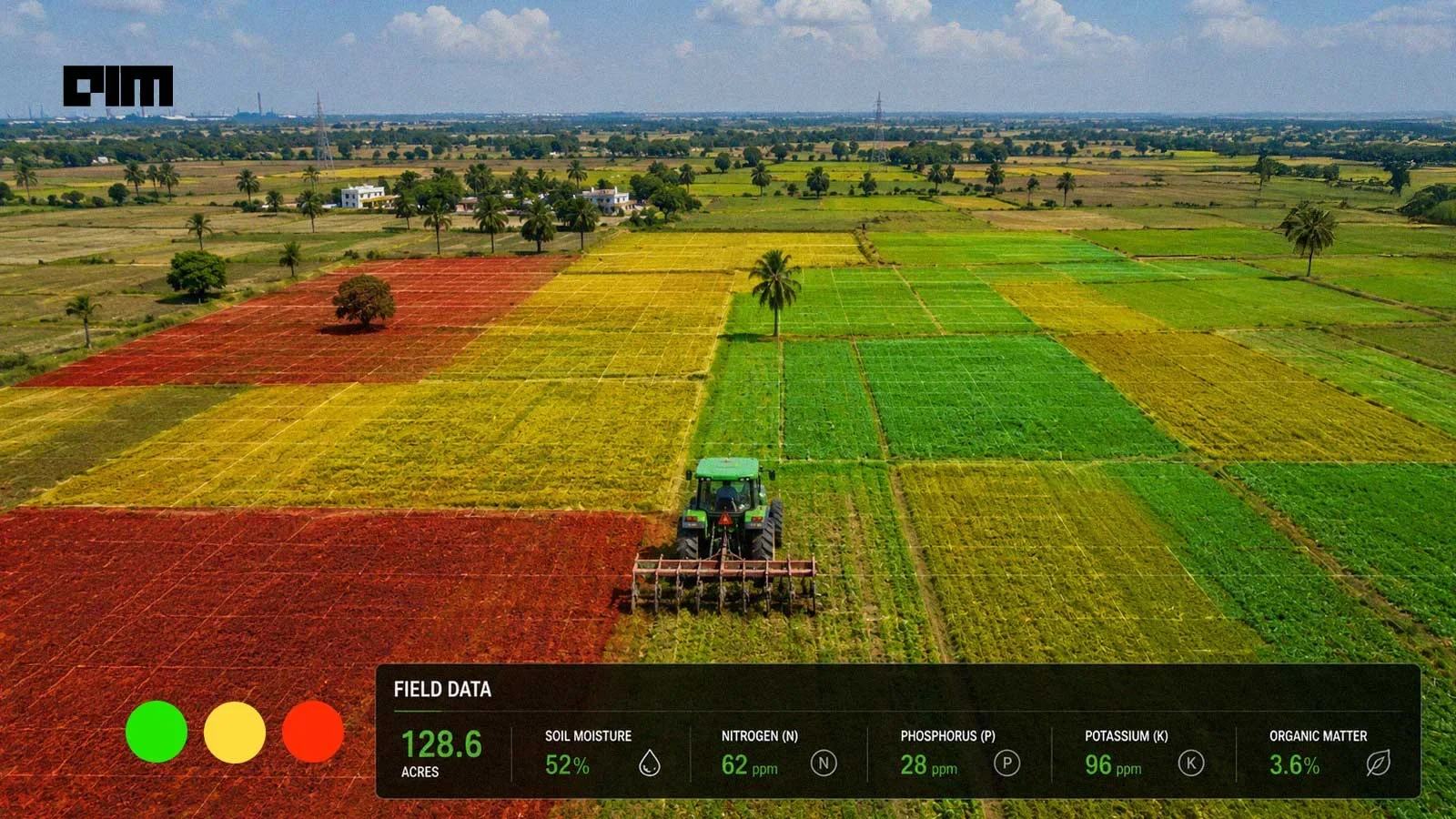
For years, India’s agritech story revolved around farmer-facing apps, drone pilots, and marketplaces promising to digitise agriculture. Of late, AI has entered the picture, especially as enterprises manage thousands of acres, contract farmers, audits, compliance workflows, and sustainability reporting.
The new battleground for agritech is traceability, compliance, and intelligence at scale.
India’s agriculture sector contributes nearly 18% to the country’s GDP and supports close to half of the workforce, according to government estimates. Yet much of the sector still runs on fragmented records, paper trails, spreadsheets, and manual audits. At the same time, global food companies and exporters are facing mounting pressure on sustainability disclosures, carbon reporting, pesticide traceability, and supply chain transparency.
This is where a new generation of agritech startups is positioning itself as enterprise infrastructure.
“We realised agriculture either ran on disjointed apps, paper or intuition,” Vinay Nair, Co-founder and CEO of KhetiBuddy, tells AIM. “A potato arrives at a processing facility, and nobody can tell which field it came from, what treatment it underwent, or what its carbon footprint was.”
KhetiBuddy, which recently evolved its AI-native platform under the brand Verdnt, is building software that connects field operations, ERP systems, supply chains, and sustainability reporting into a unified platform for agribusinesses. Over 35 enterprises across India, including wineries, tobacco firms, and government-linked projects, are already using the platform. The startup has also expanded into Canada, the UAE, and Europe.
This reflects a broader global agritech trend. Enterprises increasingly want granular farm-level intelligence, not just yield estimates. Large buyers today need proof of compliance, residue management, water usage, and sustainability metrics, especially as export regulations tighten in Europe and North America.
For agritech startups, this creates a greater opportunity in “agriculture operating systems” than in standalone advisory apps.
Agritech 2.0
The role of AI itself is shifting. Earlier agritech systems largely functioned as recommendation engines, helping identify diseases, weather patterns, or crop issues. But newer startups are embedding AI directly into operational decision-making.
Bengaluru-based Niqo Robotics, for instance, is building precision spraying systems that can identify weeds and crops in real time at the plant level.
“At the core of Niqo Sense is a combination of plant-level visual data, real-time processing, and AI models built to work in real farm conditions,” says Founder and CEO Jaisimha Rao.
The system uses computer vision to identify crop and weed patterns and trigger targeted spray actions in fractions of a second. Instead of blanket pesticide application, the machine sprays only where weeds are detected. According to the company, this reduces unnecessary chemical usage while improving efficiency.
The larger implication is that agritech is moving from software that merely “advises” farmers to systems that can autonomously sense, decide, and act in the field.
“This is where physical AI becomes especially relevant in agriculture,” Rao remarks. “The intelligence is embedded into the machine’s decision-making and directly linked to field action.”
The Enterprise Angle is Stronger
While consumer agritech adoption has often struggled with monetisation, enterprise-focused agritech companies are seeing stronger commercial traction by solving immediate operational pain points.
For example, KhetiBuddy says one tobacco client reduced compliance audit time by more than 50% after digitising farm-level reporting workflows. Similarly, wineries using the platform gained real-time visibility into contracted farm production and crop quality parameters such as grape sweetness levels.
The company points to another example from Europe, where a large potato processing enterprise, managing hundreds of contract farmers, relied on farm-level data infrastructure to support irrigation planning, input credit management, quality control, and satellite-linked crop advisory.
Nair adds that the customer expanded its contracted farming programme from 1,500 hectares to 4,500 hectares after building a unified data backbone. As one client put it: “If you don't have the real-time data, there are so many things we cannot do.”
This enterprise-first approach is also reshaping how agritech startups think about AI adoption. Rather than replacing agronomists or farm managers, most companies are positioning AI as an augmentation layer.
KhetiBuddy operates on an annual SaaS subscription model priced based on user count, activated modules, and acreage under management. Customers also pay implementation fees for onboarding and integrations, while white-label deployments carry additional licensing charges.
KhetiBuddy currently uses AI for anomaly detection, agronomic reasoning, and workflow intelligence, while keeping humans in the loop for operational decisions.
The company says it is gradually moving toward agentic AI systems, in which farm managers could eventually use voice-based agents to manage operations.
A Sector Still Battling Long Sales Cycles
Despite the momentum, enterprise agritech remains a difficult market.
Unlike fintech or SaaS, agritech adoption cycles are slower and heavily dependent on education, regulation, and proof of ROI.
“The biggest challenge is that many agribusinesses still see these systems as ‘nice to have’ rather than essential,” Nair said, adding that adoption usually accelerates only when compliance or production risks become unavoidable.
That reality has pushed several agritech startups toward bootstrapping and long-term product building rather than rapid venture-funded scaling.
KhetiBuddy remains bootstrapped, with the founders saying customer feedback, rather than trend-driven feature building, has shaped the platform's evolution. This approach might not align with the kind of growth story venture capitalists typically chase.

Your reaction
Discussion
What's your take on this story?
No comments yet — be the first to share your view.