
When IBS Software was founded in Kerala in the late 1990s, enterprise software followed a familiar playbook. Companies built products, sold licenses, rolled out periodic upgrades and let customers wait for the next release.
That model helped IBS grow into a leading travel technology company. Today, its software powers reservation systems, cargo operations, crew management, loyalty programmes and airport operations for some of the biggest names in aviation, including Lufthansa, British Airways, Air France, Emirates and Qantas.
But after nearly three decades of building enterprise software, Executive Chairman and Founder of IBS Software VK Mathews believes the AI era has broken one of the industry's biggest assumptions.
Products alone are no longer enough.
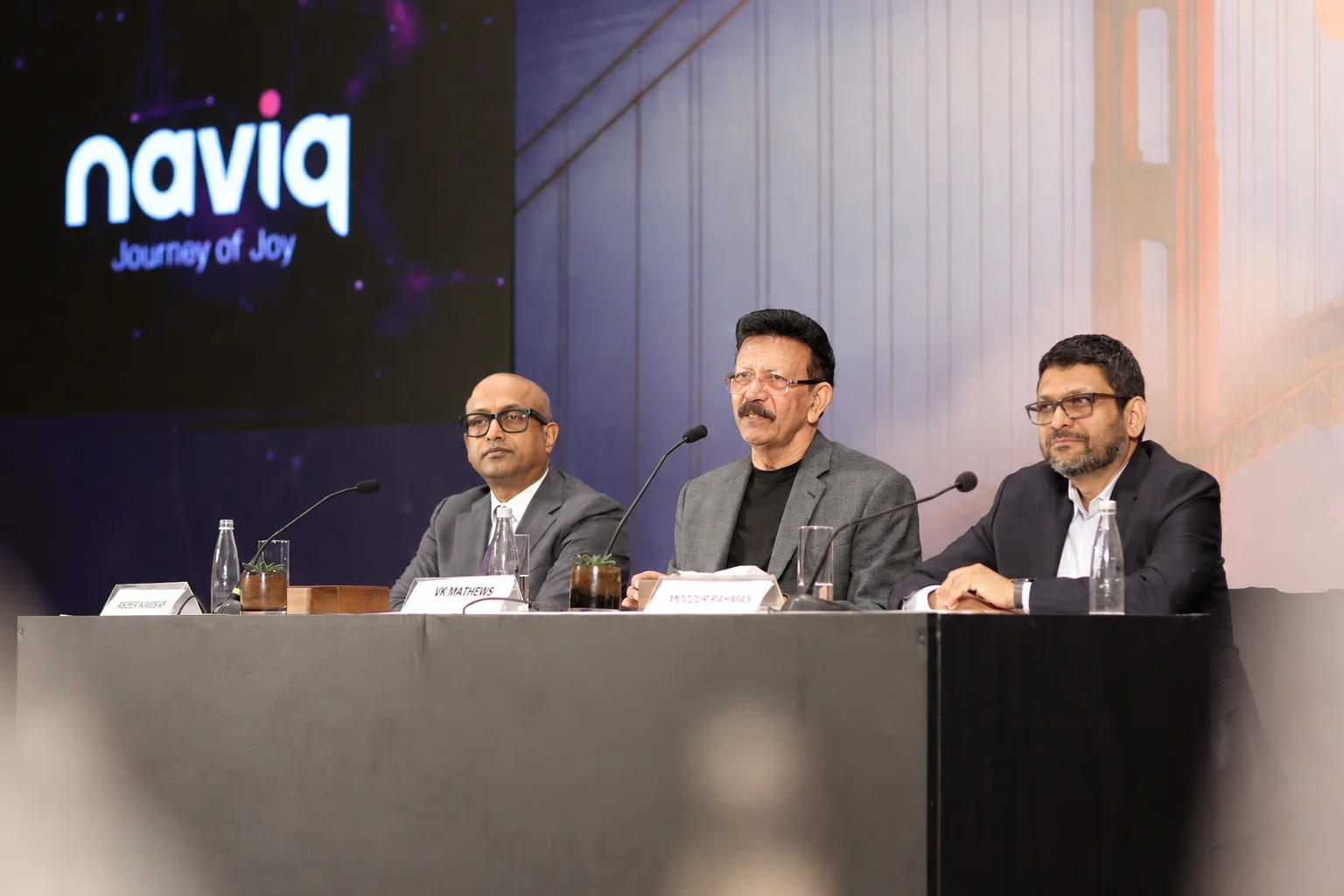
That belief has led IBS Group to launch Naviq Technology, a standalone AI company focused exclusively on the travel industry. It begins life with nearly 2,000 employees, plans to grow to over 5,000 professionals by 2030, invest nearly $500 million over the next five years and eventually generate between $350 million and $500 million in annual revenue by 2031.
For most companies, AI has become another feature to be added to existing products. IBS has taken a different route. Instead of embedding AI into its software portfolio, it is creating a separate company dedicated to helping travel businesses redesign their operations using AI.
That decision reflects a much broader change sweeping through enterprise technology.
Enterprise software wasn't built for AI
For decades, enterprise software companies have operated on product roadmaps. Features are prioritised, developed over months, tested and eventually shipped to thousands of customers through future releases.
AI doesn't work that way.
Airlines don't want to wait for the next software release to automate disruption management. Cargo operators don't want to postpone experiments around freight optimisation until the next version of an application arrives. Hotels aren't looking for another dashboard. They want AI integrated into pricing, guest experiences and operations today.
"Enterprise software cannot move forward with the agility and the kind of innovation just through products alone," Mathews told AIM. "Customers cannot wait for future releases."
That, in many ways, explains why Naviq comes into force.
IBS Software will continue building enterprise products. Naviq will sit alongside it, helping customers customise workflows, integrate AI across multiple systems, build domain-specific applications and deploy solutions that fall outside traditional product roadmaps.
The split also avoids a common conflict in enterprise software. Customers often need independent partners to implement, validate, and customise solutions without relying entirely on the software vendor. A separate AI company provides that flexibility while allowing IBS to continue focusing on its core products.
It is a playbook increasingly visible across the technology industry.
IBM has repositioned itself around AI consulting through Watsonx. Accenture has built dedicated AI transformation practices. Salesforce has moved beyond CRM into AI agents through Agentforce. Rather than simply selling software, enterprise vendors are increasingly selling transformation.
IBS is applying the same logic to one vertical: travel.
Why travel needs its own AI company
Unlike finance or retail, the travel industry operates as a network of interconnected systems.
Airlines juggle aircraft utilisation, crew scheduling, baggage operations, reservations, loyalty programmes and customer service simultaneously. Airports coordinate thousands of moving assets. Cargo companies manage freight across customs, warehouses and logistics partners. Hotels and cruise operators rely on pricing, occupancy and personalised guest experiences.
Generic AI models understand language. They don't understand airline operations.
"The domain competence or the context is the most important thing," Mathews says. "Not the coding, which the machines do."
That philosophy sits at the heart of Naviq.
Rather than building horizontal AI tools, the company wants to specialise in solving travel-specific problems.
Mathews points to inefficiencies hiding in plain sight. Around 17% of airline seats globally fly empty. Air cargo uses barely half of its available capacity, while less than 1% of global trade by volume moves by air. Delays cascade across networks, reducing aircraft utilisation and disrupting customer experiences.
These aren't chatbot problems. They require operational intelligence built on years of industry data, workflows and domain expertise.
One example Mathews discussed was the use of airport and passenger movement data to predict flight delays before boarding begins. If passenger behaviour suggests boarding will be delayed, airlines could intervene early rather than react after schedules begin to slip.
The idea illustrates Naviq's broader ambition: AI that improves business outcomes rather than simply automating tasks. "AI should not be seen as labour replacement," Mathews says. "It should be seen as an outcome amplifier."
For airlines, that could mean filling more seats, increasing loyalty, improving on-time performance or generating additional revenue instead of merely reducing headcount.
Building above the foundation models
Despite launching an AI company, Naviq has little interest in competing with OpenAI, Anthropic or Google. Instead, it plans to build on top of them.
"The world cannot function without the global models," says Moizzur Rahman, President of Naviq Technology. "The question is what variations do we need, and then train them for the travel industry."
That reflects an increasingly common enterprise strategy.
Foundation models are becoming infrastructure. The competitive advantage is shifting towards proprietary data, domain workflows and industry-specific orchestration.
Rather than creating another large language model, Naviq intends to combine existing models with travel data, enterprise systems and operational knowledge.
Its workforce reflects that strategy. Alongside software engineers, the company plans to employ industry specialists, AI architects, domain experts and forward-deployed engineers who work directly with customers to build customised AI solutions.
Betting on outcomes, not software licences
Perhaps Naviq's most unusual idea lies in how it wants to charge customers. Traditional enterprise software relies on licences or subscriptions.
Naviq is exploring outcome-based pricing.
If AI helps an airline carry more passengers, improve aircraft utilisation, move more cargo or generate higher loyalty revenue, the company wants to share in those gains.
That approach is significantly harder than charging for software. It requires customers and vendors to agree on baseline performance, measurable improvements and data transparency.
But it also reflects how AI is changing enterprise technology.
Companies increasingly care less about buying software than about achieving measurable business results.
India's next AI opportunity
The launch also comes as India searches for its role in the global AI race. Much of the world's attention remains focused on chips, frontier models and compute infrastructure.
Rajesh Nambiar, President of Nasscom, argues India's opportunity lies elsewhere.
"The real value of AI will not come from simply building the biggest model," he says. "It will come from making AI work."
That means operationalising AI across industries rather than competing directly with frontier model builders. Nambiar describes that future as becoming a "global AI orchestrator", combining domain expertise, enterprise systems and AI to solve industry-specific problems.
In many ways, Naviq envisions that theme. The company is not trying to build another GPT.
It is trying to answer a different question. What happens after every enterprise has access to the same AI models?
IBS Software believes the answer will no longer depend on who owns the smartest model. It will depend on who best understands the industry. And that may prove to be the bigger AI opportunity.
(With inputs from Prabhu M, senior editor at AIM.)

Your reaction
Discussion
What's your take on this story?
No comments yet — be the first to share your view.