
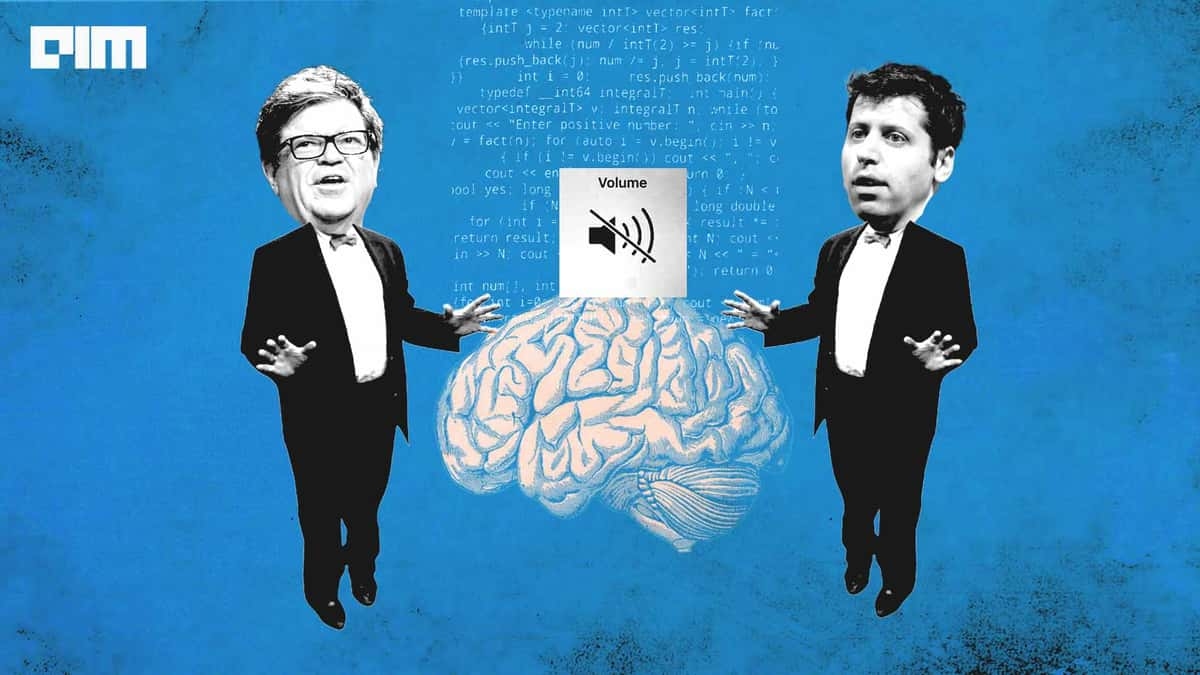

Is generative AI – particularly ChatGPT or DALL-E – just too much fun to mean business? The fun part is attained through real-time content creation. So is it entertaining? Yes! Useful? Not so much – resonates Meta’s chief AI scientist Yann LeCun.
In an exclusive interaction with Analytics India Magazine, LeCun said that these systems in their current form are just for entertainment, and do not lead to anything useful. Further, he said that for generative AI to be useful, it has to make sense of real world problems and assist people in their daily lives. "I don't think these systems in their current state can be fixed or called intelligent in ways that we want and expect them to be," said LeCun.
OpenAI chief Sam Altman also recently tweeted saying that ChatGPT is incredibly limited and creates an illusion of greatness and can be misleading. Though it can be used for fun and creative purposes, relying on it for factual information is not such a good idea.
Last month, Meta AI and Papers with Code released Galactica, an open-source large language model with 120 billion parameters. Intended for scientific papers and curating a corpus of human’s scientific knowledge, it took only three days for Meta AI to take it down after it started producing unreliable and hallucinatory outputs. Many researchers pointed out that this could be highly dangerous for scientific research.
The long time critic of deep learning for AGI, Gary Marcus, called out Galactica’s “bullshit” outputs and said that Meta AI is following the footsteps of OpenAI’s GPT-3 text generator, which according to him “spits out total hogwash”.
Read: Top 10 Alternatives to GPT-3
During the Web Summit in Lisbon, Marcus was joined by Noam Chomsky to talk about today’s cutting edge AI. While Marcus was clear and straight up criticised OpenAI’s DALL.E that cannot understand simple grammatical concepts and generates compositionally lacking images, Chomsky was also only a little optimistic about the usefulness of large language models.
Real-World Applications
Although there are plausible criticisms of generative models, a lot of models like ChatGPT, DALL-E, and Stable Diffusion have real-world applications and proved to be useful in many scenarios. For example, ChatGPT can be very helpful for progressing the edtech industry by providing solutions to simple problems and acting as tutors.
Some developers tried ChatGPT to generate SQL queries from text and the outputs were perfect. Another scenario was when the model could convert unstructured data into structured data.
Read: These 8 Potential Use Cases of ChatGPT will Blow Your Mind!
Text-to-image generators, though were initially thought to be a threat, are actually benefiting the stock images industry. Recently, Shutterstock announced that it will allow AI-generated images to be used on their website.
Notion, Jasper, and Copy.ai have been using OpenAI’s GPT-3 and assisting writers to generate comprehensive articles and texts. Recently, Canva also integrated a text-to-image generator using Stable Diffusion. For Cypher 2022, Analytics India Magazine’s flagship AI conference, the banners and posters were also designed using Midjourney.
Apart from text and images, GitHub Copilot has been a blessing in disguise for the developer ecosystem, where it helps in generating code from text inputs. Meta came up with InCoder to match GitHub’s code generator.
Moreover, StabilityAI announced a collaboration with AWS to make its tools open-sourced for more students and researchers, similar to what OpenAI did with Microsoft.
Clearly, from a use case perspective, OpenAI seems to be dominating the generative AI landscape.
Is OpenAI winning the Generative AI race?
“I don't think any company out there is significantly ahead of the others," said Yann LeCun. He explains that many researchers are working on large language models with just slightly different approaches and that there are three to four companies producing GPT-X-like models. "But, they [OpenAI] have been able to build and deploy their systems in such a way that they have a data flywheel.”
- India’s GCCs to Add 1.4 Million Jobs, Drive 170 Million Sq. Ft. Office Demand by 2031
- AI Can Be Cyborg or Centaur. But Can Enterprises Monetise It?
- AMD’s Server CPU Business Faces a New AI Boom
- How an Engineer Is Using AI to Bridge the Accessible Education Gap
- AI Agents are Making Human Customer Service a Specialist Job
- Why Nandan Nilekani-Backed F2A Believes India's Investment Opportunity Lies in Edge AI