

In its Q2 2026 earnings call, CoreWeave reported 112% YoY revenue growth, but that wasn’t the standout statement from CEO Michael Intrator. He revealed that NVIDIA’s six-year-old A100 GPU is still making money for CoreWeave, and some of those contracts run through 2029.
That puts a dent in the widely believed narrative that every new GPU generation quickly renders its predecessors worthless.
Silicon Data, which tracks GPU rental prices across non-hyperscale cloud providers, shows that since the beginning of 2026, rental prices for the latest NVIDIA B200 GPUs have risen by roughly 28%, while the older H100, launched in 2022, and A100, launched in 2020, have climbed by around 38% and 20%, respectively.
So, why are GPUs appreciating?
A 6-Year-Old GPU Appreciated 20% In Hourly Rental Price. But Why?
Similarly, Nebius reported $582 million in revenue in Q2 2026, up 454% year-over-year.
The company said pricing continued to rise for new-generation GPUs, while older-generation chips also received ‘strong pricing support.’ It raised its contracted power target to 5 GW and said demand was strong enough that it could sell its entire 2027 capacity today, but is choosing not to do so in order to retain flexibility as pricing and customer demand evolve.
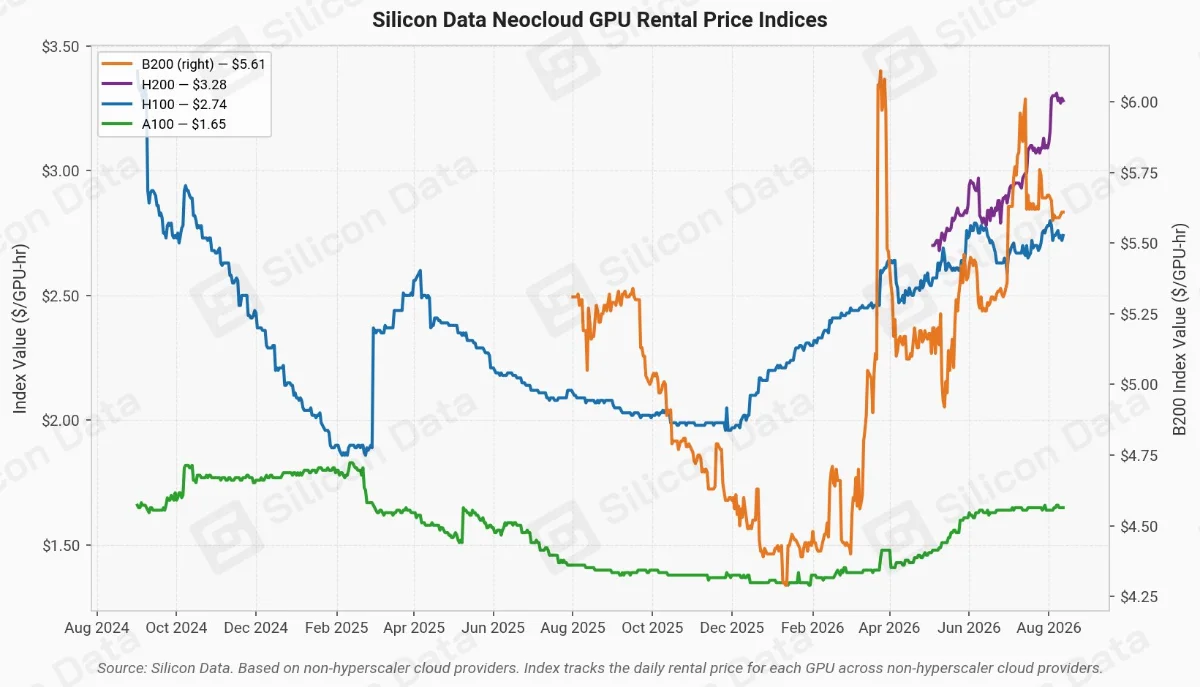
“What we are seeing is the result of the depreciation math we used, which assumed new silicon replaced old silicon—but it doesn’t anymore”, says Matt Kimball, Principal Analyst at Moor Insights, in an interaction with AIM.
In 2025, the GPU depreciation theory gained traction. Each new generation of NVIDIA accelerators was expected to rapidly erode the value of its predecessor, shortening GPUs’ economic lives.
That mattered because hyperscalers depreciate GPUs over an assumed “useful life.” A shorter life meant higher annual depreciation and lower reported profits, while a longer life spread the cost over more years.
The debate intensified as companies began revisiting these assumptions. Meta extended the useful life of most servers and network assets to 5.5 years. Both Amazon and Alphabet extended their server lifecycles to six years in 2024, then cut them back to five years for a subset of equipment in 2025.
The new pricing trends, however, suggest that newer GPUs are not simply replacing older ones.
The Reasoning Behind Pricing GPUs
Kimball explained that companies are unlikely to shut down functioning H100 clusters simply because B200 systems become available.
Deploying newer GPUs can cost more than keeping older ones running, even when the newer chips are faster.
“This reframes what a GPU is actually worth,” says Kimball. “An H100 that's already racked, powered, cooled, and cabled in a facility running today is worth more than a Blackwell part that lands in twelve months and waits on an interconnection queue”
In other words, companies are not pricing GPUs purely on their theoretical performance but on the revenue-generating capacity they have today.
Software is extending that economic life further. Kimball explained that techniques, including quantisation, continuous batching, speculative decoding, and paged KV-cache management, have increased effective throughput on H100s without any change to the underlying hardware.
“Because of this, the H100’s cost per token improved while it sat in the rack. This has extended the economic life in a way the original depreciation schedules never contemplated.”
Why Inference and Agentic AI are Creating Demand
Perhaps the biggest shift concerns how GPUs are used today, with inference taking a larger share of workloads than training.
Steve Hou, Head of Research at Silicon Data, affirms that the shift towards inference has fundamentally changed the demand equation for compute. Training once accounted for most AI workloads, but inference has steadily taken a larger share, with the rise of agentic workloads accelerating that shift.
“Suddenly you are programmatically calling the models,” Hou says. “The demand is multiplying geometrically, because you're running these things in loops.”
Hou estimates that inference could eventually account for as much as 90% of overall AI compute demand, up from roughly 20% today. He points to the A100 as a particularly telling example.
Unlike the H100, whose rental price can fluctuate as training workloads move to newer generations, the A100 is now primarily an inference GPU. Its continued price appreciation, therefore, offers a clearer indication of how demand for inference is pulling older hardware back into the market.
More powerful accelerators can absorb workloads where their additional performance matters, particularly large-scale training. Inference, however, creates a much broader market. If an older GPU meets a model's required latency and cost parameters, there is little reason to replace it simply because a faster chip exists.
“Inference has a different appetite than training. Training wants—training needs—the newest silicon,” Kimball notes.
“When talking about production inference, we are looking at the least expensive part that can hit a latency target. And for a lot of deployed models, the H100 is a good fit.”
That growing demand also means there simply isn't enough usable compute available today.
Hou said there was virtually no spare capacity in the market, with cloud providers increasingly holding on to capacity rather than offering discounts for longer commitments. Providers are also favouring shorter contracts because they can reprice capacity more quickly when those contracts expire.
“No one wants to sell, and it doesn’t create a good marketplace,” says Hou.
Lack of Physical Infrastructure
But the shortage extends beyond the supply of GPUs themselves. A data-centre project can be announced, and the chips shipped without those GPUs becoming usable compute.
Companies still need land, permits, and power. Once those are in place, newer GPUs such as the B200 require additional work to install, tune and bring online at scale.
Recent data from Air Street Capital show that nearly 95% of announced projects and NVIDIA’s Grace Blackwell GPUs have not been deployed.
“It is not a trivial task to bring Blackwell online,” says Hou. “Shipments coming out of NVIDIA don’t immediately translate into what is actually available.”
Kimball also estimates that most compute constraints are driven by the infrastructure required to support the GPUs.
“Building out that infrastructure takes years—and much of it is tied to a manufacturing base that just can’t produce fast enough,” he says.
According to estimates from Sightline Climate and Bloomberg, between 30–50% of AI data centres scheduled to open in 2026 will either slip or get cancelled. “This is an area where you can’t just buy your way out of a shortage of transformers and substations,” Kimball comments.
Cooling is another, less discussed constraint on AI compute. Blackwell racks can draw 120–150 kW, pushing conventional air cooling beyond its practical limits and demanding liquid cooling.
“So a facility can have power available but can’t stand up current-generation racks without a liquid retrofit,” Kimball says. “And this is its own capex project with its own lead time.”
That constraint is also making older H100 GPUs more valuable. While liquid-cooling infrastructure is being installed, existing air-cooled systems can continue supporting H100 workloads.
“That's a big part of why H100 pricing is behaving the way it is.”
There is another distinction to make here: accounting depreciation is not the same as a GPU’s economic life.
Hou argues that while depreciation schedules can write down an asset's book value over a fixed period, they do not necessarily reflect how long the hardware remains commercially useful. The A100, for instance, is still operating at high utilisation more than five years after launch, with rising rental income offsetting the decline in its residual value.
Silicon Data’s fair-value estimates show the same effect. The A100’s residual value stopped declining as inference-driven rental income rose, while the H100 and B200 were actually appreciating despite ageing.
Hou attributes this to a widening gap between compute demand and supply, with new chips adding capacity rather than displacing older ones.
“Every single chip is being put to use because there is always some model on which some chip is good for doing inference,” Hou says.
No Depreciation = No AI Bubble?
Depreciation assumptions were a major part of the AI-bubble argument: if GPUs lost most of their value within a few years, the enormous capex required to build AI infrastructure would become increasingly difficult to justify.
But rising GPU prices kill only one version of that debate. Kimball notes that the broader return-on-capital question, however, remains.
“The bubble argument looks at whether AI-related revenue can grow fast enough to cover the capex and depreciation,” says Kimball.
But with AI-related revenue still far below the scale of capital being deployed, he says, “I don’t see anything in the rental price index that speaks to this gap.”

Your reaction
Discussion
What's your take on this story?
No comments yet — be the first to share your view.