

With the number of electric vehicles increasing on Indian roads, the need for a more efficient charging infrastructure, along with more efficient charging instruments, is taking centre stage. Handling the bulky chargers supplied with EVs today makes the job cumbersome. But, innovations in power electronics could bring about the much needed change.
Just as laptops evolved from heavy adapters to slim, high-speed chargers, EV charging is undergoing its own design revolution.
Texas Instruments’ (TI) latest UCC25661 LLC (logical link control) controller enables a new generation of compact, high-frequency EV chargers, said Mark Ng, director of automotive systems at the company. This advancement would prove critical for situations where space is limited, such as home setups, or portable chargers for two-wheelers.
Ng highlighted that the breakthrough lies in input power proportional control (IPPC), which eliminates the narrow input range limitation of older LLC designs.
“By allowing a wider operating range and switching frequencies from 50 kHz up to 750 kHz, the controller significantly reduces the size of magnetic components like transformers and inductors.”
Currently, the UCC25661 LLC controller is available for purchase in multiple countries through authorised distributors like Mouser Electronics.
The result is smaller, more efficient chargers.
“It’s the same principle that makes today’s GaN-based laptop chargers so compact,” Ng explained. “Higher switching frequencies lead to smaller components and more portable designs.”
Historically, LLC converters used frequency control for regulation, but TI’s IPPC simplifies this by making input power the primary control variable. This helps in efficient operation across a wide range of conditions that are ideal for the diverse power environments in India.
Why This Matters for India
India’s EV battery market is projected to grow from $16.77 billion in 2023 to $27.70 billion by 2028. This surge is driven largely by cost-sensitive two- and three-wheelers, which dominate the EV adoption curve. However, the lack of reliable charging infrastructure remains a major roadblock.
Sanjeev P, CEO at E3Electric.ai, a Bengaluru-based EV start-up, told AIM that India’s EV adoption journey will only be successful “if we democratise access to
charging. Smarter, compact, and AI-powered chargers can bridge the infrastructure gap by making charging more accessible, affordable, and scalable.”
He added that at E3 Electric.ai, they are witnessing encouraging progress in this space, and believe such solutions will be instrumental in accelerating India’s transition to clean mobility.
Ng also added that the two-wheeler EV market in India and Southeast Asia is on the verge of a major transformation. “If we do our jobs correctly,” Ng said, the two-wheeler market should explode in the same manner that was observed in China, predicting a massive wave of electrification in the region.
Unlike petrol pumps, EV charging points are sparse, especially outside major cities. Moody’s estimates that Indian automakers will invest nearly ₹85,420 crore ($10 billion) in EVs, batteries, and manufacturing by 2025. But without an adequate charging network, range anxiety persists.
Portable and efficient chargers could help bridge this gap. Riders could charge their vehicles from any standard AC outlet such as at home, in a café, or at a roadside shop. TI’s technology could also address the “last-mile” charging challenge, providing a lifeline when riders run out of charge mid-journey.
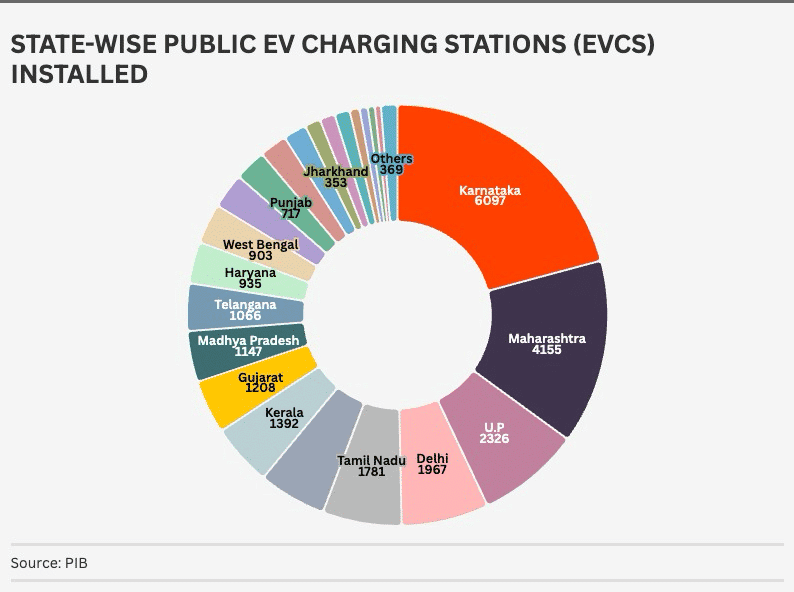
According to the Ministry of Power (MoP), 29,277 public EV charging stations (EVCS) have been installed across India as of 2025, as PIB reported.
While this is progress, it is far from sufficient for the millions of EVs expected to hit the roads in the coming years. To accelerate the rollout, the government has earmarked ₹2,000 crore under the PM E-DRIVE Scheme for building charging infrastructure nationwide, as per guidelines issued in September 2024.
While most current chargers in India rely on analog control, the future points to AI-enabled systems capable of predicting faults before they happen.
Semiconductor companies like TI are embedding AI cores into microcontrollers for industrial applications, and this intelligence will soon reach EV chargers.
For users in Tier-2 and Tier-3 cities, smart chargers could be a game changer. They bring the convenience of charging anywhere using a standard outlet, while smaller and more efficient designs make them more affordable.
Built-in safety features, such as AI-based fault detection, help minimise risks like overheating or fires, giving riders more confidence. Together, these benefits ease range anxiety and can accelerate the shift from petrol to electric two-wheelers across India’s smaller cities.
The Bigger Picture
India is on track to become one of the world’s largest EV two-wheeler markets in the next five years. Compact and intelligent charging technologies aren’t just incremental improvements—they are key enablers of mass adoption.
Just as GAN (generative adversarial network) revolutionised laptop and smartphone charging, semiconductor-driven innovation could do the same for EVs.
In short, the next EV charger may not only be smaller than a laptop adapter, but also smarter, safer, and pivotal in populating Indian roads with EVs.
- AMD’s Server CPU Business Faces a New AI Boom
- How an Engineer Is Using AI to Bridge the Accessible Education Gap
- AI Agents are Making Human Customer Service a Specialist Job
- Why Nandan Nilekani-Backed F2A Believes India's Investment Opportunity Lies in Edge AI
- India Needs to Build the AI 'Brain' for Robotics, Not Just Import Hardware
- Why Enterprise AI Prototypes Break in Production