
5 min
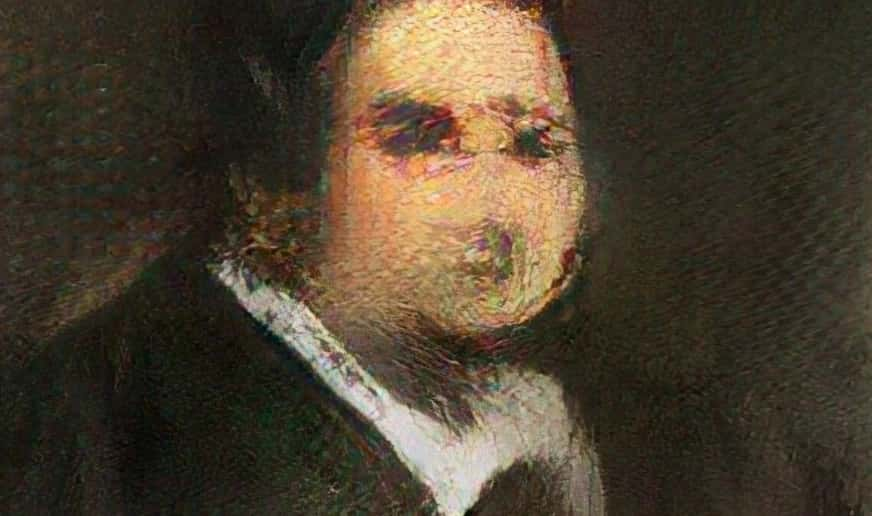
In a recent development surrounding AI’s creativity, popular British auction house, Christie’s auctioned an art piece created by an AI algorithm. The portrait was sold on thursday for a whopping $432,500.
The portrait is a painting of a character named Edmund, a part of the fictitious Belamy family. This painting is also a part of the 11 portraits created by the same AI algorithm.
All of Belamy family portraits is a creation of a trio named Obvious, a Paris-based art collective. Hugo Caselles Dupre, one of the members of Obvious had learnt about Adversarial Neural Network (ANN) during his PhD in machine learning. This fictional family is a homage to the creator of Generative Adversarial Network (GAN), Ian Goodfellow, whose name when translated in French is ‘Bel ami’.
[caption id="attachment_29615" align="alignnone" width="872"] Portrait of Edmond Belamy[/caption]
The AI algorithm in this artwork has the following components:
Portrait of Edmond Belamy[/caption]
The AI algorithm in this artwork has the following components:
- Generator - which generates a new image based on the datasets given to it, i.e., paintings
- Discriminator - which plays a role in spotting the difference between raw data and the image that is being generated.
- Sarvam, Krutrim Account for 68% of Indic AI Funding as Sector Raises $687 Million: Tracxn
- Alphabet Revenue Jumps 25% as Google Cloud Doubles & Search Growth Slows
- ‘You’re Not Doing This AI Stuff,’ Databricks CEO Tells Snowflake
- HCLTech Launches Nano GCC Model With AWS to Build AI Operations
- Microsoft’s Azure Revenue Grows 48% in September Quarter
- GitHub Expands Infra With 4 Mn Cores, Debuts Copilot Fusion for Multi-Model Routing