
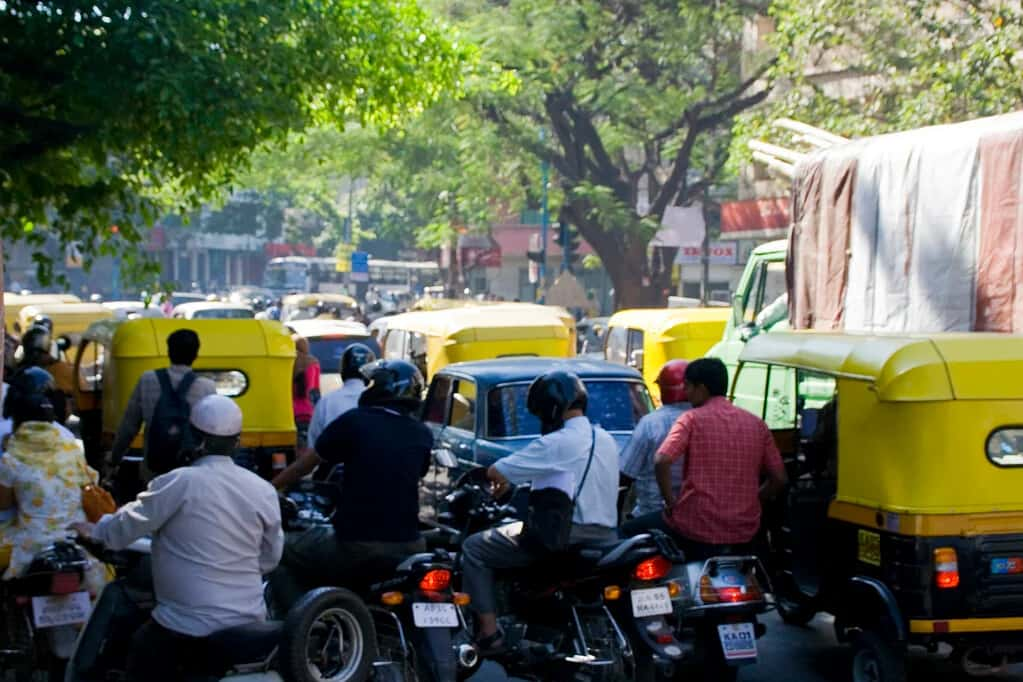
If the reports are to be believed, all the traffic signals in Bengaluru are going to get a face shift with the help of AI.
This new system is capable of calculating the vehicle density and share those details to a central processing unit which in turn will decide the time required at each junction.
The traffic density is monitored by cameras to decide on how much time to allow vehicles to clear a signal. These signals will be adaptive, while the AI units will calculate, assess and network with other signals automatically.
The signals will be coordinated so that when the first signal is green, the 2nd should be green too, for uninterrupted movement. Changes in the volume of traffic must be observed and the signals upgraded every six months.
As per a statement from the Additional Commissioner of Police (Traffic) B R Ravikanthe Gowda, Bangalore will undergo installations of AI means in all its 387 traffic signals for better regulation of traffic.
“The cameras calculate vehicle density and communicate the details to a central processing unit which, in turn, decides how much time should be given at each junction,” says Gowda.
Last month, Google revealed how they are making road travel easy for the people of Bengaluru by using state-of-the-art machine learning techniques. Now, with the initiative of state government, the riders can cut down on the time and fuel wasted in traffic jams.
- OpenAI Introduces ChatGPT Wallet for Agent-Led Payments
- ReNew Pledges ₹80,000 Cr for Green Data Centre to Fuel India’s AI Push
- Mars Opens Hyderabad GCC With Genpact to Expand Digital, AI Capabilities
- Shield AI Opens Bengaluru Engineering Office to Build Defence Autonomy Software
- Adobe, Google Expand AI Partnership Across Creative and Productivity Tools
- Google Launches Gemini 4 Hydrogen for Faster Coding and AI Workflows