

A Stanford University study published last week reveals a significant mismatch between the focus of AI development and the actual desires of the United States workforce. The study, titled ‘Future of Work with AI Agents’, surveyed 1,500 workers across 104 occupations and gathered assessments from 52 AI experts regarding the capabilities of current AI agents and tools.
The findings revealed that 41% of Y Combinator (YC) AI startups provide capabilities that workers don’t want to be automated.
Researchers divided tasks into four zones by evaluating workers’ desire for automation and the technological capability of AI systems to automate them.
"41.0% of Y Combinator company-task mappings are concentrated in the Low Priority Zone and Automation 'Red Light' Zone," said the authors. This means that these (41%) YC startups offer systems that are highly capable of automating specific tasks, but workers have a low desire for these tasks to be automated.
“Current investments mainly centre around software development and business analysis, leaving many promising tasks within the 'Green Light' Zone and Opportunity Zone under-addressed,” added the authors.
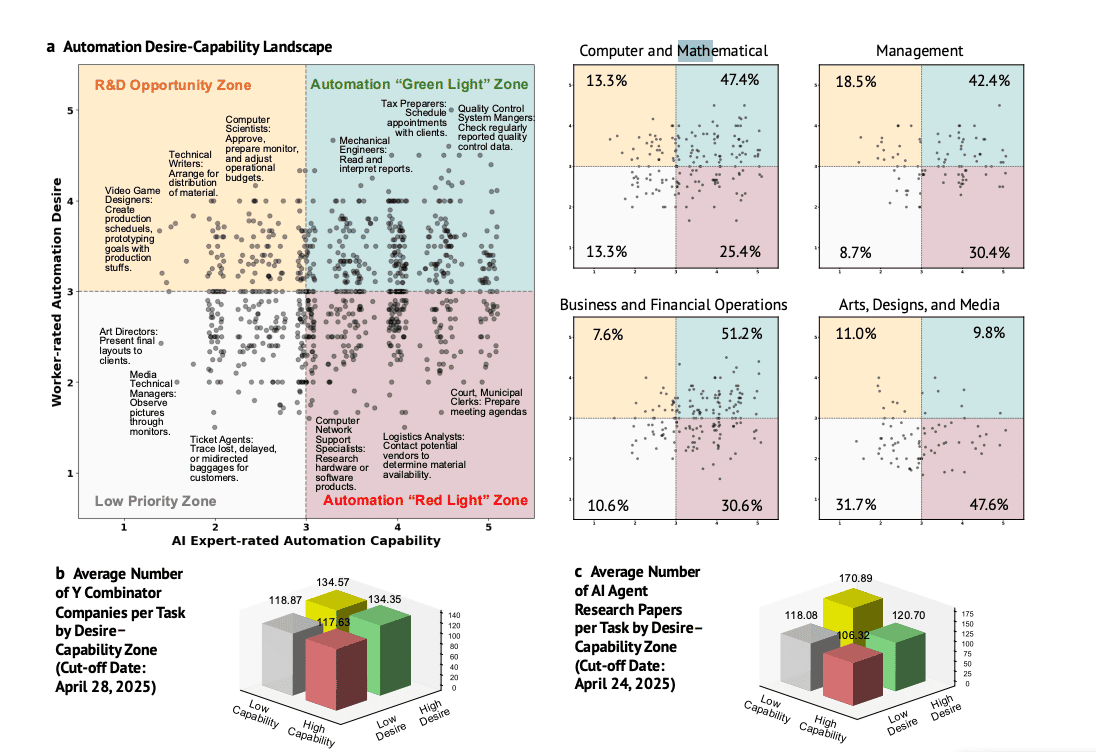
The study compiled the complete list of YC companies (as of April 2025), comprising 5,516 companies. The authors then employed an LLM-based process to categorise companies based on their descriptions, identifying those relevant to AI.
Besides, 46.1% of tasks surveyed had a positive worker attitude towards automation.
However, the workers are eager to automate low-value, repetitive tasks to free up time for more high-value work. Furthermore, for 47.5% of tasks, workers prefer higher levels of human involvement than deemed necessary by the experts who participated in the survey.
Y Combinator, based in San Francisco, is a startup incubator that invests $500,000 in early-stage companies. It takes a 7% stake for $125,000 and turns the remaining $375,000 into shares in future funding rounds. 2025 marks 20 years of Y Combinator backing thousands of companies and creating over $800 billion in market value.
For a detailed look at the study's findings, including more statistics and results, take a look at its PDF document here.
- Europe's Biggest Tech Startup Cuts AI Coding Costs by 90% Using Chinese Model
- E2E Networks Launches Blaze To Offer Pay-Per-Token AI Inference Services
- Apple Posts Record Revenue in India for Q4 FY26
- Dispatch Network Raises ₹5 Cr Pre-Seed Led by Antler India to Build AI-Powered Delivery Network
- Coforge Launches BridgeCX With Pega, Mastercard for Customer Personalisation
- HCLTech Launches AI Agents to Support Mainframe Operations