
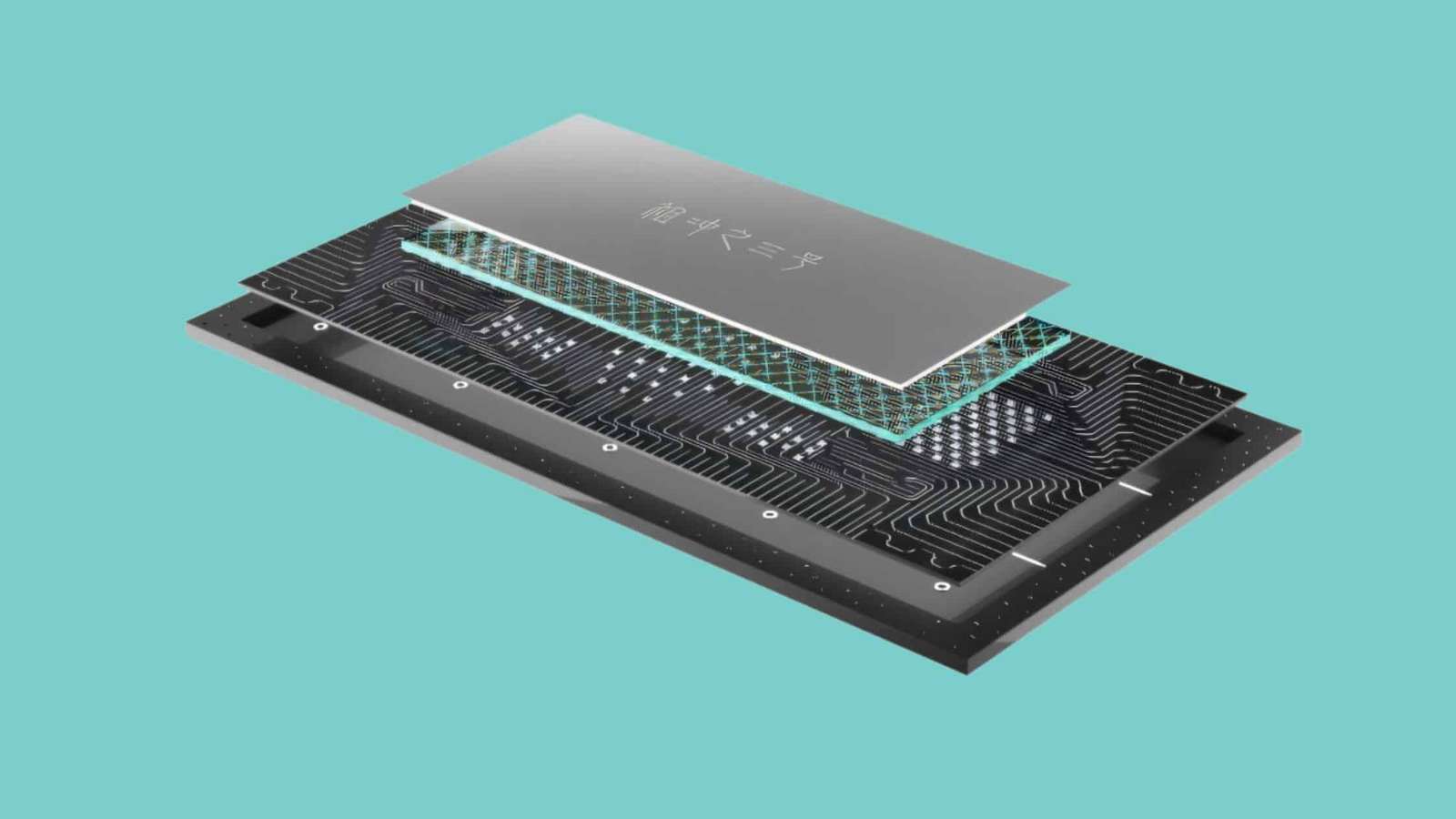
Chinese researchers from the University of Science and Technology of China (USTC) have unveiled the Zuchongzhi 3.0, a superconducting quantum processor with 105 qubits, marking a significant milestone in Chinese quantum computing.
The processor operates quadrillion times faster than the world’s fastest supercomputer and one million times faster than Google’s latest Willow, as per the findings published in Physical Review Letters.
The Zuchongzhi 3.0 was tested with an 83-qubit, 32-layer random circuit sampling task, claiming to achieve results that would take classical supercomputers over 6.4 billion years to replicate.
This achievement surpasses Google’s Sycamore processor, developed in 2019, by six orders of magnitude. The research team highlighted advancements in coherence time, gate fidelities, and readout accuracy.
The processor achieves a coherence time of 72 microseconds, single-qubit gate fidelity of 99.90%, two-qubit gate fidelity of 99.62%, and readout fidelity of 99.13%. These improvements enable more complex operations and computations.
Building on previous successes with the Zuchongzhi-2 and Jiuzhang photonic systems, the team continues to push the boundaries of quantum error correction and scalability. They are researching surface codes for error correction and plan to expand integration capabilities to distances of 9 and 11.
The research team collaborated with institutions such as the Shanghai Research Center for Quantum Sciences and the Chinese Academy of Sciences.
In December last year, China also achieved a milestone in quantum computing with the launch of the ‘Tianyan-504’ superconducting quantum computer, equipped with the 504-qubit ‘Xiaohong’ chip.
The quantum computer, developed collaboratively by the China Telecom Quantum Group (CTQG), the Chinese Academy of Sciences (CAS), and QuantumCTek Co., Ltd., represented a leap in the field by surpassing the 500-qubit mark.
- OpenAI Signs Four Agreements With Abu Dhabi Across Government, Energy And Investment
- Deep-Tech and Green Finance to Drive India’s Climate Investments in 2027
- Google’s Project Suncatcher Satellite Generates First AI Response in Orbit
- DeepSeek Proposes Super-Agent Architecture to Automate AI Coding Workflows
- Arrowhead AI Launches Fletch Voice Model for Multilingual Customer Calls
- Amazon Warns Engineers Against AI Productivity Traps in Latest Memo