Key takeaways
- Google released the Natural Questions dataset to enhance question-answering research and improve evaluation methods.
- BERT, an open-sourced language model from Google, addresses complexities in understanding language models.
- Facebook has open sourced its NLP toolkit LASER, highlighting its commitment to AI advancement.
- Both companies believe transparency and open sourcing foster accelerated innovation and diverse real-world applications.
- Google and Facebook continue their tradition of sharing in-house innovations with the public.

Facebook’s BoTorch And Ax
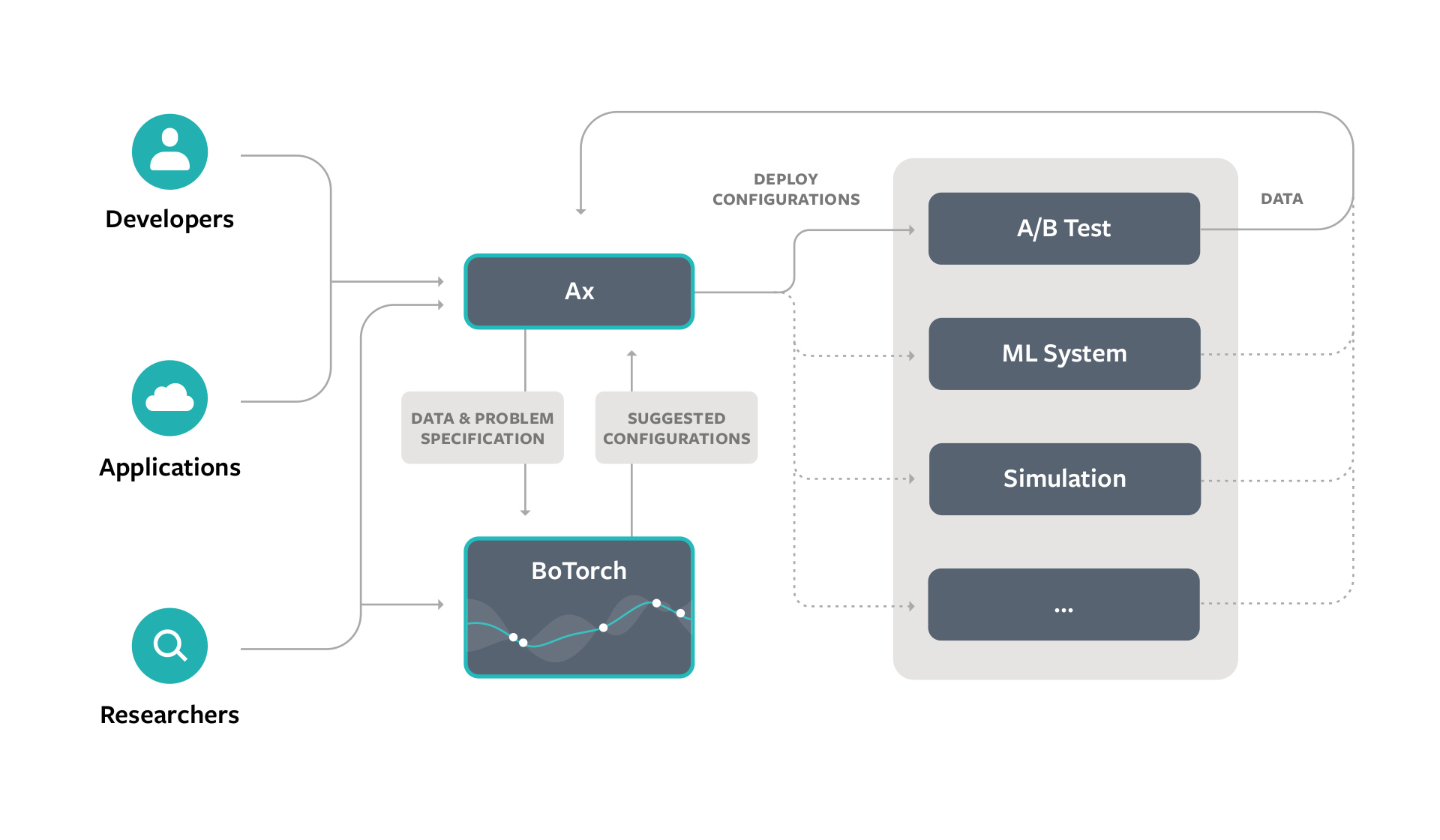
At the recently concluded 2-day event F8 Developer Conference held in San Jose,California, Facebook dished out more updates for the machine learning developers. BoTorch and Ax are two tools which open sourced this week. BoTorch BoTorch is a research framework built on top of PyTorch to provide Bayesian optimization, a sample-efficient technique for sequential optimization of costly-to-evaluate black-box functions. BoTorch advances the state of the art in Bayesian optimization research by leveraging the features of PyTorch, including auto-differentiation, massive parallelism, and deep learning. Ax Ax is an ML platform for managing adaptive experiments. It enables researchers and engineers to systematically explore large configuration spaces in order to optimize machine learning models, infrastructure, and products. At Facebook, Ax has been broadly applied by engineers who do not have extensive experience with machine learning, as well as by AI researchers. Ax provides easy-to-use APIs to interface with BoTorch, along with the management necessary for production-ready services and reproducible research.