
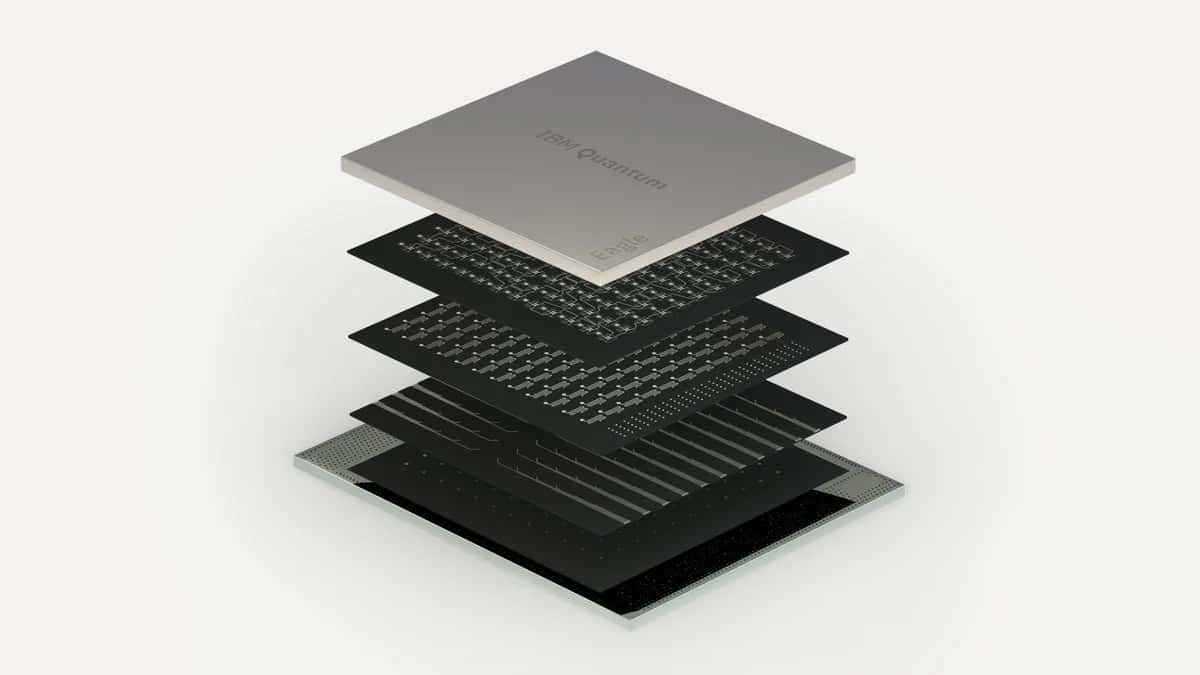
IBM Corp. recently debuted Eagle, its newest and most sophisticated quantum processor, which features 127 qubits as well as several major architectural improvements over earlier chips. The processor also marks a new milestone in IBM’s efforts to develop large-scale quantum computers.
Eagle is the first chip from the company to feature and surpass more than 100 qubits. Eagle features several upgrades, crucially, through-silicon vias (TSVs) and multi-level wiring, providing the ability to effectively fan out a large density of classical control signals while protecting the qubits in a separated layer to maintain high coherence times. IBM says that Eagle’s high qubit count also makes it the first quantum processor that’s much advanced to be simulated on a classical supercomputer.
It is being believed that future quantum computers with more qubits than today’s systems could take on calculations too complex for even the fastest classical supercomputers. IBM has been steadily adding more qubits to its quantum processors in recent years to move closer towards unlocking the technology’s future applications.
With the Eagle processor, the company also plans to introduce concurrent real-time classical compute capabilities that will allow for the execution of a broader family of quantum circuits and codes and is already working on future iterations of its quantum hardware. Eagle is set to be followed next year by Osprey, a processor that will have more than 400 qubits. In 2023, IBM intends to introduce an even more powerful processor expected to feature north of 1,000 qubits.
Eagle is based on the heavy hexagonal quantum chip design introduced by Falcon that IBM detailed last year. The design was created with the goal of reducing qubit errors, which represent one of the biggest obstacles to large-scale quantum computing; bit qubits in Eagle still retain the ability to exchange data.
“Eagle is based upon our heavy-hexagonal qubit layout as debuted with our Falcon processor, where qubits connect with either two or three neighbours as if sitting upon the edges and corners of tessellated hexagons. This particular connectivity decreased the potential for errors caused by interactions between neighbouring qubits — providing significant boosts in yielding functional processors,” said IBM executives Jerry Chow, Oliver Dial and Jay Gambetta.
IBM’s quantum chips are based on superconducting qubit technology. The chips represent data in the electronic quantum states of artificial atoms. IBM applies sequences of microwave pulses to the artificial atoms in order to carry out calculations.
- Coforge Revenue Rises 54% as AI Engineering and Deal Bookings Gain Momentum
- Tech Mahindra Partners With SpaceXSI to Bring AI Into Software Engineering
- Infosys AI Revenue Rises 29% in Q2, FY27 Growth Guidance Cut
- LTM Launches BlueVerse Industrial AI Lab in Chennai
- Chariot Launches Speech Recognition Model for 10 Indian Languages
- Meta Expects Up To $145 Billion In Capex As AI Investments Expand